Sunday, May 10, 2015

Three Student Monte

"The Adventure of the Three Students" is an odd but entertaining story in the Sherlock Holmes canon. Set at an unspecified England university, the case involves the theft of answers to an upcoming exam, and a professor who doesn't want to compromise the university's public image with any official investigation. He is able to furnish Holmes with three suspects, and leaves it to the detective to identify the guilty party and quietly deal with the situation.

Among all the cases Holmes ever tackled, this one has to be among those with the lowest stakes. The crime is minute -- and might not even be seen as such outside academic circles, since nothing was physically taken. What's more, the changing times in the century since Arthur Conan Doyle wrote it has blunted what little impact there might have been. It's hard to imagine today any truly serious university scandal arising from the stealing of answers from one part of one professor's one exam.

But with the matter so trivial in nature, full focus can fall on the investigation. And here, Doyle has crafted a rather intriguing puzzle. In the story itself, Holmes compares the situation to a game of Three Card Monte (though he doesn't name it thus); the target is one of three students, it's only a matter of picking the right one. Other Sherlock Holmes stories present false suspects, but I can't think of another one that so straightforwardly identifies them to the reader. And there's no twist here; the culprit is not revealed to be any fourth individual that wasn't under suspicion.

So here, more than in most Holmes stories, the reader has the chance to pit himself against the detective -- or, if not to solve the case, to at least spot the clues that are crucial in the solution. I've criticized the way Doyle hasn't "played fair" in past stories, so it's only fair to praise him for doing so here. If the case had a bit more heft to it, this might well be my favorite story from the collection. As it is, I still give it a respectable B.

Saturday, May 09, 2015

Congressional Discord


The two posters you see to either side are for the same movie. That alone should tell you a lot about the confused mess that is The Congress. A foreign film with both French and Israeli origins, The Congress was made in 2013, but is only just seeing distribution in the U.S. thanks to a deal with the Alamo Drafthouse's "original programming" branch, Drafthouse Films.

It's incredibly hard to describe what The Congress is about, in large part because the face it presents at first does not reflect the movie it ends up being. Here's the "Being John Malkovich"-like pitch that sold me on wanting to see it in the first place:

Actress Robin Wright, of The Princess Bride and Forrest Gump fame, is at a career crossroads. She has passed over enough acting jobs during the prime years of her career to jeopardize her "brand," and she is now faced with only one option. Her studio is beginning to branch out into an exciting new area, digitizing performers and using their computer avatars in perpetuity to make new films. Wright is offered the money needed to help her son's medical condition, in exchange for giving up acting and allowing her digital avatar to carry on making movies in her stead -- movies Wright herself was too picky to agree to in her prime.

I'm sure that sounds plenty odd to you, but here comes the really odd part: that describes only the first 40 minutes of the film. The second act picks up 20 years in the future, when Wright's studio wants to extend her contract for all sorts of new technology, and she agrees to enter an "animation only environment" to finalize negotiations. The remainder of the film then becomes animated, and is a hallucinogenic screed against the perils of dehumanizing technology.

This second half of the movie is what completely lost me. To be clear, the animation is absolutely beautiful. An imaginative and stylized world is lovingly rendered, a bizarre hybrid of old black-and-white Warner Brothers cartoons and Japanese anime. But aside from the tenuous thread of "out of control technology," this section of the film has absolutely nothing to do with the first part. Where the live action intro relies on Wright's reputation as a choosy and "difficult" actress, leveraging it into a quirky narrative, this animated film could easily be about anyone. The result is a very pretty, yet incoherent, jumble.

But Robin Wright, playing "herself," gives it her all. It's a strong and deeply emotional performance, both in the live action and animated chunks of the film. The strangeness of the film makes it awfully hard for the audience to care, but there's never any doubt that she cares very much. Similarly committed performances come from Jon Hamm as the voice of Wright's "character animator" in the animated section, and Paul Giamatti as a doctor in the live action section (himself no stranger to actors playing "themselves" for the sake of a gimmick).

Still, the performances -- no matter how good -- can't save the confusion of two incompatible films being forcibly stitched together. If you're a fan of painstaking animation, there might be some compelling visuals in this for you. Otherwise, I really can't recommend the film for anyone. I give it a D-.

Friday, May 08, 2015

TNG Flashback, Chain of Command, Part I

"The Best of Both Worlds" may be remembered as the defining two-part episode of Star Trek: The Next Generation. Certainly, it's the best season-ending cliffhanger in all of Star Trek. But the best two-part episode, strongest in both its first and second parts? That honor goes to "Chain of Command."

Picard is abruptly relieved of command and reassigned, along with Dr. Crusher and Worf, to a top secret mission. The three of them are sneaking into Cardassian space to investigate rumors of a dangerous new weapon the Cardassians are developing. Meanwhile, the rest of the Enterprise crew must adjust to their by-the-book captain, the abrasive Edward Jellico.

Though you'd never know it from the tense pacing of the episode, the "Chain of Command" story wasn't originally intended to be a two-parter. Michael Piller suggested to showrunner Jeri Taylor that there was enough material here for two episodes, and a big opportunity to save on the series' budget by getting two for the price of one (particularly since much of the second episode could take place in a single room, with just two characters talking).

Where this first half benefits most from the extra time is in its portrayal of Jellico, the replacement captain, and in the ways that our regular characters are forced to react to him. Jellico blows in like a hurricane, changing the duty schedule before he even reaches the turbolift, and telling Picard to his face that the Enterprise is his now (because Picard is unlikely to survive his covert mission).

It's an absolutely perfect bit of casting to get Ronny Cox to play Jellico. Amongst science fiction fans, he was most recognizable as the despicable villains of Robocop and Total Recall, and he immediately brought that association with him. The audience was primed to hate him, even before he started rearranging the furniture. Cox loved the role, joking, "I've done a lot of things in my career, and I've got people in my family who think that's the only thing of any worth I have ever done." He also appreciated Jellico's place in Star Trek. He was aware of the fact that "Gene Roddenberry didn't like conflict between the characters," and knew that he was the first human character to really come in and "ruffle everybody's feathers" like this. Cox also quipped that this appearance made him a "trivia answer" -- as one of the few non-main cast members to ever record a log entry.

But in truth, Jellico isn't entirely a villain, as script writer Ronald Moore does a very good job of walking a line where, objectively, he isn't really such a bad guy. He's just a guy with a more military bearing. It's easy to forget that Starfleet really is a military organization. Certainly, most Star Trek viewers aren't going to be in the military themselves. But is it so awful for Jellico to want to choose the number of shift rotations on his own ship? To want Troi -- like all other crewmembers -- to wear a uniform while on duty? To want Data to pipe him onto the bridge with the respect he's earned from a long career? Plus, we see that Jellico is a family man (another key difference from Picard), with a son sending him drawings from back home. And we get to see that he's actually quite good at his job; he knows exactly how to deal with the Cardassians, making them think they're working to squeeze out a concession he would have freely given.

No, Jellico is not a bad guy at his core. But certainly the way he goes about doing things rubs everyone, characters and audience, the wrong way. Here, seven years before the movie Office Space would immortalize the Lumbergh style of management, Jellico is "by the way"ing half his orders, tacking them on at the end of unrelated conversations. And the other half of his orders, he's barking out with a coarse "get it done" that perfectly contrasts with Picard's "make it so." We bristle on behalf of Riker, Troi, and LaForge.

Meanwhile, there are several great moments for the team of Picard, Crusher, and Worf. First, it's great even having Crusher in the mix here; the "metagenic weapon" Macguffin is a great story justification to use her, and it's great to see that character used in an action-oriented role. The three make a great team as they work the Ferengi Solok for transportation -- Picard is the diplomat, Worf the muscle, and Crusher the flirt. Worf and Crusher also have fun ribbing each other about their respective phobias. (Bats and heights, respectively.)

The episode also lays some track for Deep Space Nine. Originally, the Ferengi character of Solok was meant to be Quark. When it was realized this episode would air one month before the new series began (and that thus, no one in the audience would know who Quark was), the character name was changed in an otherwise identical scene. Instead, references are made to a treaty in which Cardassians give up control of a number of planets -- one of them being Bajor, just as the spin-off series would soon show. The episode also introduces Admiral Nechayev, who would recur on both The Next Generation and Deep Space Nine. (And her bristly, acidic demeanor paves the way for us to hate the change of Enterprise command even more.)

There's plenty more to say, but most of it more relevant to part two. So I'll quickly wrap up with...

Other observations:
  • Troi actually does look much better in the uniform. Putting her in it was Ronald Moore's idea, and Marina Sirtis was reportedly happy about the change. Seeing her in uniform really makes you realize that her not wearing one was subtly demeaning to the professionalism of the character.
  • As for the change to remove Livingston the fish from the captain's ready room, Ronny Cox claims this was actually Patrick Stewart's doing. Stewart had been lobbying the producers to get rid of the fish; he thought it reflected poorly on Star Trek's values to have a captive animal on display in such small confines. (In fact, I remember seeing him speak at a Star Trek convention myself, and explaining this view to a questioning fan.) Unfortunately, the fish returned along with Picard.
  • With this episode begins the rather shockingly forward practice of having women rub on Ferengi ears when they want something. Oh, not the fact that their ears are an erogenous zone -- Lwaxana Troi discovered that a few seasons back. But she found that out by accident, and in a situation that was sexually charged to begin with. I mean, when you really think about it, if the scene in this episode were involving a human, what Crusher does is just start massaging his crotch. And we'd see this kind of thing again and again, more times than I could count, on Deep Space Nine. I'm not entirely sure what I'm saying here. After all, Ferengi are generally sexist characters that are always getting the tables turned on them in these situations. Maybe I'm just saying I find it a little odd that this is always played for laughs. Or that you could get it on television in the early 1990s.
  • If there's one great missed opportunity in this episode, it's that Whoopi Goldberg wasn't available to appear in it. It would have been quite interesting to see how Guinan handled Picard's reassignment, and the new Captain Jellico.
With so many great character moments in the episode, and clever manipulation of the audience to make us feel what they feel, "Chain of Command, Part I" is the best sixth season episode yet. I give it an A-. Of course, even better was immediately around the corner...

Thursday, May 07, 2015

Scars

This week's episode of Agents of S.H.I.E.L.D. was burdened a bit by having to address the events of Age of Ultron. With a complicated plot of its own already in play, and not many episodes left to tell it in, the show really couldn't afford to spend much time tying in with the film. But with the world basically brought to the brink of extinction in that movie, they couldn't really ignore it either.

So the TV writers did probably the best they could. First, they simply had Edward James Olmos say "Ultron" a bunch. (Alright, it was a little more skillfully done than that, but that's basically what it amounted to.) Second, they did a breezy, unrelated flashback teaser revealing to us that the long-running "Theta Protocol" Macguffin was actually the construction of a new hellicarrier, as seen at the end of the movie. Fair enough. Bringing back Patton Oswalt for his first guest appearance in too long helped that pill go down easily enough. (And you have to love the cross-Disney tie-in of the Star Wars bed sheets.)

But the episode was also a bit burdened by having to end the way it did, with Jaiying suddenly going all Magneto on all non-mutantsInhumans. Unlike "Theta Protocol," which the writers had carefully teased for the last several episodes, there wasn't much inclination before this that Jaiying had these warmongering tendencies. She's been the zen calm voice of reason. And while this bait-and-switch provided a moment of surprise, I would rather have seen a more consistently drawn character.

Yes, Jaiying has said how protective she is of her people. Yes, we know she had past bad experiences involving Whitehall (putting it mildly) and "the Cavalry." And she's really not even wrong that letting her people be "indexed" is a gross violation of privacy and kind of fascist. But I feel like the kind of person who'd take on all of S.H.I.E.L.D. in open war wouldn't have allowed Cal to stay at Afterlife for any length of time. She certainly wouldn't have allowed him to return after trying to get rid of him. Nor team up with him, as it appears from the last few scenes of the episode that she's done.

Unfortunately, having trouble fully accepting that big reveal, I had a hard time finding much else to be thrilled by in the episode. This was an episode without much action, and with a lot of talking that moved plot pieces into position more than it explored character. I guess the two standout moments for me were:

First, the scene where Mack resigns from S.H.I.E.L.D. I have to believe they wouldn't write the character off the show in such a low-key way, and that he'll be back later. But it was interesting to see Mack take a stand on principles, even if they were kind of vaguely racist (anti-alien) ones.

And second, there was the fun thread with Raina. The writers very cleverly didn't show us her visions this week, leaving us to wonder whether she was slipping back into her old, manipulative self. Jaiying's twist at the end seemed to say that Raina was actually being on the level, and might have been able to avoid conflict between S.H.I.E.L.D. and Inhumans. (Not that we the viewers would have wanted that on an action-adventure show, but it made a nice turn for the character.)

I guess I'd say this episode landed around a B- for me. I'm pleased that Agents of S.H.I.E.L.D. has reached a point where even when it slips, that's about as low as it gets for me. That wasn't the case in the first season. We'll see if this breather to set up the final act pays off with a satisfying finale.

Wednesday, May 06, 2015

Ultron Legacy

After seeing Avengers: Age of Ultron, I believe I understand why Joss Whedon is choosing to step away from Marvel to pursue other work. It is a pretty good movie -- better than most action blockbuster fare, better than many Marvel films, and certainly better than any superhero film DC has served up in 7 years. But there are also notable creative misfires in the film. They basically all have to do with where time and attention is being spent in an overstuffed story, and I feel confident saying Whedon himself would never have made such mistakes were he not at the mercy of the Marvel machine.

(Since it seems like everyone saw the movie this past weekend, I'm not going to steer clear of spoilers in the following.)

The film is at its best when it gets the most personal. Hawkeye's storyline is fantastic, a nice apology for him getting the short end of the story stick in the first Avengers. Perhaps because he is one of the least conventionally "super-powered" heroes of the piece, it's revealed that he has found a way to balance a personal life with his "Avenging." Saving the world is less abstract for him; he has a family he's saving while he does it. And he comes off perhaps more brave and noble than the rest of the team too, putting it all on the line even though he is more vulnerable and has more to lose than the other Avengers.

Similarly, the romantic storyline between Black Widow and Bruce Banner worked for me. There's a clear logic that Black Widow, a character bred for fighting and subterfuge, would begin to question that commitment after the events of The Winter Soldier -- where the organization she worked for turned out to be corrupted by evil. And then, in contemplating a withdraw from fighting and subterfuge, it makes sense that she would be drawn to someone who always tries to avoid the fight, and who is open with her about his one great "secret." This put a relationship that matters in play not just for members of the team, but within the team.

But beyond that, relationships and motivations started to get shorted for time. We heard people talk about the longstanding bond of the Maximoff twins more than we actually got to see it depicted on screen. We never learn where Nick Fury has been hiding all this time, why was he in hiding all this time, nor why he decided to come out now. We never really got to delve far enough into the philosophical implications of creating an artificial intelligence, neither with the barely-a-character Vision, nor the inexplicably "just born bad" Ultron. (Stark had built one quasi-intelligence, Jarvis, who turned out just fine. How exactly did Ultron come out all crazy and genocidal?)

And why were these vital bits of character pushed out of the story for time? To make room for material that didn't even truly have a place in this movie; it was just setting up for future Marvel movies. Thor's nonsensical cave spa trip, for example, stole precious minutes of screen time (setting up for Ragnarok and Infinity War) and added absolutely nothing to any kind of character arc for him in this film. And while War Machine and Falcon each got a few nice lines, I certainly wouldn't have missed either of them if leaving them out of the movie could have made the story tighter for the remaining characters.

Not that Joss Whedon didn't get in plenty of good stuff, even with Marvel's master plan tying one hand behind his back. There was, as expected, a lot of great humor. Much of it was infused with character and not just pithy for the sake of being pithy -- Captain America's trouble with "language," Hawkeye's rivalry with Quicksilver, Tony Stark's attempt to scientifically explain Thor's hammer, and more.

Whedon's script also really nails the personal cost when titans collide. The destruction in this movie matters, and the heroes undertake mighty efforts to minimize the casualties. (Quite unlike Man of Steel, where all of Smallville and half of Metropolis are thoughtlessly devastated.) And as a director, Whedon definitely ups his game too. He has always been a fan of "oners" (long single takes), but here includes several of them -- including a long one to open the film.

I feel special mention should also be made of the stellar motion capture performances in the movie -- perhaps the most nuanced yet achieved. The Hulk absolutely looks and moves like Mark Ruffalo, and you can see James Spader's mannerisms captured in even the slightest lip curl of Ultron. (I could wish for Ultron to be less a clone of Spader's character Reddington from The Blacklist, but that's on Spader, not on the amazing work capturing his copycat performance.)

All told, it's an entertaining film. I give Age of Ultron a B+. But its best elements are often subsumed by that unfortunate urge that infects all superhero sequels: too many new characters and too much action. Whedon handles that better than most, but still can't make natural the agenda (outside of his personal aims with the film) to set up the next phase of the franchise.

Tuesday, May 05, 2015

Sons of the Harpy

With this week's episode of Game of Thrones, the showrunners fed book readers' an enormous feast on the one hand... while on the other, completely pulling the rug out from under us.

Without being too explicit for non-book readers in my audience, I'll simply say that the episode incorporated a big helping of back story that, coming as it did in a single episode, seemed to confirm the single most compelling fan theory surrounding a plot thread George R.R. Martin has not yet resolved

But on the other hand... holy crap, Barristan Selmy is dead! (I myself was in doubt as the end credits rolled, but actor Ian McElhinney has given interviews confirming his character's death.) Not only is Ser Barristan still very much alive as of the end of A Dance With Dragons, but he was actually pivotal -- to George R.R. Martin, at least -- in how that book finally took shape. Martin famously struggled in writing Daenerys' storyline, to a degree where that plot is the main reason that story wasn't continued until 11 years after the publication of A Storm of Swords. And ultimately, the only way Martin finally saw through the mess was to turn Barristan Selmy into a viewpoint character. It's a bit galling to think that the showrunners may have found a better way... and on their regular, 10-episodes-every-year schedule.

And make no mistake: so far, I think the show's way is better. One of the biggest problems with the "Sons of the Harpy" subplot of the book is how abstract a threat they are. All of their attacks take place off screen, taking lives neither Dany nor the readers ever meet. By putting two known characters right in the thick of a massive fight with the terrorists -- and actually killing one of those characters -- Dany's next course seems crystal clear. She tried public execution, and that didn't work. But she absolutely must have peace, at any cost, before she loses someone else close to her... which justifies the desperation of her next move.

Another big change from the book seems to be a means of getting at a similar result in a different way. Much in A Feast for Crows hangs on whether Margaery has remained chaste while married to a too-young-to-consummate King Tommen. By aging Tommen on the show (and making Margaery more crafty), the threat had to transfer to someone else. And as Lorys wasn't serving any particularly compelling role in the book, he was perfect for the job. Making Lorys' sexuality an issue for the pious Sparrows serves that narrative purpose, while injecting the potential for interesting social commentary on "religion versus homosexuality."

Speaking of sexuality, they certainly amplified that aspect of the relationship between Jon Snow and Melisandre this week. The book definitely tells us that there's something about her that Jon finds seductive. But in the book, she never so aggressively pursues a desire to make shadow assassin babies with him. Neither does she tell Stannis point blank that she will go with him to assault Winterfell. Either something is going to frustrate that intention of hers quite soon, or arguably the second most popular fan theory as of the end of A Dance With Dragons is going to have a major hole punched in it!

The adventures of Bronn and Jamie proved as entertaining this week as I'd hoped. There were plenty of nice moments, from Bronn's doubt that Myrcella is Jamie's "niece," to Jamie's silent quip that he's no good for rowing a boat, to the outstanding fight scene they had in the desert. Actually, Dorne in general featured more prominently this episode, with the introduction of the Sand Snakes. Dorne finally even made the opening credits map.

In some smaller moments: Stannis got some much needed humanizing this week, in the form of a well written scene with his daughter. (Again with the prominent grayscale references!) The crown's debt will be a plot point in the TV show after all... though here it seems to be about sending Ser Meryn to Braavos, where Arya just happens to be. Tyrion and Jorah had a few brief but fun scenes; I realized this week that by having Tyrion travel with Varys (unlike in the books), Jorah actually kidnapped Tyrion from his former employer -- a nice way to refute his work as Varys' spy. And lastly, I was reassured that Littlefinger remains as clever as I've always thought he was. He has put Sansa in harm's way on purpose, just so Stannis can rescue her. (And should Stannis fail, he thinks Sansa can work some magic on the Boltons as a backup plan.)

The story continues to entertain, staying far more compelling and fast paced this season than the books upon which it's ever-decreasingly based. I give this episode an A-.

Monday, May 04, 2015

Um... Never Mind

So... change of plans.

There was a wrinkle in the Fiji vacation plans. A bit of a family crisis. Everything is okay now, fortunately, but the bottom line is:


I'm back in Denver, and soon back to regularly scheduled blogging. Not that you weren't getting by fine without me.

Thursday, April 30, 2015

Moce (Goodbye)

The blog is taking a short hiatus here. I'm off to Fiji for scuba diving and beach time. See you on the flip side.


(Actual accommodations probably not pictured.)

Wednesday, April 29, 2015

The Dirty Half Dozen

This week's Agents of S.H.I.E.L.D. was a pretty good episode, if you get over a couple of contrivances.

Getting the original core six characters back together was a bit of a tough sell. I mean, if even Simmons wants to kill Ward (and I believe she would, if for no other reason than to try to make things right with Fitz), then it seems like all the rest of them would too. Perhaps not Coulson, but certainly May, Skye, and Fitz.

Perhaps an even bigger ask is believing that Gonzalez would allow an "all Coulson" team to go unsupervised into the field. Bobbi even asked to go with them! I could buy it when it seemed as though what Gonzalez might really be hoping for was for them all to die in action. But once he revealed at the end that he actually did want the mission to succeed, then it defies logic that he wouldn't send at least one of his own people. The only reason not to was for the narrative purity of the team consisting of just the original cast members.

But like I said, if you get over those contrivances, there was an awful lot of fun here. The infiltration into the Hydra base was executed very well. And a big tip of the hat to the long single-take fight scene featuring Skye. (Agents of S.H.I.E.L.D. apparently isn't going to just let itself be upstaged by Daredevil in that department. Granted, this single take wasn't as long, but on the other hand, there didn't appear to be any place they could have substituted a stunt double for Chloe Bennett.)

The name dropping and teasing for Age of Ultron worked fairly well too. In particular, the Maria Hill cameo was a nice way of having our TV heroes pass information off into the movie without any of them actually having to appear in the movie (or, I'm guessing, make "required viewing" of the TV show).

Raina's powers continued to develop. It's interesting that the writers have actually given her the ability to see the future, when a major red herring of the first season was "the Clairvoyant," and a supposed future-sight ability that everyone insisted couldn't actually exist. Indeed, there's great dramatic symmetry in Raina -- who was so disappointed to learn the Clairvoyant wasn't as advertised -- becoming an actual clairvoyant. Plus, Raina basically gets to see Age of Ultron before anyone else in America, so she's got that going for her.

It's a little hard for me to invest in the Agent 33 storyline. Not only have we not seen her real face for most of her on screen appearances, but we've hardly ever seen her real personality either. First she was a victim of brainwashing, then she was a misguided disciple of Ward. Perhaps having Bobbi reach out to 33 will pay off in future episodes; Bobbi, at least, we care about. A great deal. Indeed, I quite look forward to the Bobbi/Hunter conversation that will need to happen soon.

So that's it until the movie. As for the episode, I give it a B+.

Tuesday, April 28, 2015

Strange Thoughts

A darling of Sundance and other film festivals, the movie Love Is Strange was at one point talked about as a possible Oscar contender. Somewhere between that splashy arrival, its wide release, and the run-up to the Oscar nominations, all its momentum fell away -- it received no nominations in any category. But I'd heard enough good critic buzz about it to throw it in the Netflix queue anyway.

Love Is Strange is the tale of Ben and George, an old gay couple in their 70s. After nearly 25 years together, they decide (and are finally able) to get married... after which George is immediately fired from his job teaching music at a religious school. Suddenly unable to afford their expensive New York apartment, they look to their friends for help and a place to live. But it soon proves a hardship for everyone.

Although this movie sounds very much like a "Gay Film" on paper, those elements really just push the story into motion. The bulk of the movie is quite universal, neither gay nor straight, and mainly illustrate the difficulties of living with family. Ben moves in with his nephew, putting an immediate strain on his family. The nephew's wife and teenage son wind up most impacted by the new situation; the former works at home and has to deal with Ben day in and day out, while the latter is forced to share his room right at the time of life he most wants privacy. At the same time, Ben is quite set in his ways at his age, unused to living with so many other people. And as his husband George is having to live elsewhere, the two must deal with living apart at a time when they finally were able to marry.

The film's biggest asset is its cast. John Lithgow and Alfred Molina star as Ben and George. Each lends an incredible pathos to his character, and the two are effortlessly authentic as an old couple of 25 years. Marisa Tomei plays Ben's in-law Kate, and does an excellent job portraying a difficult character arc, going from total support of Ben to fed up with his constant presence. Young actor Charlie Tahan is also quite strong as teenage Joey, lashing out against the unwelcome intrusion of "Uncle Ben."

The film is strong in its simplicity, and often quite honest and real. But it also indulges in a few distractions that really hurt its overall effectiveness. There's a side plot involving young Joey and a mysterious friend, with some unsubtle implications about the nature of their relationship. It's not so much that this thread is unnecessary as it is unfulfilled; the movie never really seems to reveal the point. There's also a strange turn near the end of the film. After being starkly realistic for 75 minutes, the final 15 minutes pull a bait-and-switch by bringing in fantasy and imagination. What is surely meant to be poignant instead comes off feeling unearned by what has come before it.

The overall effect of the movie is not bad, but I personally see why it didn't survive to figure into the Oscars this year. I give Love Is Strange a B-. It's fine if you happen to catch it (mostly for the acting), but not necessarily something to seek out.

Monday, April 27, 2015

High Sparrow

This week's Game of Thrones was stuffed to the brim, running the full hour and still feeling swift as always.

The biggest storyline of the week for book readers was the newest major departure from the book -- Sansa Stark is to be wedded to Ramsay Bolton. It's a wonderful development that improves the narrative for almost every character. TV viewers and book readers alike are aware of what a psychopath Ramsay is, and the thought of having Sansa anywhere near him is horrific. It might even be more tense for book readers, who can imagine some of the horrors that were visited on a minor character in the books now befalling Sansa instead. Theon's story is elevated too. Faced with the dilemma of what -- if anything -- he can do in his position, at least he would be contemplating it to help an actual Stark (rather than the imposter of the book).

The one character I'm not sure this change helps is Littlefinger. He has always been the character in this story that knows exactly what every person in the game of thrones is about. Yet it seems as though he knows nothing of Ramsay's penchant for cruelty. It's hard to imagine him putting Sansa in danger deliberately and not caring, but the alternative is that he doesn't know what he's doing in this situation -- and that can't be true. I suppose we'll have to see what develops in the weeks ahead.

The other major departure from the book was made possible because the child characters are older on the show. Thus we got to see Margaery actually seal her marriage with Tommen. (Third time's a charm, I guess.) Yes, as we've seen time and time again, the TV incarnation of Margaery is a very clever and calculating individual. If Book Margaery is even really a player of the game at all, she has chosen the role of naif. TV Margaery is willing to be much more bold. And I expect the show's writers will have more bold moves in store.

Other small adjustments this week dealt more efficiently with major plot points. As in the books, Cersei is responsible for increasing the power of the High Sparrow. But here, she is essentially the one that gives him any political power at all; in the book, she augments power he already has in a more abstract chapter that involves historical precedent and clearing family debt. Nice adaptation there.

Tyrion's capture by Jorah Mormont completes the excising of the aggravating "Griff" subplot from the books. But the fact that they still made a point of showing us a Red Priestess in Volantis, and an even louder point of talking about greyscale, does make me wonder if those minor plot points from the book are in fact not as minor as I thought they were.

Jon's story at the Wall continues as it has this season, largely in the path of the books, but largely out of order from the books. On this occasion, I think it improved things on one count and damaged them on the other. In the books, he offers a promotion to Alliser Thorne after he executes Janos Slynt (a circle of vengeance moment for Slynt's role in betraying Eddard Stark). Here, Jon offers a carrot before a stick, which I think lends greater credibility to his acceptance as Watch Commander. But on the other hand, on the show he turns down Stannis' offer of Winterfell and legitimization after being appointed Watch Commander. In the book, Jon was more noble to turn down the offer when he had nothing to fall back on, only the prospect of abuse at the likely soon-to-be-commander Thorne. Jon refusing from a position of power makes it seem less of a sacrifice.

Arya's story essentially played out exact beats from the book, but powerfully so. It mattered in the book that she couldn't give up her sword Needle and chose to hide it instead, and that moment carried the same impact on the show.

And then there was Brienne's story of why she loved Renly. Again, this was taken from the book, but it was powerfully performed here in monologue by Gwyndoline Christie. She took you through each step of Brienne's anguish, embarrassment, and resolve. And also made more explicit was the real motivation that seems to get her up in the morning -- the possibility of getting vengeance on Stannis. That's something not at all clear in the books.

Overall, a wonderful episode that put a lot of tense stories into motion. I give it an A-.

Sunday, April 26, 2015

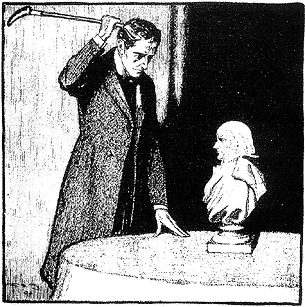
A Bust of an Adventure

Because exploration of his characters was rarely high on Sir Arthur Conan Doyle's agenda, the quality of any given Sherlock Holmes story generally turns on the cleverness of the mystery at its core. In this, "The Adventure of the Six Napoleons" is rather a disappointment.

Inspector Lestrade of Scotland Yard shares an odd and seemingly trivial crime with Holmes and Watson: two locations, a store and a residence, have been burgled for the strangest of purposes. The perpetrator has disturbed nothing but plaster busts of Napoleon Bonaparte, shattering them into pieces upon the ground. Holmes must uncover the motive behind the crimes before he can apprehend the culprit.

The trouble with this story is that the twist is readily apparent from the moment Lestrade introduces the case: someone is breaking the statues in hopes of finding something inside. But the story doesn't provide any clues as to what might be hidden in the statue; Holmes reveals this only in the climax, having deduced it from investigation the reader isn't made privy to.

The result is a lot of uninteresting pages between the brief introduction and brief conclusion. The reader already knows the shape of the ending, but is denied the opportunity to guess the specifics. Watson and Lestrade come off even less capable than usual; Lestrade's theory of some madman who hates Napoleon is laughable even for him. There's simply nothing here to engage the reader before the inevitable wrap-up.

I'd say "The Adventure of the Six Napoleons" rates only a D.

Saturday, April 25, 2015

Breaking Free from Prison

There's been a lot of talk lately about the HBO documentary Going Clear: Scientology and the Prison of Belief. Having picked up HBO again for the new season of Game of Thrones (and Veep, and Silicon Valley), I was able to see what the fuss was all about.

Taking inspiration from an earlier book (of the same title) by Lawrence Wright, Going Clear examines how Scientology came to be, explores its actual practices and beliefs, delves into its scandals, and interviews a number of former members. To the degree the film seems to be expressing a message, that message seems to be: "how did these guys get tax exempt status as a church?" To the degree people have been commenting on the film, the commentary seems mostly to be: "I'm astounded at the crazy crap Scientologists believe." Going Clear is certainly a well-made documentary. But on both those counts, I was hardly surprised.

It's worth noting that this film was made by Alex Gibney, the same man behind the documentary Mea Maxima Culpa, which examined the child abuse scandal in the Catholic church, and the institutional protection of the abusers. Arrange the two documentaries mentally, side by side, and you get my take on Scientology: why are people surprised by any of this? Yes, Scientologists believe some batshit crazy stuff. So do other religions. Yes, it's offensive that Scientologists are able to exempt themselves from paying taxes and use their money like a corporation to fuel their own expansion. Same for other religions. Yes, Scientology seems to be a transparent means of aggrandizement for a few power-hungry individuals. Same for other religions.

"How is Scientology a religion?" many people ask. How is it not a religion?

Since Going Clear so astutely puts this on display, I was definitely bound to like it. It's a more focused film than Mea Maxima Culpa, which often let (justifiable) rage dull its razor. I was already aware of the origin myths of Scientology, so the movie wasn't particularly informative for me on that count. Still, if it's a vehicle for people to think critically about one religion, it's doing good. Some of those people might then go on to think critically about all religion.

I give Going Clear a B+. It's an insightful, and not unnecessarily cruel or flippant, take down of a Scientology. It's a magnifying glass and, perhaps, a mirror.

Friday, April 24, 2015

Supreme Disappointment

Over the past couple years, I've read a few books about the U.S. Supreme Court, each with a different tone. There was the "insider exposé" that was The Brethren, the critique of originalism that was The Nine, and the more purely informative overview that was The Supremes' Greatest Hits. I've recently added another book to the list, this one largely critical of the institution itself: The Case Against the Supreme Court.

Author Erwin Chemerinsky is a law professor and practitioner, dean of the law program at the University of California, and attorney who has argued at the Supreme Court. He has steeped himself in constitutional law and the Supreme Court throughout his decades-long career. And over time, that has had the effect of transforming a reverence for the Court into a disillusionment with what he sees as its long history of failure.

Chemerinsky builds a fairly compelling case that the Supreme Court has rarely been a force for good in U.S. history, and that even when it has, it hasn't done as much as it could. He begins his argument with a sort of mission statement for the Court that few could quarrel with: the purpose of the federal court system -- and the Supreme Court above all -- is to look out for the little guy. The Court exists to enforce the protection of the individual's rights against unconstitutional overreach, be it from unthinking and unfeeling majorities or acts by the government itself.

He then parades an alarming litany of examples in which the Supreme Court grossly failed in this mission. Some are widely known, like the infamous Dred Scott decision that dissolved the Missouri Compromise and condoned slavery; and Plessy v. Ferguson, which upheld the "separate but equal" doctrine of segregation that would endure for decades. Still more cases were already known to me, and should be generally more well known than they are, like the shameful Korematsu decision that upheld forcing Japanese Americans into internment camps during World War II.

But there are so many more horrific decisions in Supreme Court history that I knew nothing about. The Court supported the forced sterilization of the mentally disabled. It upheld the Sedition Acts of World War I, seriously curtailing free speech. It struck down a law aimed at reducing child labor. It condoned McCarthyism. It voided numerous attempts to prevent corporate monopolies, and to establish a minimum wage. When given the chance to acknowledge the right of women to vote before the passage of the 19th Amendment, the Court did nothing. And it was so pro-slavery in the Civil War era that it even struck down Pennsylvania's attempt at a law which simply said "if you're coming to our state to take back your escaped slaves, we don't want you to use extreme force or violence."

Over several chapters, Chemerinsky presents dozens of cases that no serious person of any political conviction could defend as rightly decided. This was his aim -- to make a point that could be embraced by people of any political ideology. It's why he starts on the politically neutral ground of the more distant past. Later, he transitions to the present, showing that close analogies can be drawn between those past cases and more recent ones.

For a while, it seems as though Chemerinsky is on solid ground. He covers a case where the Court ruled that victims who were seriously harmed by a generic drug can't sue the manufacturer for damages -- even if the harm was caused by design defects, and even if that patient could have sued the manufacturer if they had been taking the brand name version of the same drug. He presents another case where a man, after 24 years in prison for a crime he didn't commit, was told by the Court that even though the prosecutor at his trial knowingly withheld evidence that would have proved his innocence, he could neither sue that prosecutor nor the city that employed him.

But Chemerinsky just can't help getting a few extra swipes in. After spending three-quarters of his book building an argument using cases that would seem unimpeachably wrong to anyone, he presents a chapter with the trolling title "Is the Roberts Court Really So Bad?" He examines Bush v. Gore (which wasn't even decided by the Roberts Court), Citizens United (the notorious campaign financing case), and Shelby County (the nearly-as-notorious Voting Rights Act case). And while I personally agree with his analysis of those cases, I suspect they're all too ideologically loaded to support his argument as powerfully as his other examples. I can easily imagine a conservative reader, who might have been gently persuaded by the bulk of the book, suddenly throwing it down in disgust. That's a shame, because the author has a solid underlying point. (And it's not like he lets the liberals off the hook either. One of his chapters argues that the Warren Court -- the one brief period in history where the Supreme Court was truly progressive -- was unclear even in the rulings celebrated today, such as in the school desegregation case of Brown v. Board of Education.)

What does Chemerinsky suggest be done about the Supreme Court? His concluding chapter presents a number of prescriptions for improving the institution. He suggests merit-based nominations -- something President Jimmy Carter did for his federal court appointments (a practice Ronald Reagan discontinued, and that no president since, Democrat or Republican, has reinstated). He suggests substantive confirmation hearings (rather than the "Kabuki" of the current process) and term limits (a notion he admits with shock he agrees on with Texas Republican Rick Perry). He also implores the Courtto improve its communications, something the Justices themselves could implement on their own.

Ultimately, Erwin Chemerinsky has written a solid book. It would be great if the people in positions with the power to change things would take heed of his arguments. But it is a shame that he undermines his presentation a bit with some unnecessary partisan digs. Overall, I give the book a B+.

Thursday, April 23, 2015

TNG Flashback: The Quality of Life

"The Quality of Life" is a fair, if somewhat forgettable, episode from season six of Star Trek: The Next Generation.

The Enterprise has been sent to evaluate a new "particle fountain" mining technique being tested by an engineer named Dr. Farallon. But it's one of her other inventions that proves more compelling. To keep her mining operation running smoothly, she has created a set of adaptive robotic tools she's dubbed "exocomps." When one of these devices appears to exhibit an extinct for self-preservation, Data speculates that the exocomps might have attained sentience. After an accident on the mining station, he is determined to preserve their lives even if it means sacrificing the lives of Picard and LaForge.

If you think the technobabble in this episode is a bit thicker than normal, you're not imagining it. The script was written by Naren Shankar, who would later become a full-fledged member of the writing staff, but who officially at this point was just the staff's science advisor. Showrunner Jeri Taylor had bought this episode's premise from an outsider story pitch. Either for lack of staff time or following a successful lobby by Shankar, she agreed to let him develop a draft of the script on his own.

Fortunately, the script isn't all science and engineering. It ultimately comes down to Data's difficult exploration of life and what defines it. He has a more than one deep conversation with Dr. Crusher on the subject, and ultimately develops an "instinct" that the exocomps qualify. It's a huge moment for Data, because it feels so out of character for him. In an argument in the episode itself, Riker articulates pretty much every reason why: Data doesn't know for certain that he's right, yet he's still willing to see his captain and best friend die for that hunch. It's frankly hard behavior to understand or rationalize, until the final scene where Data explains himself to Picard. When Data's own sentience was questioned, Picard came to his defense. Data basically felt the urge to pay back that support by advocating on behalf of the exocomps.

While this is obviously a "Data episode," Dr. Crusher has almost as good a part in it. Besides the heady discussion of life itself I mentioned before, she gets a couple of nice feminist moments too. There's a fun poker scene in the teaser where she argues that beards on men are just as much an affectation as makeup on women. (And it seems she would have won a bet on that point, but for a timely interruption by Picard.) Later in the episode, we learn that Crusher has been bat'leth training with Worf -- and that she is improving enough to have almost gotten in under his guard. Perhaps because a woman was now running the Next Generation writing staff, things were evolving beyond the point where female characters had to use pottery to fight instead of swords.

But there are also parts of the episode that don't quite work for me. Some are merely production issues. The decision was made to portray the exocomps using rod puppets. The results seem oddly jerky, less smooth than you'd expect a machine to operate. There's also a scene in Engineering where one of the exocomps goes down an "impossible" conduit -- we see a hallway stretch on for hundreds of feet, beyond the point where we know a wall exists (people have been walking into Engineering that way for years).

Other problems are unpolished quirks in the script itself. For example, it seems awfully easy to accidentally create artificial intelligence. Farallon wasn't even trying to do it, but given her statement that she's reformatted several "malfunctioning" exocomps in the past, she's actually done it multiple times! There's also an uncomfortable, quasi-corporate vibe to the way the Enterprise crew interacts with Farallon and the mining operation. Just because the Federation is evaluating the mining process, does that mean they "own" the exocomp technology too? Because our heroes pretty much act like they do, taking control away from Farallon. Plus, it bothers me that Data (whether he was "right" or "wrong") faces no consequences for his indisputable act of insubordination to Commander Riker.

Other observations:
  • Although there are three exocomps in the story, there was only enough money in the budget to build two puppets. Every scene where you see all three is a visual effects composite, such as when Brent Spiner plays both Data and Lore in the same scene. You wouldn't think twice about such a trick today, but I find it interesting that even in 1992, split screening was cheaper than building a puppet.
  • This is the second straight episode where people specifically mention Geordi's beard. LeVar Burton preferred to have one, and in the past had very briefly been allowed to wear one. He argued again this season to have a beard, and this time had a more powerful reason for it on his side: he was getting married, and thought it fair that he be allowed to have a beard at his own wedding. The producers agreed, but then promptly made him shave it off again afterward.
  • Speaking of guys with beards, Jonathan Frakes was again in the director's chair for this episode.
Ultimately, the biggest disappointment of the episode is that the huge importance of Data's actions in it -- his growth as a student of humanity -- aren't acknowledged strongly enough. This episode shouldn't be as unmemorable as it is. Still, it's not "bad" as such. I give it a B.

Wednesday, April 22, 2015

The Frenemy of my Enemy

Well, on the plus side, this week's Agents of S.H.I.E.L.D. had lots of action and momentum in the plot. It also caused story lines to converge that had remained too separate for too long. And above all that, it was a hell of a lot of fun as it did it. But it did come at the cost of characters behaving in a logical and consistent way.

First, there was Jiaying. If she never had any intention of keeping Cal captive up at the Afterlife retreat, if he was too dangerous to have there, then what was the point of even bringing him there in the first place? And once there, why tell him Skye had been found and brought there at all? Residual feelings for their past relationship is sort of an explanation, but if she takes her job of protecting Afterlife at all seriously, she has to know that it isn't smart to cast him out into the world knowing Skye isn't to be found there. Better to send him back out on a fruitless search, thinking he can still find her somewhere.


Then there's the matter of how foolishly and completely Coulson trusted Ward. Repeatedly. He too easily assumed he'd coerced Ward into an agreement. He mistakenly assumed that the carrot that would entice Ward would be a brain wipe, when he already knows from firsthand observation that the one thing that truly motivates Ward to do good is Skye. He continued going along with Ward's plan even after a revealed double-cross. And then, at the end, he apparently left Ward alone with Fitz and Hunter! There's no way on Earth those two can keep him in check.

That last decision seems a particularly hard sell even as an act of desperation, since abandoning the group also meant turning himself in to "other S.H.I.E.L.D." I hope we get some rock solid explanation of his thinking next week, because on the face of it, his choice to give up after spending several episodes on the run leaves viewers to wonder what the point of any of it was.

I appreciate big story moves, but not so much at the expense of character. This felt like movement propelled more by a ticking clock: the end of the season is fast approaching, and the writers suddenly realized they have more story left to tell than time to tell it in. Fun, but not particularly well executed. I give the episode a B.

Tuesday, April 21, 2015

The Sounds of Desolation

I had high praise for composer Howard Shore's work on the first film of The Hobbit trilogy, An Unexpected Journey. Nevertheless, it took me until after the home video release of the last film before I finally picked up the soundtrack to the middle film, The Desolation of Smaug. While this score certainly does have its highlights, it's not the grand accomplishment of its predecessor.

Part of the problem is that Shore seems to have lost some of the desire for experimentation he showed on An Unexpected Journey. Much of his score for The Desolation of Smaug relies quite heavily on what I'd call "the chords of the Rings," a distinct style he'd established on four prior Tolkien movies -- to a point where the sound begins to constitute a bag of tricks. The album kicks off with a particularly egregious example of this, "The Quest for Erebor," a sort of shapeless collection of minor chords and languid strings. And while Shore tries shaking things up with the use of a solo boy soprano in several tracks ("The House of Beorn" and "Feast of Starlight"), the same regurgitated underpinnings from the orchestra leave those efforts rather dull.

Some of Shore's new attempts at themes fall flat as well. The new hero of the film, "Bard, a Man of Lake-town" gets an amorphous tune, largely in free time, rather than the strong (or even noticeable) anthem he deserves. Even his ancestor, "Girion, Lord of Dale," gets a more potent melody -- and Girion only actually appears on screen in the Extended Edition of the film.

But fortunately, there are also many cues where Shore snaps out of his funk. "Wilderland" builds from a slow pulse to a relentless race over five tense minutes. "Mirkwood" is a fantastic and eerie track with a whispering choir and odd clanking that one could imagine being recorded in the basement of an abandoned factory. And if some of the quieter moments of the album seem a bit vague, the action cues are bombastic in opposite measure. Shore uses thundering timpani, furious strings, and growling brass for "The Forest River," "My Armor Is Iron," and the sprawling, nine-minute "The Hunters." And I found "Flies and Spiders" to be a particularly thoughtful evolution of the "giant spider music" he wrote for Shelob back on The Return of the King -- he again focuses on strings that skitter around quickly within an octave, but this time with a different rhythm and greater support from the rest of the orchestra, all suggesting a greater number of creatures.

Shore also plays around with instrumentation in the last half of the soundtrack. First, it's just odd arrangement of his usual orchestra, creating the evocative "The Nature of Evil." Then, it's bringing in a harpsichord for "Thrice Welcome." But it's his leitmotif for Smaug that's most effective, an odd flirtation with a Middle Eastern style. Perhaps thinking of the Tales of the Arabian Nights that possibly inspired Tolkien himself to imagine a cave filled with treasure, Shore crafted a melody in a double harmonic scale and brought in unconventional percussion including zills (Middle Eastern finger cymbals) to represent the dragon and his lair. Over the course of three tracks ("Inside Information," "A Liar and a Thief," and "Smaug"), he plays around with these ideas, introducing something new and different to the musical language he has created for Middle-earth.

One other tradition of Peter Jackson's Tolkien films has been the inclusion of a song for the end credits. I've usually found these to be middling at best, but this film's "I See Fire," by Ed Sheeran, is a pleasant surprise. It's a real masterpiece of overdubbing, layering in the vocals and instruments one at a time. Sheeran starts with a single guitar and gradually adds bass, violin, cello (the only instrument he didn't play himself), and percussion. Similarly, his vocals, which begin in double-tracked unison one octave apart, gradually fill in with more harmonies each time the chorus comes around.

In all, I'd say there are more skippable tracks on this soundtrack than on An Unexpected Journey (or any of the three Lord of the Rings films), but there are still enough good ones for the album overall to get a B.

Monday, April 20, 2015

The House of Black and White

As promised by showrunners David Benioff and D.B. Weiss, Game of Thrones this week continued to depart from the book source material -- and continued to entertain by doing so.

Actually, it was one of the smaller changes that marked the only place where I thought something got lost in translation somewhere. The election of Jon Snow to Watch Commander played out over several chapters of the book. (That book being A Storm of Swords; we're backtracking to finally grab this important development.) Multiple votes were taken over multiple nights, which obviously had to be compressed for dramatic effect on the show. But book Sam made much shrewder political maneuvers to position Jon as a sort of alternative "consensus candidate" to everyone else. I had a harder time believing that one rousing speech would get the job done -- particularly when Thorne made an equally convincing (to your average rube, I thought) counterspeech.

On the other end of the spectrum, Brienne's story this week effectively allowed her to skip an entire book's worth of Martin's material -- material that was far from compelling to begin with. Sure, you have to allow that Brienne and Podrick just happen to grab food in the same place as Littlefinger and Sansa, but it's a coincidence I welcome as an alternative to weeks of fruitless searching. Instead, we got a powerful moment for Sansa, who may not have made the right choice in sticking with Littlefinger, but who at least make a choice (more than I can say for her book counterpart). Then we were treated to a wild action sequence through the forest that delivered plenty of thrills. I look forward to Brienne's continued tracking of Sansa (to where, we still don't know).

Somewhere in the middle were the changes to the Dorne storyline. Having Jamie decide to go there seems like a big improvement. Book Cersei sent him off on a menial clean-up mission to deal with the Red Wedding aftermath, which, being deliberately menial, was generally not exciting to read. It did serve to bring about Jamie's slow disillusionment with his sister over several chapters, but I have faith a more efficient way can be found to do that on the show. Instead, we now send a major character into the heart of action that sorely needed a familiar character in the books.

The secondary characters are switched around too. Bronn popped as a character far more on the show than he ever did in the books, where he was just one of three or four named fighters working for Tyrion. His wry humor will be a welcome return. Also changed are things in Dorne itself. In the books, Prince Doran had a daughter, Arianne, with an elaborate plot surrounding Myrcella -- one that did not involve killing her. It's a simplification to turn that into a desire to start carving Myrcella up for revenge, but that is at least a viewpoint that some characters had in the book. Combining Arianne and Ellaria into a single character is likely a change that will work, particularly in the name of preserving further use of an actress who was solid last season.

So far, the show's answer to the boring Meereen chapters of the book seems to be sinking Dany in the quagmire more quickly. I don't remember this decision for a public execution in the book at all -- or perhaps all that changed was her decision to be there in person for it? Either way, it made for a much stronger "what are you doing?!" moment that highlighted the core issue of the book, distilled down: Dany's attempts to do the right or just thing are rarely rewarded. The show's added visit from Drogon was a nice punctuation mark on it too; even Dany's dragon doesn't want to hang around with her much.

Tyrion's tedious travels through the east continue, largely unaltered by the presence of Varys and absence of Illyrio. I don't mind the show keeping things slow for him for the moment as they focus on other stories.

Which just leaves the story we didn't get to see last week, Arya's arrival at the House of Black and White. I loved her little showdown in the street (even if we were denied the chance to see her make good on her threat). The major change here is the return of Jaqen H'ghar! In a place where people can change their faces at will, it's still possible that it isn't him, of course. Still, the show has again put a familiar character into a storyline that lacked for that in the books. And again, it feels like a good change.

I'm excited about the directions things are going this season. This newest episode, I give an A-.

Friday, April 17, 2015

TNG Flashback: A Fistful of Datas

For quite some time, Star Trek: The Next Generation had steered clear of the "dangerous holodeck malfunction" cliché that seemed to recur so much in its early seasons. But then along came an idea to make them revisit it: "A Fistful of Datas."

When a rendezvous with a supply ship is delayed for 48 hours, the Enterprise crew suddenly find themselves with free time to kill. Worf's son Alexander takes him to the holodeck to play sheriff and deputy in the "Ancient West" town of Deadwood -- joined by Counselor Troi. But the game turns deadly when an experiment by LaForge and Data unknowingly infects their scenario. The holodeck safeties are disengaged, the controls are locked, and the characters are replaced one by one with facsimiles of Data -- complete with the android's physical abilities.

The pitch for this episode came from an outside writer, Robert Hewitt Wolfe. The idea was so well received that it earned him a staff writer position on the new Deep Space Nine series. Still, every outside script gets a polish from an in-house writer, and Brannon Braga did the honors here. He reportedly lobbied to swap scripts with Ronald Moore (giving Moore "Relics") to work on this. I've heard two conflicting versions of the tale -- that Braga was a lifelong Western fan itching to work on this; and that he knew little or nothing of Westerns, but still thought this sounded like fun.

The original plot would have pitted "Sheriff Worf" against some sort of robber land baron, but Ira Steven Behr over on Deep Space Nine heard about this episode coming up on The Next Generation and suggested a more specific Western homage, to the film Rio Bravo. It was a win all around, letting the episode feature more fun Western conventions -- complete with the Enterprise riding off into the sunset at the episode's end. It also gave a welcome upgrade to Counselor Troi's originally envisioned role as a saloon dancing girl; the cross-type, gender-blind placement of her as "the mysterious stranger" is a vast improvement.

The "Spaghetti Westerns" which this episode lovingly references were, of course, directed primarily by Italian filmmakers. So, fittingly enough, there wasn't an American directing this episode either. Patrick Stewart drew this assignment, and reportedly watched one or two Westerns every night in the run-up to filming it. From his "studies," he incorporated several shots that were specific homages to films like Rio Bravo and Shane.

The episode actually filmed on location for a single day, on the "Western street" backlot at a rival studio. Stewart made the most of that day. There are lots of wonderful, wide angle shots that show off the dusty streets of Deadwood and evoke still more classic films.

The episode gives a lot of actors a chance to shine. Michael Dorn again proves himself a skilled comedian throughout the episode, from lines like "I'm beginning to see the appeal of this program!" to the wicked grin that accompanies his finger-gun in the final scene. Marina Sirtis really sinks her teeth into her unexpected role here, adopting a fun drawl and getting several laughs of her own. (In a scene where she attempted to blow smoke rings, Dorn reportedly joked that she needed to stop being so funny in "his" episode.)

There are even good moments for the characters that don't get to join in on the holodeck fun. Patrick Stewart bristles with irritation in an opening scene that hints to us why Picard never studied an instrument before his experience in "The Inner Light" -- he gets no uninterrupted free time. Jonathan Frakes bullies his way through Riker's loud rehearsal as Beverly Crusher's newest actor (complete with a callback to Data's fantastic poetry).

Of course, its Brent Spiner who really gets to cut loose this episode. This isn't simply Data imitating human behavior to varying effectiveness; this is Spiner getting to play multiple other characters. They're mostly a great success (even if his take on Eli Hollander doesn't really match much with the guest star who plays the character before the holodeck glitch). Spiner is perhaps a bit over the top outside the holodeck -- for example, when he walks bowlegged over to the plant and spits in it. But his menace as Frank Hollander is fantastic.

Joining in on the fun is composer Jay Chattaway, who underscores the episode with plenty of authentic Hollywood Western style music. In fact, to record this score, he hired Tommy Morgan to play harmonica -- the same performer who played on most of those classic Western soundtracks.

Other observations:
  • This episode was first meant to be called "The Good, the Bad, and the Klingon" before the far better title "A Fistful of Datas" was dreamed up. The new title was so well-liked that for the rest of the series' run, the writers would joke about doing a follow-up episode called "For a Few Datas More."
  • This was another episode where the series won a technical Emmy; it won for Outstanding Individual Achievement in Sound Mixing for a Drama Series.
  • I love Picard's demure "I'm not much of an actor," for the sheer irony of it coming from Patrick Stewart's mouth.
  • Having the characters refer to this time period as the "Ancient West" seems like a fun detail... but when you really think about it, would we today call the 1400s "ancient?"
  • Can you imagine how big a cowboy hat has to be to fit a Klingon?
  • No holodeck episode would be complete without a reference to Reginald Barclay; Worf's disapproval of the prostitute in the program is quite funny.
  • Brent Spiner has spoken often of how difficult it was to work with the various "cat actors" who played Spot over the years. Given that, I have to wonder how long it took to get the footage in this episode, where the cat actually does exactly what it's supposed to in two rather long, unbroken takes.
  • When Frank Hollander comes to visit his son Eli in jail, then proceeds to threaten Worf, Eli appears to be "played" by a very fake looking mannequin posed behind Brent Spiner.
  • Worf has some serious heretofore unknown engineering skills; rigging up that communicator-powered force field seems like no small feat. (Still, the writers had to do a sci-fi take on the classic "steel plate bullet-proof vest" gag.)
  • There's an unfortunate touch of homophobia in the final act, when Worf is unable to conceal his alarm and disgust at seeing Data-as-Annie. Worf just survived a shootout, and it's receiving a quite chaste hug from a man that he can't face?
This episode is fun enough overall to forgive going back to the malfunctioning holodeck well again. I give it a B+.

Thursday, April 16, 2015

Double Digits

Today marks a mind-boggling milestone for this blog: its 10th anniversary.

When I started up Heimlich Maneuvers 10 years ago today (and nearly 3500 posts ago), a lot of my friends were into the blogging thing. A lot of us had recently been laid off from Decipher, and we were maybe looking for a way to keep in touch with each other as we departed Virginia in every direction imaginable. (Facebook wasn't yet the widely known phenomenon that could have served that purpose.)

Gradually, the blog morphed into what it is today: a place where I mostly review pop culture -- movies, TV shows, books, board games, music -- occasionally interrupted by vacation stories. I probably would have given it up a long time ago, but to my surprise, I have a tiny handful of readers who seem to enjoy it. Thanks for sticking with me, and I hope you still get what you're looking for.

I make no promises to still be at this in another 10 years. (Especially if I ever actually redirect my writing efforts into my take on the Great American Novel or something.) But for now, I'll keep my opinions coming. I have plenty of them.