Saturday, December 22, 2012

TNG Flashback: Heart of Glory

I wrote of "Coming of Age" that Star Trek: The Next Generation took its first real step toward telling stories driven more by character than by simple science fiction premise. That trend continued -- and improved -- in its next episode, "Heart of Glory."

Responding to a disturbance near the Neutral Zone, the Enterprise discovers a freighter with a trio of Klingon warriors aboard. They claim to have fought off an enemy attack, but their story is evasive and incomplete. When a Klingon cruiser signals its approach, it's revealed that the three Klingons are criminals wanted by the Empire. But can the Enterprise hold them in custody until the cruiser arrives? And will their efforts to sway Worf to their cause be successful?

This episode focuses on Worf, and fully fleshes out his past with an interesting "nature vs. nurture" story. Living on an outpost as a boy, his birth parents were killed in a Romulan attack, and he was taken to be raised by humans. He spent almost no time around Klingons growing up, but feels a deep connection to their traditions, and a powerful desire to find acceptance among his people. It's an intriguing enough history that even if you never believe that Worf might turn on the Enterprise crew (you shouldn't), you still feel for him and understand his powerful longing.

By contrast, the two surviving Klingons trying to appeal to him, Korris and Konmel, aren't really sympathetic characters. We don't really learn the exact nature of their crimes, but we see that they put a high value on battle and glory, not duty and honor. And even though this is the first time we've seen Klingons on the series apart from Worf, it's made crystal clear what a deviant sense of moral priority this is.

Actually, it's easy to overlook how pivotal this episode was in defining the "new Klingons" of Star Trek. Before this episode, they'd appeared only as villains in the original series, and the first and third Star Trek films. It was this episode that fully established the premium they place on honor, and on dying in an honorable way. (The Klingon death yell also made its first appearance here.) Worf tries to appeal to the Klingon commander coming to take the criminals, not arguing they should be released, but that they should have a chance to die on their feet in battle, marooned on some hostile planet somewhere. It's all foundational Klingon philosophy, but this episode marked the building of that foundation.

The acting is very good. Michael Dorn excels with the expanded role he's given here; he's particularly strong in pleading with the Klingon captain for mercy on the criminals. (And that's particularly impressive, when you remember that he's just acting with an empty blue screen, against a script supervisor reading the lines off camera.)

The two main guest actors, Charles H. Hyman and Vaughn Armstrong, are superb, capturing a wonderful Klingon swagger, and trying all sorts of tactics against Worf -- goading him, entreating him, enticing him. This was the first Star Trek role for Vaughn Armstrong, and while he only appeared on The Next Generation this once, he wound up playing a dozen different characters on the later incarnations of Star Trek, being one of the franchise's go-to guest actors.

The episode boasts a fantastic score by Ron Jones. He paid close attention to what Jerry Goldsmith defined as the "Klingon sound" in Star Trek: The Motion Picture, developing that approach here while not actually copying any of that music. Jones makes use of a similar, unusual array of instruments, including the Alpine horn and bamboo angklung for percussion, and builds his themes on the same fifth intervals Goldsmith used. He builds wonder for an early sequence that shows us the world through Geordi's eyes (more on that in a moment), builds tension as an away team searches the damaged ship for the Klingon survivors, and adds drama to the dilemma facing Worf. Particularly strong is the music for the jailbreak, interjecting a lot of excitement into what actually isn't that elaborate an action sequence, when you look at it carefully.

The one real misfire in the episode happens in the first act. When an away team beams over to the damaged freighter, Geordi is equipped with a bit of technology allowing the bridge to look in on the action, seeing the team's movements through Geordi's eyes. It's a very interesting idea on paper. The question of just what Geordi does "see" was inherently interesting from the moment we met him. And the writers do express some neat ideas here, such as the comparison to learning to sift noise from a crowded room.

But there are several problems. For one, we never really see "GeordiCam" again. (It appears in one later episode, where we the audience see what Geordi sees; but the crew never tries to do this again.) But the bigger problem, within this narrative, is that it steals all urgency from a tense situation. The freighter they board is about to be destroyed by the damage it has taken, but the away team spends a great deal of time just puttering around, oooing and aahing at GeordiCam. I'm forced to wonder if perhaps this episode came short on its script page count in its first draft, and whether the writers simply injected this unrelated element to pad the episode to its necessary running time.

Other observations:
  • This is another episode with no opening Captain's Log entry setting up the story. The series really is trying to grow up in terms of storytelling technique.
  • There's a nice beat during the escape from the freighter where the transporter fails to work. Not that you believe for a moment that Riker, Data, and Geordi are all going to be killed on the spot, but it's nice to see technology fail not simply for a convenient plot point. (cough-holodeck-cough)
  • For those into gadget trivia, I think this might be the first episode where we get to see the food replicator do its thing.
  • For those into behind the scenes trivia, all the footage of the Klingon cruiser in this episode is lifted straight from Star Trek: The Motion Picture. (Which is why the Klingons apparently haven't updated their ship design in 75 years. The budget for that wouldn't come until a later season.)
  • Recurring Star Trek director Rob Bowman, who did a great job with "Where No One Has Gone Before," "The Battle," and "Datalore," also does well here. He has a few showy camera moves too, including a great moment for Korris' death, cutting to progressively farther cameras during Worf's Klingon death yell.
Klingon stories aren't necessarily my favorite, but this is still a solid episode. I give it a B. It's one of the better first season efforts.

Friday, December 21, 2012

Dragonborn Again

A few months back, I wrote about the first expansion for Skyrim, Dawnguard, which I seemed to enjoy a great deal more than many reviewers. Figuring it wasn't to my tastes, I skipped over Hearthfire, the second non-story driven expansion that was all about designing and building custom housing in the game. But for the recent third expansion, Dragonborn, I was ready to return to Skyrim -- and very excited, given the enthusiastic reviews I'd seen.

It seems that perhaps reviewers and I don't quite see eye to eye when it comes to Skyrim expansions. Now they aren't completely off base. They hailed Dragonborn for presenting truly new locations unlike any of the landscape presented in the first expansion. And I agree, on the visual front, Dragonborn is a major success. The adventure takes you to Solstheim, an island with both Nord and Dark Elf elements, and features all sorts of oddities from giant monolithic stones to a village made of enormous mushrooms. And looming ominously over it all, the volcano of Vvardenfell seethes ash on the horizon.

But that's only the beginning. The main storyline of Dragonborn has you venturing repeatedly into another plane that's ruled by one of the Daedric princes. Apocrypha, as it it is called, is an alien landscape of books and swirling pages, a hellish reflection of the knowledge coveted by its ruler. The denizens you find there are very effectively spooky, and I felt more tension exploring the area than I did in any other part of Skyrim -- original game or expansion.

But story-wise, this new expansion is rather anemic -- and the story is what I enjoy foremost in an RPG. Dawnguard offered a rather significant new plotline to play (plus a massive, multi-step side quest). Playing it at a rather casual pace, it took me well over a month to get through it. I've been playing Dragonborn at an even more casual pace -- for perhaps a few hours every three nights or so -- and I reached the end of its new main quest line in less than two weeks. Now from what I've read, this expansion includes a considerably larger number of side quests to explore. (And for the moment, I intend to do so.) But I was expecting a lengthier main story here after playing Dawnguard.

And a more complicated one too. Where Dawnguard had many interesting twists and turns (and a fairly compelling new character to travel with), Dragonborn's plot is considerably more rote. Go here, then there, then there, and before you know it, you're done. I kept anticipating some kind of plot twist that simply never materialized.

Overall, I would still have to recommend the expansion. Visually, it's outstanding, and at times might just be the most creepy game you could play outside of a zombie killer with all your house lights off. Just don't expect it to last for long, or for you to be surprised by anything that happens along the way. I'd give it a B- (which may yet upgrade to a B, depending on what I find as I move onto the optional side quest content).

Thursday, December 20, 2012

Tré Magnifique?

Green Day's three-album trilogy, which began only a few months ago with ¡Uno! and continued just weeks ago with ¡Dos!, has now concluded with the release of ¡Tré! (It's named for the band's drummer, not the Spanish number.) It turns out they did not save the best for last; the album might in fact be the least of the three.

But it's not that ¡Tré! is a bad album. It's just... quite even keel. Where the prior two albums had both songs I'd rate 5 stars and material I'll skip over every time, this final album is quite average. None of the tracks has captured my imagination enough to go on relentless replay, though none of them sends me reaching for the skip button either.

There's a mix of old and new song styles on the album. The opening track, "Brutal Love," has a doo-wop blues sort of bass-and-chord structure that seemed like a fun and unexpected way to kick off a punk-pop album. But then the next song, "Missing You," is not only familiar Green Day territory, but feels a bit like an up-tempo "Wild One," a song off the first album in this same trilogy. Some songs are both old and new at the same time; "Dirty Rotten Bastards" is this album's "Jesus of Surburbia", a several-songs-in-one medley of conflicting styles, though some of the pieces themselves feel quite fresh.

I still have hopes that one or two of the tracks might break through and raise my overall opinion of the album. But that said, I seem to be picking up a lot of new music right now that's pulling me onward and away from this latest Green Day effort. So as of now, I'll give ¡Tré! a B-. If you're a Green Day fan, you'll want this, as with both prior albums in the series. If you're more casual in your opinion of the band, then it's the initial album, ¡Uno!, that you'll likely want to check out.

Wednesday, December 19, 2012

Accident Coverage

This summer, Entertainment Weekly magazine ran an article touting The 50 Best Movies You've Never Seen. Indeed, I'd only seen a tiny handful of them, and several of them sounded intriguing enough for me to add to my Netflix queue.

One was Happy Accidents, an indie romance starring Marisa Tomei and Vincent D'Onofrio, and featuring an unconventional premise. When a woman with a sad history of failed relationships takes a chance on a man she met randomly at the park one day, things start to look up. But then he confesses to her that he's actually a time traveler from nearly 500 years in the future. Now she must decide whether to keep focusing on the good parts of the relationship and entertain the fantasy, or to write him off like her many past exes.

A relationship movie is only as good as its couple. Tomei and D'Onofrio are both good actors individually, but they lack that spark as a couple that would really make the movie take off. The scenes in which Tomei's character interacts with her therapist are strangely more compelling, while D'Onofrio is at his most interesting when he's spouting off nonsense about how the world is different in the far future. Both of them invest in the movie's high concept, but neither quite made me invest in the relationship.

Ultimately, the movie seems more interested in playing games with the "is he telling the truth?" aspect of the plot than it is interested in pursuing the romance. And the movie doesn't ride the line of "is he telling the truth?" objectively enough to make the film very compelling just on that level. You're never really in doubt what will be revealed in the final act.

I may yet check out some other films from the magazine's list, though I'm disappointed that my first random pick didn't really pan out. I grade Happy Accidents a C-.

Tuesday, December 18, 2012

TNG Flashback: Coming of Age

"Coming of Age" isn't one of The Next Generation's better episodes -- nor even one of the first season's better episodes. But in a number of ways, it had its heart in the right place, and may possibly have signaled a moment (after a string of disappointing episodes) where the show started to show hints of what eventually would be good about it.

The Enterprise delivers Wesley Crusher to a planet where he'll be tested for entrance into Starfleet Academy. While in orbit, Admiral Quinn -- an old friend of Captain Picard's -- beams aboard the ship with special investigator Remmick, who has instructions to comb over everyone and everything aboard, looking for "something wrong" on the ship.

There isn't a lot of action in this episode. Indeed, when they cut together the 30-second trailer to promote it, they focused heavily on a tiny element buried in the heart of the episode just to create an apparent threat: another young man aboard the Enterprise, after being beaten out by Wesley for the chance to test for Starfleet admission, steals a shuttlecraft and attempts to run away. He manages to stall the shuttle out, nearly dying before Picard guides him successfully out of danger. It takes only a few minutes of screen time, but from the trailer, you'd think it was the major A-plot of the entire episode.

The lack of action here is because the episode was trying to pursue a few laudable goals. First, it was being very character oriented. The Admiral's real motive in coming is to offer Picard a promotion. He believes Starfleet may be threatened by a conspiracy (from within or outside, he isn't sure), and he wants someone he can trust serving as commandant of Starfleet Academy. To this end, the story follows interrogations of nearly all the main characters, showing us just how they feel about Picard's leadership. Their reactions to Remmick are interesting too. Riker, Geordi, and Troi all get rather belligerent, making the situation worse by making it appear there is something to hide; meanwhile, Data is dispassionately logical, Worf uses diffusing humor, and Dr. Crusher tells Remmick off with a smile and without raising her voice. We also get insight into Picard himself, who considers but declines the promotion, preferring to remain captain of the Enterprise.

Second, this episode is the first major effort of the series to have significant continuity. During Remmick's interviews with the crew, four different earlier episodes are mentioned in some detail. Even more importantly, the episode sets up a conspiracy storyline that the writers intended to pay off later. (They did end up addressing it in the penultimate episode of the season, though not in quite the way they'd intended here -- as I'll cover when I get there.)

Between the character focus, the strong effort at continuity, and other touches (such as an opener that not only has no log, but starts right up with a scene between Wesley and his friend Jake without fully explaining the context), this show really tries to live up to its title, as though the show itself was "coming of age" into a more sophisticated incarnation.

But it's not there yet. There are a lot of holes in the episode too. For starters, the guest cast is weak for the most part. In his portrayal of Remmick, Robert Schenkkan is particularly bad, taking too much relish in behaving like a jerk. The other students testing with Wesley are fairly wooden too, save John Putch, who as Mordock made enough of an impression to be brought back for a similar character in the second season. But worst of all are the actors in Wesley's "psych test." I suppose you could argue that was on purpose, as they're meant to be Starfleet officers pretending to be in danger for Wesley's testing scenario. But even using that logic, you'd have to say they were convincing enough to fool Wesley in the moment. That, I'm not buying.

The whole premise of Wesley's testing here is weak too. Four candidates are being tested, but in a pure set-up for story tension, only one of them will be selected -- as though somehow, the whole sector gets to send only one student to the Academy, and that Starfleet would stupidly turn away brilliant prospects just because they happen to be in the wrong galactic zip code. And yet, at the end of the episode, that's exactly what happens. Wesley and two others fail to get in, even though the officer who has been testing them says it's Starfleet's loss that they're not being admitted, and that they should all reapply later. Quotas.

Wesley's failure itself is an interesting plot development, when you actually think about it beyond the necessity to keep Wil Wheaton on the show. Later on, Wesley would indeed join Starfleet Academy, subsequently be reprimanded for bad behavior, and drop out. As I noted in an earlier episode review, a truthful story was ultimately told with Wesley, of starting out with one career aspiration only to discover a different, more appropriate path. There's no way the writers here in the first season could have planned any of this, but it could be taken as an early warning sign that Wesley was never a "fit" for Starfleet, given his failure to gain admittance here. (Although Picard does confide in Wesley at the end of the episode that he failed his first time too.)

Other observations:
  • This was the only episode of The Next Generation directed by Mike Vejar, but he'd wind up directing literally dozens of episodes for the next three Star Trek series.
  • When Picard talks young Jake through saving his stolen shuttlecraft by bouncing it off the planet's atmosphere, there are a whole host of logical holes in the scenario. Somehow, he's out of tractor beam range even though he just left the ship. Somehow, he's out of transporter range, even though his shuttle is between the Enterprise and the planet, and people use transporters to beam down to planets all the time. Somehow, only Picard is able to think of how to pilot the shuttle to safety, even among all those pilots (and Data) on the bridge.
  • This is the first episode in which a shuttlecraft makes an on-screen appearance. And they clearly blew the budget building it, because the station on the planet has several really fake-looking set extension paintings in the background.
  • There's a lot of solid acting among the regulars in this episode. Michael Dorn does well with an unusually articulate scene for Worf, in which he advises Wesley about dealing with fear. Wil Wheaton does a good job of selling the moment where Wesley realizes the nature of his greatest fear. Jonathan Frakes makes a fun but subtle acting choice in the scene where Remmick interviews him, sitting down by stepping over the chair in an aggressive manner. And Patrick Stewart is great in giving his pep talk to Wesley at the end of the episode. (For someone who says he isn't good with kids, Picard always seems to do well with them.)
  • Composer Dennis McCarthy delivers a rare score I actually enjoyed. It has some appropriately unsettling music leading up to Wesley's "psych test." It also makes liberal use of his recurring "Picard theme." Originally, before it was decided to reuse Jerry Goldsmith's theme from Star Trek: The Motion Picture as the theme for The Next Generation, McCarthy (acting as composer for the show's first episode) wrote his own theme that was ultimately discarded. He then reappropriated that music as a leitmotif for Captain Picard, using it in episodes throughout the first season, before finally giving into producer Rick Berman's desire for "musical wallpaper" without any recognizable melodies and retiring the theme.
While this episode did mark a turning point for the show, it still had a ways to go before becoming consistently good. The episode itself is only a mixed effort. I grade it a C.

Monday, December 17, 2012

Lost in Translation

Each year, a group of German board game critics award several "Spiel des Jahres" awards (or Game of the Year awards) to the types of games my friends and I love to play. As of recently, they have added two special subcategories: the "Kennerspiel des Jahres" and the "Kinderspiel des Jahres."

For those not fluent in German, it's very important to note the difference here.

My friend was curious to see what "kids' game" earned the 2012 top prize, and ordered the KENNERspiel award winner, Village. What he wanted was the KINDERspiel winner, because "Kennerspiel" translates roughly as "Connoisseur-Enthusiast Game." It's fortunate that we like more sophisticated games, because it quickly became apparent during the explanation of the rules that this was no kids' game. (Unless they have some freakishly smart kids in Germany.)

Village divides a game board into a number of different sections, each one with a unique action a player can take on his turn. But these actions are limited by the number of cubes placed in the section at the start of a round; to take an action, you must remove a cube from the area and add it to your resources. The cubes are also color-coded, which informs another key part of the strategy -- some actions ask for payment in certain colors of cubes. Plus, all of this is held in a larger game concept: the game unfolds over "generations." You manage a first generation family at the start of the game, and as each round progresses, new family members are born and old ones die off. The workers you assign to a location may not be there forever as their advanced age catches up with them.

It may sound like a lot going on, and it certainly comes across that way in the rules. But just as you'd expect from an award-winning German board game, the actual gameplay starts to make sense almost immediately. The board is particularly well-designed in explaining the costs and benefits of specific actions, and there appear to be multiple paths to a winning victory point total, all carefully balanced against each other. (In our first play through, it appeared that one player who hadn't been in as much competition with the rest would run away with the game; in the end, he only won by a thin margin.)

Among countless German board games that use similar elements of resource gathering and building, I feel that the area in which Village shines is "indirect competition." Many games allow the players to do anything... that the opponent hasn't already done. The "picking up cubes" mechanic here is a particularly clever form of this, not only limiting the number of times an action can be taken, but establishing a value on that action. Getting to do a much-needed action AND picking up a much-needed cube color at the same time is the holy grail in this game; often times, you have to settle for only one or the other.

I'm definitely looking forward to the next time I get to play. It's a bit early yet to proclaim this a true great of the genre, but I think it has the potential.

Sunday, December 16, 2012

Newman is a New Man

In my recent review of the new James Bond movie Skyfall, I neglected to mention the musical score. It's really a standout -- though arguably less so within the context of the film than in the career of composer Thomas Newman.

Though only film music enthusiasts are likely to know him by name, Thomas Newman has a sound that anyone would recognize. He's the quirky composer that delivered the oddly discordant music of American Beauty, and the playful-but-mournful theme to Six Feet Under. He has on occasion scored for things that weren't straight up drama, but even then his particular approach has come with him. His score for Jarhead wasn't particularly aggressive or "action-like," but instead continued to explore strange instrumentation and unusual rhythms.

Skyfall is thus an interesting score in that Newman almost entirely masked himself. The movie not only liberally references the Bond themes established in past films, it apes everything about the classic style. Screaming brass, prominent electric guitar, jazz percussion, trembling strings... this score is a loud, pulse-pounding, in your face composition. Indeed, Newman embraces the classic Bond sound to a far greater extent than most of the more recent Bond composers (like David Arnold or Eric Serra) did.

The result is one of my favorite Bond scores in many decades. It includes several 5-star tracks, and a host of others that I find engaging to listen to outside of the film. From the extended opening in Istanbul to the action-packed climax in Scotland, he soundtrack is full of exciting cues. There are a few too-quiet songs in the mix meant for intimate dialogue scenes -- places that might have been good for Newman to indulge his more typical composing style, but he elected to play it straight all the way from beginning to end.

In any case, it's an album I'm glad to have in my shuffle right now. I give it a B+.

Saturday, December 15, 2012

Expect the Unexpected

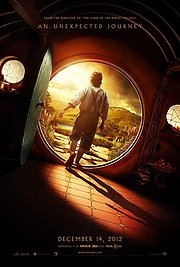
I believe the first installment of The Hobbit trilogy to be essentially review-proof. Nothing anyone writes about it is going to affect anyone else's desire to see it or not. But then, I can't really not write about it, can I? So here we go.

There are many parts of The Hobbit: An Unexpected Journey that are very well put together and very enjoyable. But there are a lot of parts to it. Tons. Ultimately, all the Lord of the Rings films have felt somewhat episodic in nature, but this new film feels like it might be several installments of some television show all stitched together in some kind of season box set. "Here's the episode where the dragon attacks." "Here's the episode with the flashback that introduces Thorin's nemesis." "Here's the episode about what Jar Jar Binks would have been like if he'd driven a bunny sled."

And perhaps more than anything: "Here are the episodes that needlessly wastes time just because we wanted to bring back characters from the first trilogy."

I don't think it's possible for anyone watching a Lord of the Rings movie to full understand the bond that must have been formed between the actors and crew making it. The film industry is a vagabond one, and many of the people drawn to it are mercurial in nature. They form an intense relationship with people that burns for a few months, and then everyone scatters their separate ways. The Lord of the Rings was different, filmed over the course of an entire year, with re-shoots that kept bringing them back together over several more. So I totally get it... Peter Jackson would want to gather as many of those actors again as possible, and they'd want to come do it.

The problem is, the story of The Hobbit is only tangentially related to that of The Lord of the Rings. So all these contrivances in the film to bring back the original actors feel like exactly what they are: grafted on bits that in no way advance the plot. At a nearly three hour run time, The Hobbit is far too long. And while the sentimental side of me enjoys the bits that call back a decade to the first trilogy, my objective mind, thinking about what's really needed to tell a driving story, would cut old Bilbo, Frodo, Galadriel, Saruman... all that needless fluff.

And most of the Radagast stuff. Dude, he's the worst.

I think another thing that hurt my enjoyment of The Hobbit was how slapstick most of the action was. The Lord of the Rings certainly had its lighter moments (Legolas surfing on oliphants; he and Gimli's "most kills" contest at the Battle of Helm's Deep), but by and large it was a fairly serious affair, and that seriousness brought a sense of danger and immediacy to the tale. The climactic battles of The Hobbit are rather silly. A big action moment of mountains literally fighting each other was so boring that that's the scene my boyfriend chose for a bathroom/snack break. The flight from the goblin kingdom is full of moments that ought to be accompanied by Three Stooges sound effects. And a finale that has all 15 heroes dangling from a tree (several of them from Gandalf's staff) in a literal cliffhanger feels cartoonish. (Just don't look down, boys, and maybe you won't actually fall.)

But as I said, The Hobbit is a very long movie, and so there are plenty of things about it that do work -- and work very well.

The performance capture tools for rendering CG characters have advanced so far in the last decade, it's truly stunning. New creations like the Goblin King are wonderful. I can't wait to see how Smaug (played in performance capture by Benedict Cumberbatch) turns out. And Gollum has been updated with enough fine points of detail and facial expression that he's now surely the most believable CG character ever created.

Of course, those performances are driven by actors. As Gollum, Andy Serkis is exceptional. The famous "riddle scene" between he and Martin Freeman is far and away the most compelling thing in the movie. The sense of danger is more palpable than in any other scene. There are moment of humor effortlessly woven throughout. You can see the mental gears turning for both characters. It's amazing.

Martin Freeman is a wonderful Bilbo. The story of The Hobbit simply doesn't offer as many scenes as The Lord of the Rings for the characters to really have a sentimental moment and express their feelings to one another... but when those moments do come, Martin Freeman absolutely nails them. He manages to keep the rather fussbudget nature of the character as a source of entertainment rather than annoyance, and his monologue which concludes the film is the most emotionally moving thing in the film.

So while I found things to like and be impressed by, I really found myself wishing I could just see the two-film version of The Hobbit instead. Maybe even the one-film version. I give The Hobbit: An Unexpected Journey a B-.

As a footnote, I did not see the "high frame rate" (48 frames per second) version of the film. And with several people I know reporting badly on that? (Everything from "awkward" to "headache-inducing.") Well, between that, and me not being that impressed by the movie, I have no plans to go back again and experience it for myself.

Friday, December 14, 2012

TNG Flashback: Home Soil

Following hot on the heels of the most boring episode of Star Trek: The Next Generation's first season (to that point), "Home Soil" tried its utmost to steal that title.

Curious to see firsthand the process of terraforming, the Enterprise looks in on a group of four scientists working to remake a lifeless planet. The evasive leader of the group tries to steer the ship away, but Troi senses his duplicity and Picard decides to investigate. When an accident kills one of the terraformers and almost kills Data, the crew discovers an inorganic life form living on the planet, which now threatens to destroy the ship as retribution for the war they say was started by the "ugly bags of mostly water" (humans).

This episode suffers from a multitude of problems. Perhaps the foremost is its utter predictability. There's no doubt as to what the crew will eventually discover on this "lifeless" world, and it's almost painful at times to watch them slowly catch up to the audience's intuition. Indeed, our heroes seem to go at least two or three times through a cycle of "could it be life? / there's no way it's life / but might it be life? / it couldn't possibly be life / unless it is life." It's almost like every act-out for a commercial break brings amnesia over all the characters.

The writing is so bad in places that it calls attention to the Herculean lifting the actors are trying to do to make it plausible. Brent Spiner has an oddly... halting... dialogue delivery in a scene where he investigates a malfunctioning laser; it almost suggests he was directed to vamp for time. LeVar Burton is saddled with an awful monologue describing the amazing beauty he sees... while looking at a tiny dot of blinking white light. But at least the main cast manages to do a little better than the horrible guest stars. The acting by the terraformers isn't uniformly bad, it's bad in a variety of ways: one is too haughty, one is too monotone, one is too hollow. (And one barely gets any screen time before getting killed.)

The investigative aspect of the plot seems like it might have some legs, but its high point is a long scene in the medlab where the characters end up basically asking the computer to do all the intuitive work of the scientific method for them. The lazy writing makes the characters look equally lazy.

It all winds up with a trite resolution. The ship never seriously seems threatened before the crew figures out that turning off the lights is all it takes to neutralize the inorganic life form. And the final moment of the episode is not a wrap-up scene, but a hasty log entry voiced by Picard over a shot of the Enterprise flying away.

Other observations:
  • The terraformers' leader, Mandl, insists that while he saw the signs of non-random patterns on the planet, he never interpreted it as life. If that's true, it's hard to explain why he tries so hard to get rid of the Enterprise at the start of the episode. What does he have to fear from people looking at a couple of swirls on the surface of the planet's sand if he truly thinks they're nothing?
  • Troi and Yar are tasked with investigating the backgrounds of the terraformers, to speculate on who might be a murder, as well as who have known what, and when. But when it comes to looking into the one female on the team, Troi tells Riker he may have better luck with her than she would. Basically, she seems to be telling Riker to go romance her. Wow.
  • The universal translator is used to communicate with and give voice to the inorganic life form. But the computer's voice is so processed and the language so broken that you actually can't understand a fair amount of the dialogue.
This episode is only better than "Too Short a Season" in that the main characters do actually have a role in the plot. Maybe the phrase "ugly bags of mostly water" is good for a laugh too. But we're still talking about the dregs of the series here. I give "Home Soil" a D-.

Thursday, December 13, 2012

Glee, Actually

Tonight's installment of Glee, with its mini-story structure and wall-to-wall Christmas music, is likely to polarize the show's fan base. (Much like this season itself.) But in my view, this was not just the Christmas themed episode Glee has ever done, but was probably the best episode yet of this much-improved season.

My only real criticism of the hour would be that I think the stories weren't told in the right order. I think it's too fashionable to adopt a chronologically jumbled narrative these days. Granted, it didn't really matter which order you took each of the parts in here. But I think they burned up the most emotionally potent stories early in the episode.

Sure, the Puckerman brothers' L.A. excursion culminated in a more tender family reunion at Breadstix, but it was generally a lightweight affair. The Brittany and Sam storyline would be too dopey to enjoy, if Glee hadn't already paved a clear "just go with it" trail when it comes to the intelligence of those characters.

But I think I would have preferred those two stories as a warm-up to the more profound material. Sue's "Christmas miracle" for Marley and her mother, though reliant on the ever-fluctuating sentiments of Sue, still managed to be sweet. Artie's "It's a Wonderful Life" segment was great on several fronts: it served up several funny jokes with the characters, gave a reason to bring back some old Glee stars for nice cameos, and had moments that effectively tugged at the heartstrings.

But most powerful of all was the Kurt segment. The awkwardness of the reunion with Blaine was interesting, but the best material was in the latest appearance by The Best Father on Television, Burt Hummel. After a few wonderful scenes that reminded us why Burt holds that title, he then dropped the bombshell of his cancer diagnosis. And despite his optimism, any long time fan of Glee had to feel their heart sink. It was a perfectly executed vignette that played on the one character relationship on the show that's been consistent from day one.

I suppose I could also quibble a bit about the song choices. Christmas songs can be a bit cloying to start with, and Glee has already used up many of the best ones. Several of the second string choices tonight had particularly repetitive lyrics. (Oh, from the bottom of your heart? Well, thank you then!) Still, the performances themselves were all pretty great.

I'd give the episode an A-. It was a nice note to break on for a few weeks.

Wednesday, December 12, 2012

Roald Trip

After seeing the amazing musical production of Matilda in London, I decided to throw the 1996 film adaptation of Roald Dahl's novel into my Netflix queue. I didn't expect it to be anywhere near as good, but I had heard it was an entertaining film with appeal beyond a child audience.

This film was directed by Danny Devito. He also stars along with his real life wife Rhea Perlman as the parents of young Matilda, an unappreciated child whose voracious love of learning leads to a discovery of telekinetic powers. The movie diverges somewhat from that of the book (which, not having read it, I believe the musical struck more closely to), but the overall essence of the tale is still intact.

The film does not whitewash the dark nature of the story. The treatment of poor Matilda throughout the story is quite honestly abusive, though her bright attitude and the light touch of the writing does manage to make a dark comedy of it. There's no Hollywood attempt to take the edge off any of this; her parents, her brother, her school principal, her situation, is horrible. But the fun flies high as well. The mischief and camp of the story is fully on display too.

The cast of the film is solid. Devito and Perlman are excellent weasels as Matilda's parents. Young Mara Wilson is wonderfully loveable and easy to cheer for as the title character. Pam Ferris is a perfect villain as school principal Miss Trunchbull, and Embeth Davidtz is a lovely light-at-the-end-of-the-tunnel as teacher Miss Honey.

It's really a nice movie all around, if not quite exceptional. Though I do have to wonder how much of that opinion was colored by having seen the musical, which is simply transcendent. I mean, it was "I think it's even better than The Book of Mormon" good, which is automatically going to make any other telling of the story seem deficient by comparison... maybe even, paradoxically, Roald Dahl's original book.

But for whatever the reason, I ultimately pronounce the movie good but not great. I'd grade it a B. It's certainly worth a viewing, in any case.

Tuesday, December 11, 2012

A Vacancy of Plot

I'm generally reluctant to give up on reading a book without finishing it, and I was stinging a bit from having done exactly that recently (with the starts-promising-but-aimlessly-meandering Kraken). And yet I found myself compelled to do so again when I found myself grappling with J.K. Rowling's newest effort, The Casual Vacancy.

When the author of the Harry Potter series first declared she was writing another book, I was thrilled. I enjoyed her books enough that I didn't want to regard her as a lucky flash-in-the-pan novice. A true author, I reasoned, wouldn't hang up her hat after one successful series, but would feel compelled to keep writing and publishing. When Rowling announced her book would be adult fiction, I was even more intrigued. She really was a writer, it seemed, who was leveraging her success to follow her own muse. She not only resisted the compulsion to follow up with something her fans would like, she decided to write something many of her fans would be too young to reasonably read.

But I never imagined she'd publish a book that was essentially unreadable, period.

The Casual Vacancy is a novel set in a fictitious rural town in England. After the death of a local level politician... stuff doesn't happen. That's as close as I can get to a synopsis. Things seemed to be brewing for a political contest to fill his empty council seat, and determine whether the town would remain independent or be incorporated into a nearby larger town. But after reading fully a third of the book, all there was was an avalanche of characters.

The book has over a dozen significant characters, most with sections told from their perspective, all with their own day-to-day minutia that didn't seem to fit into any kind of larger narrative. Children, foreigners, power-hungry figures, wives, mistresses, social workers... on and on and on, like a George R.R. Martin novel without the interesting parts or jaw-dropping plot developments.

But certainly with all the swearing. Rowling lets the first f-bomb fly around page 14, and from there there's no letting up. Rowling has said in interviews that she felt motivated to write about the lower-class world she knew growing up, but the book reads like she was simply trying to use every bit of profanity she couldn't include in seven children's books all in one novel. Harry Potter gave her literary Tourette's.

I kept trying and trying to plow through the book, as the occasional clever turn of phrase had me convinced that J.K. Rowling's clever writing style was still intact despite the boring subject matter. But ultimately, I just couldn't force myself to slog through any more. I simply have no patience for character studies without a narrative.

This being essentially just one bad book after a string of seven very good ones, I'm not about to proclaim J.K. Rowling a one-hit wonder. Nor am I even going to call for her to return to the young adult world with her next effort. But I am going to approach that effort, whenever it comes, with a lot more caution. The Casual Vacancy was an absolute mess that should be avoided, no matter how much you think might like it. (Or might want to.)

Sunday, December 09, 2012

Rise Up

This weekend, I went to see the children-aimed animated feature Rise of the Guardians. In a nutshell: Santa Claus, the Tooth Fairy, the Easter Bunny, the Sandman, and Jack Frost team up to stop the Boogeyman from taking over. It was a fairly enjoyable movie, with some definite strengths and flaws.

The character design of the film is wonderful. Everyone in the audience has seen a million portrayals of Santa Claus, but this movie managed to serve up something different -- a gruff, Russian lunatic with "Naughty" and "Nice" tattoos on his forearms. Equally interesting treatments are served up for all the main characters, and those characters are then realized with wonderfully detailed computer models. Detailed musculatures, particularly in the faces, yield very expressive animations.

The voice acting behind all these characters is equally wonderful. Alec Baldwin is sometimes recognizable (but often not) as Santa Claus. Chris Pine is the endearing protagonist Jack Frost. (If I'd been forced to guess, I would have thought it was John Cusack, but I would say that's a compliment, in that Pine projects a very empathetic and relatable persona.) Hugh Jackman lets his native accent fly as a feisty Easter Bunny, while Jude Law relishes in erudite villainy as the Boogeyman.

What's less successful is the plot itself. It gets to where it needs to (and should) go, but it doesn't mind bowling over logic to do it. Characters often do things for no discernible reason other than "it's time to do them now" (no sooner, no later), which would make everyone seem a bit fickle were the hands of the manipulative writer not so clearly visible.

Still, of movies a young child might demand you see, you could do a whole lot worse than this quite fun little adventure. I give it a B.

Saturday, December 08, 2012

A Strong Legacy

I while back, I wrote about the movie The Bourne Legacy, which continues the film franchise without Matt Damon. The lead actor wasn't the only thing to change in this new installment; after three films scored by composer John Powell, this film brought James Newton Howard in to write the music for the film.

I honestly wasn't expecting to like the music of this film very much. I think John Powell's work on the first three films was exceptional -- exhilarating music that can get the pulse racing whether attached to the film or not. I have the soundtracks of all three films in my collection, and I'm always happy when my random iPod mix serves up a track from a Bourne movie.

James Newton Howard is a composer I find hit and miss. His score for The Fugitive was outstanding, perfectly capturing the thrill of the chase at the heart of that movie. And some of his work on Christopher Nolan's first two Batman films was also strong. But in between, he contributed a lot of workmanlike scores to films that don't really command attention, and don't hold up well outside the movie.

I was pleased to find that The Bourne Legacy had one of his best scores in ages, and I rushed to pick up the soundtrack album. This score is a percussion driven, exciting collection of music. It sounds rather different than what Powell did on the earlier films, but still accelerates the pace of the film well. It also even incorporates occasional phrases of the Bourne character theme Powell created, sprinkled into scenes that tie Matt Damon's character to Jeremy Renner's.

The album definitely uses the prime cuts. There are over half a dozen strong, 5-star action cues that make for great listening, and plenty more tense and suspenseful cues that make excellent use of the full orchestra. There are a few songs meant for slower moments that don't play well without the film, and don't elicit much emotion on their own, but these are few and far between on the 26 song album.

And of course, the soundtrack includes the new recording of Moby's song "Extreme Ways," the franchise theme that concludes every film in the series.

I'd say I liked the soundtrack better than the film itself -- even more of a revelation when you consider that I went to the theater expecting the opposite to be true. I give the album an A-.

Friday, December 07, 2012

TNG Flashback: Too Short a Season

The uneven first season of Star Trek: The Next Generation served up bad episodes both racist and sexist, but as offensive as I find both those attitudes in life, perhaps in entertainment, the even greater offense is to be boring. Because while I found one or two minor redeeming qualities in those other installments, I can find absolutely nothing to recommend about "Too Short a Season."

A planet that just recently ended a four decade long civil war now faces a hostage crisis, as dissidents have captured the local Federation ambassador. The planet's leader, Karnas, has requested a negotiator with whom he worked years ago at the start of the war. 85-year-old Admiral Mark Jameson arrives to be transported to negotiations. But to make himself ready for the mission, he has taken an extreme overdose of an alien "de-aging" drug. He arrives at the planet appearing as a young man in his 20s, but so tormented by the drug's painful side effects that he may not be able to resolve the crisis.

Notice that in that recap, I didn't mention the Enterprise or any of the main characters once. That's the biggest problem with this episode -- it doesn't impact our heroes in any way. Their lives aren't in danger. They aren't requested to resolve the hostage crisis. They can do nothing to stop the admiral's rapid aging. They're all just bystanders to an Iran Contra metaphor about what can happen when volatile factions are armed with superior weaponry by an outside power.

There are two big revelations in the plot. The first comes when Karnas' ruse is revealed; there are no dissidents, and he has taken the hostages himself as a pretext for bringing Jameson to his planet to be punished for his role in causing 40 years of civil war. The second comes when Jameson reveals that he is not the master negotiator Starfleet believes him to be; he armed the rebels to secure a hostage release 45 years earlier, and then armed their enemies as well to maintain "balance" and satisfy his own warped interpretation of the Prime Directive. Neither of these is a particularly dramatic twist, and once again, none of it has anything to do with the regular characters.

Even ignoring his role in starting a civil war, Jameson is still a thoroughly unlikable character. His remorse and profound need to be useful again ring true, but he's needlessly standoffish and stupid as well. His first act upon boarding the ship is to admonish Picard about just who is going to be commanding what aspects of the mission. He even takes the captain's chair at one point, bumping Picard into Riker's traditional seat. And when he later leads a rescue mission to the planet, he insists that his memories of the subterranean tunnels will be more useful than any current tricorder scans, as though nothing could possibly have changed over the course of 45 years.

Everything about the way the Jameson character is brought to the screen fails as well. The old age makeup used for the first part of the episode is terrible, looking caked on and waxen, particularly on the cheeks. He's also saddled with an awkward wheelchair (that I've read malfunctioned extensively on set) which only serves to highlight how wheelchair-inaccessible the Enterprise actually is. We never see how he gets down off the transporter platform after beaming aboard, for example, nor do we see how he gets through any narrow doors on the ship (save the suddenly wider ones on his quarters).

The performance is equally bad. Actor Clayton Rohner, who plays Jameson, is decent in one scene when (appearing as his actual age) he expresses remorse over the misdeeds of his past. The rest of the time, he's either overacting advanced age through the shabby makeup, or overacting the pain of his drug's side effects. I've read that the ensemble cast complained he did not work well with them, and that certainly shows on camera.

Yet shockingly, he's not even the worst actor in the episode. Michael Pataki, who played a hammy Klingon in the classic Star Trek episode "The Trouble With Tribbles," here plays the even hammier Karnas, hostage-taking leader. That old episode was a comedy, so the tone was appropriate. Here, his bellowing and grunting around the stage, chewing up all the scenery, is unintentionally laughable. And he is not sufficiently skilled to sell the turn-on-a-dime written at the end of the episode, when the character decides after seeing Jameson's suffering to let up on his lifelong quest for vengeance and become a nice guy.

There's are some moments sprinkled throughout the episode with dramatic lighting and camera movement. They catch the eye, but they're transparent ways of hiding (and then revealing) a new stage of Jameson's de-aging process. There are also a few interesting musical moments contributed by one-time-only composer George Romanis, including some mournful piano phrases, and an unusually militaristic rendering of Alexander Courage's Star Trek theme at the close of the hour. But these brief flashes of interest aren't nearly enough to save a thorough bore of an episode.

Other observations:
  • There is an absolutely mystifying exchange between Picard and Dr. Crusher in this episode. Speculating early on about Jameson's medical condition, Crusher declares that "he's hiding something." When Picard responds that that's the sort of observation he'd expect from Counselor Troi, she appears to take offense. What's that about? Does Crusher think Troi is a hack? Or that psychology is a hack science? What exactly is her problem here?
  • Angry (more or less) about the way Jameson is dictating to him, Picard decides to assert himself by beaming down with him on the rescue mission. Inexplicably, Riker offers no objection to this.
  • The episode ends with a very classic Trek-like scene in which Riker and Picard pontificate about the futility of questing for youth, and the value of age and wisdom. Sulu and Chekov Data and Geordi exchange knowing nods at the conn.
Even episode director Rob Bowman later acknowledged this episode was verbose and not good. To quote Picard from this very episode, "not good is a galactic understatement." I grade this episode the first of the series worthy of an F.

Thursday, December 06, 2012

Swan Song

Glee has been forging new territory this season with its attempt to juggle a new cast of McKinley students and the post-graduation lives of the established characters. Tonight, the writers continued the trend of challenging the conventions of the series, by having New Directions lose Sectionals. Barring some weird redemption or reversal (always possible on Glee, I suppose), the competition element of the series is now off the table for the rest of the season.

I for one am thrilled with this development. Without the Macguffin of prepping for competition, the show can make time for other stories. Without the need to produce "Regionals" and "Nationals" episodes stuffed full of stage performances, the show can focus on songs that have more emotional weight behind them.

Ironically enough, we got both elements tonight, with half the episode's songs being stage performances... but crammed-to-bursting with emotional context for the characters of Rachel and Kurt. Rachel finally got her moment to shine after being beaten down in her first semester of NYADA, while Kurt got his second chance to audition for entry... and nailed it.

As their fortunes rose, fortunes plummeted for the gang back in Ohio. Kicked out of its own choir room, the Glee club scattered to other activities, as Finn and Marley in particular struggled with feeling responsible. While I'm glad the episode put enough time into the Rachel/Kurt storyline to make it land effectively, that did cost time that might have been used to explore Finn and Marley's sense of loss here. Or the sense of responsibility Kitty ought to feel in all this. But perhaps that's still to come. I mean, glee club is literally not going anywhere for the rest of the school year, right? I guess I'm just saying that the immediate fallout of the moment was glossed over a bit too quickly; Schu and Santana appeared only for half a minute each, while all the other characters who were around last episode -- Quinn, Puck, Mercedes, Mike -- all just vanished without a trace.

Further crowding out that aspect of the plot was the developing romance between Sam and Brittany. I enjoyed how a lot of the dialogue seemed pitched straight at the audience, anticipating the backlash of Brittany moving into the relationship. Still, I would rather have seen this all put on hold to deal with the more immediate story.

In any case, the song performances were pretty solid. The duet between Sam and Brittany was solid, with their voices blending well in the harmonies. The very Fosse-like treatment of "All That Jazz" was entertaining. I've already mentioned how the trio of songs on the NYADA stage were well-informed by the emotions of the characters.

And then there was the finale. This episode cheated its way into my heart, perhaps, with the selection of Crowded House's "Don't Dream It's Over." This has always been one of my very favorite songs. The lyrics and even the music itself do this perfect dance back and forth between melancholy and hopefulness. I've always felt that, depending on the circumstances, the song can bring a tear to your eye or a smile to your face. Or both. And Glee served up a nice version of it too, not radically altering the original arrangement, while not performing it as a straight cover either. For me, it was an instant Glee favorite.

Despite the episode being a bit crowded, the elements that were given space to breathe landed strongly. All told, I'd give it an A-.

Wednesday, December 05, 2012

TNG Flashback: 11001001

Of all the episodes of Star Trek: The Next Generation, "11001001" has both one of the most memorable and forgettable titles of all. And that's rather fitting, as the episode itself is mostly forgettable, save for a few truly memorable elements.

The Enterprise docks at a starbase where a group of Bynars -- a species of aliens who have a deep interconnectedness with computers -- will be upgrading several key systems. The Bynars fake an accident which appears to threaten the ship's destruction, then steal the Enterprise after everyone evacuates. Commander Riker and Captain Picard, still aboard and caught up in a holodeck fantasy the former created, and now are the only people in a position to retake the ship.

I think what really makes the episode so largely forgettable is that there's never any real jeopardy anywhere in the episode. The ship's antimatter breach is a ruse. The Bynars aren't really trying to steal the ship for good; they just want to borrow its computer storage to use as a backup for reformatting their homeworld's supercomputer. Even when Picard and Riker set the Enterprise's auto-destruct (for the possibility that they won't retake the ship), they turn it off again with nearly two minutes to spare.

The pacing of the episode is a bit slow in places too. The teaser is a rather lengthy sequence showing the Enterprise docking (though that does look gorgeous on Blu-ray), and the Bynars coming aboard through several corridors and airlocks. The first act opens with Riker wandering bored around the ship, bumping into other main characters and finding out what they're doing with their spare time. And the key sequence in which Riker first creates his holodeck dream-girl, Minuet, is loosely edited; there are large pauses between wide shots of the changing scenario and close-ups of Riker's reaction.

Nevertheless, this is a big character episode for Riker. He acknowledges at the end of the episode that he fell in love with Minuet (even with wet blanket Picard there with him most of the time). It's a relationship that actually gets referenced again several seasons later. And the episode wisely devotes a lot of time and space to interactions between Riker and Minuet, taking the best shot it can at making the audience believe their love. Jonathan Frakes certainly sells it, as does guest star Carolyn McCormick. And yet I still have some reservations. And I think they come down to this: if this really is Riker's ideal woman, there are some mixed messages about what that might be saying about him.

On the surface, Minuet is quite strong. She's completely self aware, the first holographic character who is a true creation and not a REcreation. Riker can talk to her about real world considerations beyond the confines of her jazz dive reality. But he and Picard both spend a lot of time marveling at how real she is, to a degree that they're saying some things right to her face that a real person would have to start taking offense to. Of course, she doesn't because the Bynars have programmed Minuet to distract Riker (and Picard) and keep them in the holodeck as long as possible. But my point is: this is what Riker responds to -- a woman who engages in witty repartee on the surface, but is ultimately a submissive doormat when the chips are down. She's also relatively emotionless, or so restrained in her emotions as to appear nearly so. When she pleads with Riker in the final act to help the Bynars, I do believe what she's saying, but she does it in such a dispassionate way. Or in a tone that I don't think comports with the prospect of global genocide, anyway.

The Bynars are an interesting idea, that's for sure. They do steal an original series gimmick of pitch-shifted speech to make male voices come from slightly feminine (but largely androgynous) characters, but there's more going on to them than that gimmick. With their tandem speech patterns, and their black-and-white binary thought processes, they feel to me like the series' best attempt so far at creating an actual alien culture, as opposed to just a "society that planet-wide is like this one place and time in Earth history."

Composer Ron Jones serves up another great score here. There's an ethereal, slightly spooky theme for the Bynars. Crisp militaristic tones play when the Enterprise is leaving spacedock, and a bold statement of Jerry Goldsmith's Star Trek theme greets its return. There's also the jazz stylings that play in Riker's holodeck scenario. Great music all around.

Other observations:
  • There's some unintentional humor in the opening captain's log, when Picard talks about the upgrades the ship is about to receive, "including the holodeck, with which we've had some problems." That's putting it lightly. (Though the callback to the malfunctions of "The Big Goodbye," mentioned specifically later in the episode, are a nice bit of continuity.)
  • While the ship is in spacedock, Wesley is left in command of the bridge. Obviously, he doesn't really have any responsibilities beyond just being there, but I wish that a bigger moment had been made of Wesley actually getting command. I'm sure in his mind, it was the biggest thing to have happened in his life, ever.
  • Riker has wised up since "Datalore." There, he was willing to trust a strange android found on a remote dead world just because it happened to look like Data. Here, he's skeptical of aliens endorsed by Starfleet to perform ship maintenance in one of their own spacedocks. (But hey, he's right.)
  • There are several fun, lighter moments with some of the characters. We get Worf's hilarious philosophy: "If winning is not important, then Commander, why keep score?" There's also Geordi and Data's exploration in creativity, which Riker dubs "a blind man teaching an android how to paint." Picard has a nice moment sitting back at the conn station for the first time in years. But my favorite side moment in the episode is actually a heavier one, when Data beats himself up a bit (in a non-emotional way, of course) about not being on the bridge during the crisis when he is in fact capable of being on-duty indefinitely, without break.
  • There's a big hole in the Bynars' plan here. They keep Riker aboard the ship so he can reboot the computer. But at the end of the episode, because Bynars always work in pairs, both he and Picard are required to unlock their computer file. Minuet even says point blank during the episode that Picard being there too was "fortunate happenstance," so basically their whole planet could have died but for dumb luck.
  • Speaking of Picard being there, shouldn't there be a protocol about barging into someone else's holodeck scenario? Riker could have been doing anything in there. In fact, he was in the midst of a deep kiss at the time, and one can imagine where things might have progressed if Picard had arrived a few minutes later.
  • The doe-eyed extras in this episode seem to feel no urgency in responding to Data's evacuation order.
  • At different points in this episode, the Enterprise computer voice switches between the usual female voice (provided by Majel Barrett) and a random male voice. I wonder why?
  • At the end of the episode, Minuet has inexplicably disappeared. Even if you accept that she was purely something special the Bynars cooked up, couldn't Riker have gotten them to copy the program for him? (The real answer, of course, is that we certainly didn't want a recurring love interest for Riker on the show, holographic or otherwise.)
Much of me likes this episode, despite the flaws it shows when you start to pick at it. All told, though, I'd give it a B-. It's not really an "essential" episode of the show, though it's not too bad either.

Tuesday, December 04, 2012

Presidential Decree

Last night, I went to see Steven Spielberg' newest film, the historical drama Lincoln. It boasts an epic cast and an epic run time, though the film itself is actually rather narrow in narrative scope.

The film purports to be based in part on the biography Team of Rivals, by Doris Kearns Goodwin. Having read that book myself, I must say that's a tenuous connection at best. The biography is a sprawling tome that covers every facet of Lincoln's election and presidency, while going into great length about his prominent cabinet members as well. The film, of necessity, must pare that down somehow, and does so by focusing almost entirely on the month of January 1865, and the push to pass the 13th Amendment to end slavery in the United States.

Much of the movie feels like an 19th century version of The West Wing, and there's good reason for that. The creator of The West Wing, Aaron Sorkin, had a background in writing plays before coming to television, and crackling dialogue was second nature to him as a result. The screenwriter of Lincoln has had even more success on the stage than Sorkin did; Tony Kushner's Angels in America was a huge success. And his forays into film writing have been infrequent enough that he still maintains that theatrical element in his work.

The movie does manage to make great, tense drama out of political coercion, vote counting, and bargaining, giving just as much space to oratory as it does depictions of the Civil War. The throughline in both depictions is showing the human cost -- the lives lost on the battlefield, and the lives impacted by the decisions of lawmakers. This means Lincoln himself isn't in every frame of this ostensible biopic, and that's a good decision.

In fact, I might have been tiring ever so slightly of the depiction of Lincoln by the end of the movie. It's well documented that he was a man with the right story for every occasion, but this is demonstrated perhaps once or twice too often in the film. It's good writing to reveal a character to an audience through example; it's bad editing to repeat the examples more than necessary.

But then, it may have been hard to decide just which story could have been the one to leave on the editing room floor, because Daniel Day-Lewis is compelling in every moment of the film. It's a step above good acting where you can "see how the wheels of thought are turning" in the character's mind; here, you can sense the thinking going on, but also get the sense that the thought process is too sophisticated to fully comprehend -- as sometimes said of Lincoln himself.

Of course, Daniel Day-Lewis is just the leader of an immense cast, all of them excellent. Sally Field, David Strathairn, Joseph Gordon-Levitt, James Spader, Hal Holbrook, Tommy Lee Jones, John Hawkes, Jackie Earle Haley, Jared Harris, Lee Pace, Walton Goggins, and more are here. People you'd recognize line up to have just a single sentence of dialogue on the screen. (As an aside, if you're a longtime Denver area resident that has attended theater at the Denver Center Theater Company, you might recognize older company veterans John Hutton and Jamie Horton.) Everybody wanted to be a part of this.

Since this movie is getting some decent Oscar buzz, I feel obliged to say that I didn't like this film quite as much as Argo, my own personal front runner so far. But this is certainly a worthy contender, and could speak to this being one of those occasional golden years that delivers several quality films to battle for the honor. I give Lincoln an A-.

Monday, December 03, 2012

Time Out

I'd heard that it wasn't exactly "good," but I still felt compelled to check out the 1995 movie Nick of Time when it ran recently on HBO. The allure of Johnny Depp and Christopher Walken in one movie was too much for me to turn away.

Nick of Time is a short 90-minute thriller that unfolds in real time. Depp plays a widower whose young daughter is kidnapped by a villainous Walken. Walken will kill the girl if Depp doesn't assassinate the governor of California (who is making a re-election campaign appearance at a local hotel) within the next hour-and-a-half.

It's easy to see why the movie was so widely panned -- it's preposterous from top to bottom. And it all basically stems from how implausibly stupid the bad guys are. The audience is asked to accept that a conspiracy to assassinate the governor could involve literally dozens of people, and yet still somehow require a random stranger to pull the trigger. It asks you to accept that this random stranger would be drafted in a train station just 90 minutes before the deed was to be carried out. And it just gets worse from there.

In this age before widespread cell phone use, the villain pulls the hero's strings by constantly showing up to interact with him in person. So now you're asked that the conspiracy realized it needed a patsy, but isn't concerned about being seen on security cameras with the guy. Then the villain gives the hero a surprisingly wide berth to screw around while working up to the kill; he interacts with several other characters, appears to hide in a mens' room for 10 minutes... all without triggering serious reprisal from the villains.

If one thing in this movie is more implausible than the plot, though, it's the dialogue. Each scene is crammed to bursting with the sort of amateur lines whose creation you can imagine were preceded by "and then it'd be so cool if he said this!" Worse than simply being unnatural, it's oftentimes outright comical.

And yet, I can't quite bring myself to hate the movie. It all comes down to a couple of things. First are the performances of the actors that drew me in in the first place. Johnny Depp and Christopher Walken act their asses off. Depp tries as hard as he can to muscle over the silly plot and sillier dialogue to bring a measure of truth to the proceedings. And Walken, in his patented way, plays a heightened sort of madman that almost reads like someone doing a Christopher Walken impersonation -- it's brilliant in its own way. The movie is stupid throughout, but these two somehow manage to also make it entertaining.

Secondly, there is the likelihood that this film went on to inspire the creation of the TV series 24. Sure, Jack Bauer is a skilled agent and not a random civilian, but otherwise the first season opened up exactly as this movie -- a real time thriller in which a man's daughter is abducted to coerce him into carrying out a political assassination. 24 not only did this story better, but was one of the best things on TV for several years (before devolving into a parody of itself). So if Nick of Time had anything to do with providing the inspiration, I feel compelled to give it a bit of a pass here.

Still, the movie is not good by any objective measure. So I'm going to give it a C- grade. It's really not worth your time, unless the idea of a hot mess starring Depp and Walken appeals to you on the face of it as it did to me.

Sunday, December 02, 2012

TNG Flashback: Angel One

To get to the second season episodes of Star Trek: The Next Generation that I sampled last week, I must keep forging ahead with the first season. Which brings me to "Angel One."

As the Star Trek: The Next Generation episode "Code of Honor" was tone deaf on the issue of race, "Angel One" is similarly bad on the subject of sexism. The key difference is that the former was innocent enough on the page and offensive only in its execution; "Angel One" actually thinks it's making noble points about gender discrimination, while undermining its own intended message.

Looking for survivors from a destroyed ship, the Enterprise investigates a planet controlled by a matriarchal society. An escape pod of men did indeed crash on the planet, and are fomenting rebellion against the society's gender discrimination from a secret hideout. Not being members of Starfleet, they aren't bound by the Prime Directive, and the away team cannot force them to leave. Meanwhile, the Enterprise may be summoned to respond to a Romulan attack, but when a debilitating virus breaks out aboard the ship, the crew finds itself in no position to go anywhere -- or even to assist their own away team on the planet below.

There's an awful lot going on in this episode, and very little of it working well. Ultimately, this is another Prime Directive parable very similar to the earlier episode "Justice." The locals want to execute someone, and the Enterprise has its hands somewhat tied by the Prime Directive. In this episode, it isn't even a regular cast member whose life is on the line, so the dramatic stakes are much lower. And again, the notion of what exactly the Prime Directive is hasn't quite been settled on. Riker says at one point that it prohibits them from interfering with less advanced societies, but not from interacting. Otherwise, he notes, how could we learn from you? A fair point, that is eventually abandoned when the writers settle on a total non-interactive policy within a season or two.

As if the "Justice" re-run wasn't bad enough, the secondary plot somehow manages to combine still two more ideas the series had already covered in just a dozen episodes -- a virus infecting the crew and a holodeck malfunction. Somehow, the holodeck (which is not supposed to create anything dangerous, nor anything capable of leaving its confines) serves up a virus-laden snowball that splatters Picard as he's walking through the corridor nearby. And because the episode is so crowded, we never even really see him getting sick. Suddenly, Dr. Crusher is there telling him he's infected and unfit for command, and he's barely able to stand up. And ultimately, this disease subplot is nothing but a contrivance to keep the Enterprise from beaming up the escape pod survivors right away once the away team finally convinces them to leave.

The Romulans are mentioned for the first time on the series, as seven of their battle cruisers are threatening a Federation outpost. I've read this was a last minute change from the Ferengi, who had proved to be such pathetic villains earlier in the season. It's truly a shame the writers made the change, because when the Romulans would actually appear on screen for the season finale, we'd get a far more mysterious and interesting (but contradictory) story telling us that the race had gone almost entirely into seclusion for decades. Then again, that long absence was never actually explained in any episode, so it was a missed opportunity anyway.

However the real train wreck of the episode is its commentary on gender discrimination. The episode tries to portray how sexism is wrong, and the writers decided that the novel way to do it on Star Trek would be to reverse the Earth-typical male centrism. But I have to wonder if maybe this was the wrong approach to the story. On the one hand, I can see how the science fiction thing to do is to draw a (thin) metaphor by depicting a discrimination atypical for our society. On the other hand, flipping things around like this makes the "oppressed minority" in this story be... white men. (Because there are no people of color on this planet that we see.) So, from a certain point of view, the story is almost saying to us, "there's been discrimination on Earth for all of human history, but when you see it happen here to white men for just 45 minutes, you're going to realize what an outrage it is!"

Still it could have worked out anyway, if the episode had truly depicted women in strong roles. At first, it seems like that's what we're going to get. We get to see Troi play the diplomat quite skillfully in the teaser, and then she and Yar lead the away team to the planet. Bu everything comes unraveled when Beata (the leader of the matriarchal society) finds Riker sexy. He protests briefly that it's not his function to seduce or be seduced by alien leaders, but then he totally Kirks up the joint and, through the power of sex, convinces her on the spot that generations of both capital punishment and gender discrimination are wrong. When it comes time for the rousing speech at the end of the episode that saves the crash survivors and the day, it's not delivered by Troi or Yar, but by Riker. That's right, folks -- in the episode that's supposed to be speaking out against sexism, a man has to come in at the end to solve the problem the women can't handle. Terrible.

Other observations:
  • The virus subplot is a weak, manufactured threat, but it does at least give us the chance to see other characters take command of the Enterprise -- and this is really the one highlight of the episode. Geordi is practically glowing when he takes command, and instantly adopts Picard's already-signature line: "Make it so." (And Worf has a nice little moment where he advises Geordi on delegating tasks.) Later, Data takes command, bringing his careful analysis to the job when he interprets the strict letter of Riker's instructions in a way that works to everyone's advantage.
  • Unlike in "The Naked Now," Dr. Crusher manages to cure this virus without contracting it herself. How she avoided it is a complete mystery -- maybe the writers just didn't have the script pages to have her get sick. But at least that plot element isn't replayed too.
  • At one point, Picard serves up the ridiculous line, "On the Enterprise, Mr. Crusher, nothing 'just happens.'" Actually, things seem to "just happen" at least once a week.
  • The costume designers had an interesting challenge this episode, trying to depict how a female dominated society would objectify men. What would be the male equivalent of high heels, prominent cleavage, and heavy makeup? The results are bright pastels, exposed chests, and renaissance-like codpieces. It looks a bit silly, but is probably about as close to the mark as they could have gotten within 1980s broadcast television standards.
I really do enjoy the moments of seeing Geordi and Data in command. There are also a few other brief highlights involving the main cast -- such as when Troi and Yar laugh at Riker's attempt to "go native." But overall, "Angel One" is a pretty shameful effort. I grade it a D.

Saturday, December 01, 2012

Armygeddon

Though I've long been aware of the many geek-revered quotes that originate from Army of Darkness, I'd never actually seen the movie itself. I recently decided to remedy that and earn whatever geek credits go with watching the film. But I had a hard time seeing what all the fuss was about.

Army of Darkness comes off like a movie made on the budget of whatever everyone involved happened to have in their wallets at the time. It's not a movie made effectively on the cheap, it's a movie that's proud of how cheap it is. Made in 1992, it's full of special effects that would have looked dated in 1972.

The plot is wafer thin, a loose weave meant only to hold the individual sequences from the fevered minds of Sam and Ivan Raimi. Even that may be too generous; the film feels more like fits of awkward ramp up to canned punch lines. These would be the quotes that so many people bandy about, which seemed like they could be funny out of context, but in context come off more like things that amateur writers thought sounded cool in their heads.

The one attraction is the ever-game star, Bruce Campbell. It's a stretch to say that he sells any of the bad visuals or ridiculous camp of the film -- it's all too far gone for that. But he does commit to every preposterous thing the movie asks him to do, and he himself seems to be having a hell of a fun time doing it. When he snaps off one-liner after one-liner, you can see imagine why people picked them up to use outside the film.

And yet, last I checked, this movie was rated 263rd best of all time over on Flickchart, and that's a level of adoration I can't begin to understand. No amount of thinking Bruce Campbell is the man (and he is) could begin to explain that love, or how a movie so weak and amateur could have a reach and influence so wide.

I grade it a D+. It's basically a waste of time other than to do as I did -- to fully educate yourself on the origin of phrases like "this is my boomstick," "gimme some sugar, baby," and the like.