Showing posts with label Supreme Court. Show all posts

Friday, June 07, 2024

My Day in Court

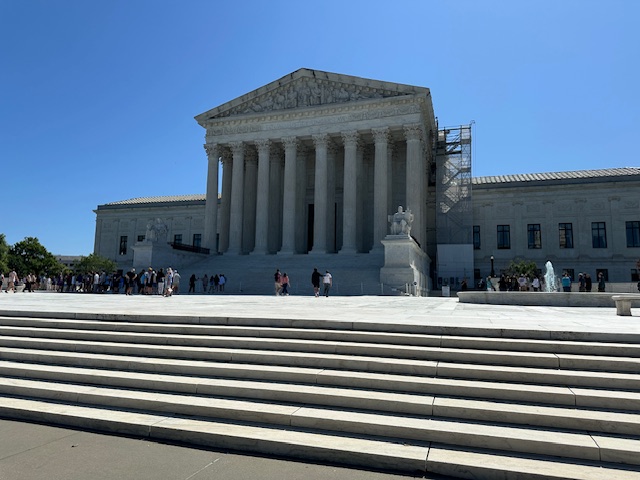
Day two in Washington D.C. began with a visit to the Supreme Court. It's basically impossible to get inside on a day when business is being conducted: with limited seating and high demand, people routinely pay "line sitters" to hold space to get inside and see the court actually in session. In sharp contrast, on a day when the court is not in session -- Fridays, generally, as this was -- you can basically just go in and walk around.

If you pay any attention to the rulings coming out of the Supreme Court (and if you don't, you really should), then it won't surprise you to learn that the building is full of contradictions. In light of the increasingly partisan rulings have been handed down of late, ever less respectful of precedent and divorced from sound reasoning, the place is really feeling like a museum celebrating cognitive dissonance.

You enter on the lower floor, which is literally set up like a museum with interactive exhibits, busts and portraits of past Justices, and a viewing room devoted to one of the Court's most-celebrated rulings: Brown vs. Board of Education (desegregating schools).

One of the interactive exhibits presents short summaries of the arguments presented in a real past case, inviting you to tap your own decision. You then learn how the Court actually ruled. You might expect such an exhibit to focus on cases that vindicated individual rights, or perhaps to offer background placing rulings in historical context. Instead, the exhibit almost proudly tells you how and where the Supreme Court says it's OK for you to be surveilled, to what degree this freedom or that was cabined, and so on.

With so many Justices in the history of the Court, too many to display them all, you might expect that those who are featured in statue or portrait would be selected for specific reasons. And you might expect someone to curate what sort of message those reasons might be sending -- as they are with the wing devoted to the small handful of women to thus far serve on the Court. But it's pretty hard to understand, say, why the placard by Harry Blackmun's portrait is a few short sentences boldly declaring his foundational authorship of Roe v. Wade when the Court has pointedly (and years ago now) overruled that case. ("This guy was great. WRONG. But great." seems to be the message.)

And that viewing room devoted to Brown v. Board of Education? It showcases the biggest lack of self-awareness of them all. In a room featuring artifacts related to the case, you can sit and watch a short film in which several of the current Justices give interviews about how foundational and transformative that ruling was. Several, not all. It feels notable which Justices couldn't seem to find 10 minutes to sit in front of a camera and say that they're OK with one of the country's most foundational anti-racist rulings.

But Clarence Thomas found the time. And that is rich. Literally 8 days before I was sitting in this room watching this film, Thomas authored a solo concurrence (in Alexander v. South Carolina State Conference of the NAACP) in which he argued that the government overstepped in the Brown II ruling (the case that followed up the original with a stern "we meant what we said, dummies"). Down in the Supreme Court basement, Clarence Thomas is telling gormless tourists every 10 minutes how important Brown was. Upstairs, he's writing that it was government overreach.

Basically... most of the sitting Justices on the Supreme Court really need to take a trip down to the basement. It's long been clear to me that most of them are blithely uncaring of the real-world harms brought about by their mockery of jurisprudence. And no, it's not like they're personally responsible for what's going on next to the Court gift shop (woefully shy on interesting items, by the way), nor even that they should devote much time to such things. But they've really got quite a monument to their own ignorance going on down there.

And also: here's a cool shot of the room itself where all the "magic" happens:


So, uh.... yeah... the Supreme Court is a very impressive and beautiful building with many impressive things to see. And going there was a totally dispiriting, if not enraging, experience.

Thursday, January 04, 2024

Supreme Overview

Now that I've posted my "Top TV Shows of 2023" list (complete with "honorable mentions"), I want to take a moment to talk about another show that, while not truly close to making that list, was nevertheless something I'd like to recommend.

Deadlocked: How America Shaped the Supreme Court is a documentary from director Dawn Porter. It was released on Showtime, so depending on what sort of Paramount+ access you might have (say... to watch Star Trek), it may already be available to you. The four-part series is a well-edited collection of interviews with prominent legal scholars, detailing exactly how we got to the current Supreme Court membership we have.

The series begins with a look at the Warren Court era of the 1960s, the period that most people -- even casual observers or non-observers of the Supreme Court -- think of as the "ideal" of what the Court can and ought to be. While the documentary shows just what the Court could do at that time, it also shows that in the moment, it became increasingly unpopular for doing so: the first domino being pushed in the chain. From there, the documentary tracks every new justice to be appointed to the Court, leading up to today.

As you may know, I'm really a Supreme Court junkie. I suppose I've always considered it a natural extension of the fact that to an alarming degree, the amount of civil rights I personally enjoy stems directly from the whims of the nine people who happen to be part of that group at any given time. But the thing is, I really think that more people should be Supreme Court junkies. And for the same reason.

I would certainly think that the rulings handed down from the Court over the last couple of years would shine a brilliant spotlight on that fact. Whether you're LGBT, non-religious... or a student, a woman, or just someone who enjoys drinking clean water, there's a Court ruling in just the last two years alone that notably carved out a big chunk of your freedoms. So if you're not really aware of who's currently a Supreme Court Justice -- and whether you would have voted for the people who put them on the bench --  I highly recommend you rectify that. And this documentary series is a good way to do that.

As a Court junkie, there was really nothing in this documentary that was new to me. It certainly didn't go as deep as I personally would have liked. Still, it's very well made, featuring insightful interview subjects throughout. Heading into a national election year... well, it's not that I needed the reminder of what's at stake. It was welcome all the same.

I give Deadlocked a B. If you're looking for a "crash course" on the subject, you'd be hard-pressed to find something else that packs in so much, so clearly, in such a tight package.

Monday, November 07, 2022

For Your Own Sake, For the Future of the Supreme Court, Vote Democrat

Tomorrow is election day in the United States. If you are eligible to vote and haven't yet (or haven't made your plans to do so tomorrow), then let me use this infrequent post about politics to do so -- and to urge you to vote for Democrats.

I could offer reasons enough to have my blog become all politics, all the time. But let me focus on one reason in particular: the Supreme Court. Its six-member conservative super-majority spent last term making one terrible ruling after another, and is poised to do even worse this term (if you can imagine that). Voters need to make sure that for the foreseeable future, any new justice appointed (thorough vacancy, or should the need for court rebalancing become even more obvious) must be appointed by a Democratic president and Senate.

You are of course aware of the Supreme Court's ruling last term in Dobbs, a case which overruled Roe vs. Wade, removing the nationwide right to an abortion. That wholesale degradation of women's freedom would be bad enough all its own. And yet, that ruling was in fact so appalling, drawing so much focus, that it covered for several other rulings that, in any other term, would be the headline-making disaster on everyone's mind.

Right around the same time the Supreme Court was ruling that women should only have rights that would have been recognized two-and-a-half centuries ago (a time when they had almost none), they also released these rulings. They restricted how concealed firearms can be limited in public spaces. (Not their own court, of course.) They declared that the right of someone to pray publicly supersedes the rights of those who might feel coerced to participate because of power disparity. They ruled that the Environmental Protection Agency lacks the agency to protect the environment from power plant emissions (under the specious theory that it's a "major question" that a gridlocked Congress must weigh in on).

And those cases all just come from a period of a few weeks. Don't overlook "highlights" from earlier in last year's term. The court blessed a scheme to take away individual rights, so long as it's rooted in bounties collected by private citizens. It eroded laws separating church and state in a case requiring states to fund religious schools. It ruled that a state can violate your constitutional rights in a criminal proceeding, so long as the state assures that such violations don't affect the jury. (Also, they can search your property without cause if you're close enough to a border, and you can't sue anymore if they fail to detail your Miranda rights.) Plus, if a defendant with a bad lawyer should get another bad lawyer to argue that fact? That's your fault; you have no recourse.

If all that isn't enough to make you mad, here are the cases which the Supreme Court has already heard in just one month of its current term -- and the rulings they seem likely to make, based on attitudes during the oral arguments. They will likely rule that universities have no interest in ensuring that their enrollment looks like a cross-section of the country's population. They seem likely to allow even more gerrymandering of congressional districts, ruling that even openly racist drawing of district lines is legal so long as a half-hearted non-racist justification can be offered. Odds are they'll allow the wealthy to pollute the nation's water supply under the theory that it's just too hard to know what water is actually part of the nation's water supply.

Then there are the cases that still lay ahead this term. The Court will be hearing a case that could give a state's gerrymandered legislature final say over election administration -- over any election officials, the governor, or even judges. They will rule on an argument that laws prohibiting discrimination against LGBT+ people are unconstitutional because a person's right to discriminate supersedes the right of the discriminated to secure good and services. And they'll hear dozens of other cases -- any of which could massively affect your life and your rights -- cases that even an avid Court watcher like myself hasn't even really processed yet amid the ceaseless stream of sewage currently flowing from the Supreme Court building.

Something at the Court must change, and soon. Vote Democrat to ensure that when that change comes, it's for the better.

Friday, May 06, 2022

Word Search Jurisprudence

Longtime readers of my blog know that I follow goings-on at the U.S. Supreme Court far more closely than the average American. This is simple logic when aspects of your own life depend on the goings-on at the U.S. Supreme Court far more than the average American. (Not that my interest is solely self-interest.)

When early this week, a draft opinion by Samuel Alito overruling Roe vs. Wade was revealed, I was not surprised. You didn't have to really be that much of a "court watcher" to know how this was going to go: for years, Republicans have told us they want to stack the courts with people who would overrule Roe vs. Wade. They were telling us directly, not dog-whistling, not slyly signaling -- boldly declaring their intentions.

But being inoculated from the surprise did nothing to mitigate the rage. That's in large part because this particular draft as written by Alito seems specifically calibrated to provoke rage. It is such a work of legislation masquerading as legal thinking, so much the very thing "originalist" conservatives decry, that it boils the blood.

Alito goes on for nearly 100 pages, but the summary of what he wrote is basically: I did a word search on the Constitution and "abortion" isn't in there. This sort of disingenuous approach to law is par for the course from Republican-appointed judges these days. I'd point out that if legal analysis was really this simple, there's seemingly no need for all the education lawyers and judges get. But then, they don't necessarily get it these days, which is why more and more Republican-nomiated judges are rated as "Not Qualified" by the American Bar Association.

The truth, of course, is that Alito and other extremist members of the Supreme Court simply stop reading the law at the point that suits them -- that point being 1787. They'll endlessly dive into the background and thinking of the framers who wrote the original document... but somehow, the 17 times we've amended the Constitution since then, the intentions of those lawmakers, just don't seem to be as important.

The 14th Amendment was about abolishing slavery, yes. But it was written knowing better even than we understand today exactly what slavery meant. When those lawmakers wrote about what it meant to "deprive any person of life, liberty, or property," they knew exactly what kind of deprivations were routine for slaves. Slaves were separated from their families, not permitted to have families, forced to bear offspring, and far, far more... "indignities" is a woefully insufficient word. Can anyone be said to truly have their "liberty" in the face of that? If they don't have privacy, or self-determination? The "word search method" of Constitutional law eschews even the simplest kind of thought exercise, because if you did so, you'd get an obvious, different answer.

And what's especially galling here, a disingenuous rot at the heart of this claim to prize "the words of the Founders," is that you have to explicitly ignore some of their words to get there. Those first 10 Amendments that were there from the very beginning? You never hear conservatives talking about the 9th. (Or frankly... any other than the 1st, 2nd, and 10th.) "The enumeration in the Constitution, of certain rights, shall not be construed to deny or disparage others retained by the people." That's stating in very specific terms that you can't "word search" the Constitution -- just because it's not specifically in there doesn't mean it's not in there.

When the real ruling in Dobbs v. Jackson Women's Health Organization comes down in a few weeks, I'm sure that dissenting justices will say all of that far more articulately than I. (And with a more enlightened legal foundation. These are the things you do when you actually care about "showing your work.") Sadly, the words will be a dissent.

"Word search" jurisprudence will go on to strip more and more rights away in the years ahead. Popular opinion won't limit how far they go; leaving Roe and Casey in place is favored by around 70% of the U.S. population -- even in red states -- but they're striking it down anyway with a fervor and glee that oozes "what are you gonna do about it?"

The only way to stop these draconian judges is to stop voting for the Republican candidates who put them on the bench. Don't wait for them to come for the particular law that you think will impact you personally. For one thing, they will eventually. Moreover, this law, right now, affects you personally.

Wednesday, May 26, 2021

For the People?

The U.S. Supreme Court made news last week by agreeing to hear a case next term that could enable the newly enlarged conservative supermajority to erode or even reverse abortion rights throughout the country. I was already primed for disdain of the Court, having just recently finished reading a book by Adam Cohen, Supreme Inequality.

The book's subtitle hides nothing of the author's thesis: The Supreme Court's Fifty-Year Battle for a More Unjust America. The introduction frames a compelling argument that almost everything that liberal-minded people tend to think about the Supreme Court is wrong. "It's a backstop for justice, a champion for the little guy, a bastion of hope for people who the system has otherwise wronged." Cohen argues that it was, for a too-brief 15 year period under Chief Justice Earl Warren, but that in the 50 years since, landmark rulings protecting those with less power have otherwise been shockingly few and far between.

I'm not sure there's a clear organization to the chapters that follow, but each one is well argued unto itself. Perhaps it's just that there are so many examples of injustice to choose from that it defies any organizational principle. The book goes on to look at cases where rights were at stake for voters, workers, targets of discrimination, and much, much more. Almost always, the Court majority chips away at equality, any reasonable concept of fairness, even self-determination.

Remember the hearings for Brett Kavanaugh, asks Adam Cohen? How, aside from the allegations of sexual misconduct against him, many feared the Court would lurch sharply to the right with him on it? (The book was written before Amy Coney Barrett was appointed.) That only represented a small move from just how far to the right the Court already was. The last time the Court was anything close to centrist or left? You'd have to go back to when Richard Nixon applied political pressure to force the resignation of Abe Fortas in 1969.

I find it rather surprising, though, that the book does not go on to offer any conclusions or proposals in response. Does the author simply find the situation hopeless? Or think it sufficient to simply shame? After making the case so thoroughly for why the Supreme Court should change, it feels like a glaring omission that it makes no arguments as to how. Term limits? Additional members? Something else?

As far a recommendation goes? Well, you might not need any more rage over politics in your life right now. But Supreme Inequality is a rather brisk read for a heavy topic. It makes clear and accessible many case names you may have heard of without fully understanding (Buckley v. Valeo, Ledbetter v. Goodyear, etc). I would give the book a B overall. It may not be recreational reading for most people, but it's a potent case for why liberal voters -- who tend not to prioritize the Supreme Court enough -- should care.

Tuesday, October 20, 2020

A Look at the RBG Spectrum

Last weekend, I decided to follow up my recent view of the Ruth Bader Ginsburg biopic, On the Basis of Sex, with the recent documentary about her, RBG. The two proved to be effective companion pieces to one another.

Where On the Basis of Sex was a dramatized look at a relatively narrow window in Ginsburg's life before the Supreme Court, RBG takes a broader look at her entire life, focusing mostly on her time as a justice. It's not a film trying to present a traditional underdog narrative; it's here to celebrate the achievements of a woman who would rarely call attention to herself.

Where the two films overlap is in the sense they give you of Ginsburg's time in law school. Both make clear how hard she had to work, how dismissive so many people around her were, and how she skillfully juggled the demands of her education (and her husband's, as he battled cancer) with raising children. But after that, On the Basis of Sex focuses solely on her first major case -- argued in front of the Tenth Circuit, not the Supreme Court. RBG would rather you understand just how much she accomplished throughout her life.

In RBG, you see how the incremental approach suggested in On the Basis of Sex actually played out over the years. You hear about most of the six cases she argued before the Supreme Court during the 1970s (winning all but one). You see the patience and strategic prowess she brought to bear on changing minds and changing lives. It's uplifting, affirming, and powerful to watch.

Finally, the movie settles into RBG's later years on the court -- and this last section of the documentary left me considerably more conflicted in emotion. These were the years in which Ginsburg actually become most famous and celebrated. These were the years in which she became The Notorious RBG, the Great Dissenter. On the one hand, her patient but firm reasoning was the same here as it was in the 1970s, and the fact that she continued on in that mission, that righteousness, that certitude, is inspiring. She never wavered and she kept fighting, staying true to principles that had always served her well in life.

On the other hand... she was dissenting in all these major cases that represented a huge erosion of rights and freedoms. She -- and we -- were losing these cases. Ledbetter, a refutation of gender equality that had to be corrected by Congress and President Obama's first major action after inauguration. Shelby County, the voting rights erosion that led directly to the widespread poll and dropbox closures, and hours-long lines, that we see today. Hobby Lobby, the decision allowing for-profit corporations to claim their own religious beliefs, and force them onto all their employees. Ginsburg wrote a powerful dissent in all these cases (and more), dissents that will hopefully, one day, be the argument that carries the day.

And yet, they're dissents. Losses. It's hard not to look on this final section of the movie, especially watching it now, after Ginsburg's passing, and see a lot of defeat mixed in with the triumph. It magnifies the emotions surrounding her death, and let's be honest: 2020 has been a year where magnified emotions don't generally feel very good.

That said, though... it has long been the case that conservatives are generally more motivated to vote with court composition in mind than progressives. There are signs now that with the death of Ruth Bader Ginsburg, that status is flipping. I do believe if more people watched this documentary and understood just how much RBG accomplished in her life, exactly what rights she saw vindicated in the law, and exactly what direction she'd hoped to steer the court, that would indeed be more motivating to more people.

And so even though I'd probably grade the movie a B "as a film," I would regard it as essential viewing, and strongly recommend people watch it. (Especially if you haven't voted yet or made your plans to. Get on that!)

Thursday, June 28, 2018

Supreme Disappointment

I'm no legal scholar, but I do follow the Supreme Court quite closely for a layperson. I knew what was coming. One week before the presidential election of 2016, I used by infinitesimal slice of the internet to highlight the importance of voting based on the Supreme Court. If you're going to be a so-called "single-issue voter," then truly, that should be your issue.

If you didn't believe me then, perhaps you'll believe me now. If you don't believe me now, you most certainly will by the time the 2020 presidential election comes along.

Yesterday, Justice Anthony Kennedy announced his retirement from the Supreme Court. This will make for the second Justice appointed by the current president (after the first seat was held open for eight months prior to the election by Senate Majority Leader Mitch McConnell). This appointment is going to have a monumental effect on the court. The rules now require only 50 votes to confirm a new Justice. Republicans have 51 votes. Trump can seat whoever he wants. We've seen him already seat Gorsuch; we know the type of man he will seat next. (Anybody want to bet against me on it being a man?)

To be realistic, Anthony Kennedy was only a "center justice" in that the Supreme Court was already so far to the right politically that old-school conservatism (of the type that has no place in current American politics) looked centrist by comparison. Just this term, Kennedy's vote on the Court helped hobble the power of unions (if you think teacher pay is unjust now, just wait), upheld race-motivated gerrymandering (in a case so clear cut that if it doesn't violate the Constitution, then truly nothing does), and endorsed the so-called "Muslim ban" (anyone who thinks Trump won't treat that as a blank check for more of the same, want to go double or nothing?).

But to be certain, Kennedy's replacement will be even farther to the right, because Kennedy occasionally reached across the aisle. He was the fifth vote holding in place two particular lines of cases. First, abortion rights. Everybody has heard of Roe vs. Wade. Fewer people know that it's already not "the law of the land," amended considerably in Casey vs. Planned Parenthood, and abridged further in additional Supreme Court cases that allowed significant restrictions on access to abortions. But to some extent, abortions have remained largely attainable in the U.S., with Kennedy keeping a foot in the door. Second is gay rights. Kennedy was the fifth vote to strike down criminal prosecution of homosexual intimacy, and later to legalize same-sex marriage.

That's all going to come under attack in the next few years. By the next presidential election in 2020, the nationwide right to abortion will be either eroded by further restrictions that allow some states to shutter even more locations, or by an outright pass allowing states to criminalize it if they want to. In that same time frame, there will be a ruling out of the Supreme Court allowing people to refuse service to discriminate against LGBT people on religious grounds (fully; not in the "well, this one baker gets a pass because one commissioner said mean things to him" sort of way).

This is why "principled conservatives" have put up with the Trump circus so far. For exactly this. Anything they might not have liked about Trump was worth putting up with to have a Republican in place to nominate new Supreme Court Justices. The Supreme Court is now this close to being staunchly conservative for a generation. And frankly, anyone hoping otherwise is drawing to an inside straight at this point. If either Ruth Bader Ginsburg or Clarence Thomas dies or retires while a Republican is president, then the Supreme Court will be irrevocably, intensely conservative, for fully 20 to 30 years.

This is not a call to action. The time for action was two years ago. Now there is nothing you can do. There's nothing I can do but type out this rant in the hopes that it will make me feel better.

It didn't, really. Damn.

Friday, May 12, 2017

Loving Criticism

The 1967 Supreme Court case of Loving v. Virginia is one of the more prominent cases in U.S. law. The unanimous verdict struck down anti-miscegenation laws barring interracial marriage, marking another advance for civil rights. (The ruling also figured prominently in the case that struck down same-sex marriage bans decades later.)

The case had previously been chronicled in a documentary, The Loving Story. As much as I appreciated the history, I was lukewarm at best on the film. That left me hopeful for improvement in a new, dramatized take on the tale released last year, a movie simply titled Loving. Unfortunately, I felt like it missed the mark even more than the documentary.

This new movie came from writer-director Jeff Nichols. I found that unexpected and improbable, given the only other movie of his I've seen, the sci-fi tinged family drama Midnight Special. It seemed like quite a change-up. Still, I quite liked that movie, and the way the personal stakes of its story remained front and center throughout. Maybe Nichols was the right person to tell the Loving story.

Richard and Mildred Loving were not a particularly outgoing couple. The fact that they were living together in violation of the law no doubt magnified their already quiet personalities. So if told accurately, this was never going to be a movie in which they gave bombastic, Oscar-baiting speeches. Still, it's so understated that it often feels like nothing is happening.

Interestingly, the movie is so matter of fact about their relationship that it doesn't even get into their legal troubles until 15-20 minutes in. I found myself thinking that someone coming into this film without knowing the story, someone without racial prejudice, might well wonder what the hell it's all about. When the movie does get there, it does enter its strongest section: an impactful display of what it's like to deal with bigotry -- both casual and overt -- on a regular basis.

But when things finally do turn to the court case, I found myself wanting more. Historical fact, combined with the writer's choice of perspective, combined to deny that. The Lovings did not even attend the hearing at the Supreme Court, and the movie makes the decision to remain grounded completely in their perspective. While I appreciate the impulse to keep it their story, it means we never get the triumphant moment where their argument is aired forcefully in public. There's no "yeah, take that haters!" moment in this film, even when the case is won. The Lovings just keep on living their lives.

It's something of a wonder that Ruth Negga received an Oscar nomination here for her performance as Mildred Loving -- not because it's bad work, but because it's so muted and restrained, so not the sort of work that normally garners Oscar attention, that I'm not sure how it broke through. Joel Edgerton has the volume dialed down even more as Richard Loving, giving the most subtle and understated performance of the film and his career.

The actors with the most to do in terms of flash also have very little to do in terms of their actual time in the movie. Nick Kroll, normally known for comedy, plays an ACLU lawyer. Marton Csokas gives us our villain to sneer at as a racist local sheriff. Michael Shannon plays a photographer for LIFE magazine. The three appear collectively in perhaps a quarter of the movie.

So once again, I find myself praising the actual story of the Lovings, hoping that more people knew of it... only to have another movie I can't really recommend to anyone. Loving is just too dry, too soft-spoken, to trumpet their courage in the way it deserves. I give it a D+. Stick with the documentary, or perhaps better still, the actual Supreme Court ruling that bears the Lovings' name.

Friday, October 28, 2016

A Matter of Supreme Importance

I rarely get into politics here on the blog. But it seems like every time a U.S. presidential election comes around, my resolve finally erodes at some point and I allow myself one political post. Well, this is it. And here's the twist: I'm not here to advocate for my preferred candidate. Instead, I'm asking you to consider a particular factor in your voting.

Polls show that most Americans are unaware of what goes on at the Supreme Court. Most can't name even one of the Justices. The composition of the Court barely rates as a factor in voting. This boggles my mind.

The judiciary, of course, is supposed to be fair and impartial. But it's ridiculous to pretend the Supreme Court can be. The cases that make it all the way up through the legal process to the Supreme Court, by definition, can't be decided by clear, existing law. Cases land at the Supreme Court because this law says one thing and that law says another. They land there because a judge in Texas said one thing and a judge in California said the opposite. They land there because the actions of a Congress or a President have trampled over the rights of a minority, and the Supreme Court is the only place that can hold them accountable. A Supreme Court case is almost always going to require a values judgment, so it's important to think about the values of the Court's justices.

This election's impact on the Supreme Court is not hypothetical. There is a vacant seat. It matters who fills it, because about one out of every five cases the Court hears is decided by a 5-4 vote. In most of those cases, the current eight justices split along predictable ideological lines: Breyer, Ginsburg, Sotomayor, and Kagan routinely support liberal arguments, while Roberts, Alito, Thomas, and Kennedy routinely support conservative arguments. The person who takes that ninth seat is going to break ties in the most politically charged cases of all. That person will be either a conservative-leaning choice (nominated by Donald Trump) or a liberal-leaning choice (nominated by Hillary Clinton; or Obama's very-slightly-left-of-center selection of Merrick Garland).

Say what you will about voting third party on other issues... for deeply felt principle, as a simple show of frustration, or as a stand for the future. But on this issue, right now, in this election, a third party vote is a vote that completely ignores the Supreme Court. Neither Gary Johnson nor Jill Stein (nor anyone else) will be nominating the next Supreme Court justice. The election of either Clinton or Trump will decide the next direction of the Supreme Court. If you're not voting for one of them, then the Supreme Court isn't a priority for you. Of course, that's your prerogative. But consider this:

When the Supreme Court makes a decision, it's built to last. When it upheld segregation as legal, it took 58 years to reverse the decision. You're almost certainly aware of your Miranda rights, for which you can thank a 50-year-old Supreme Court decision that to this day regulates many ways in which the police can question a suspect. The right to abortion exists -- somewhat abridged, but still largely there after decades of legal challenges -- because of what 7 men decided in 1973. This is the power that a Supreme Court justice wields. And in my lifetime, the average length of time they wield it has risen to 26 years, more than 3 times as long as the term limit on the president who appointed them. The possibility of change at the Supreme Court comes around infrequently, only in the event of retirement or (as in this moment) death.

Now consider some of the major cases from recent years, cases that were decided by just a one justice margin. Imagine the alternative outcomes with just a single changed vote.
  • Citizens United v. FEC: A conservative decision lifted restrictions on political spending by corporations, stating that such limitations violated free speech rights. The liberal dissent argued that corporations should not have the same free speech rights as individuals.
  • Shelby County v. Holder: A conservative decision eliminated federal supervision of voting laws, declaring it a 40-year-old policy no longer appropriate in the present day. The liberal dissent argued that federal oversight should have continued in states with a history of racially biased policies.
  • Obergefell v. Hodges: A conservative dissent would have left it up to public vote to determine whether same-sex marriage would be allowed. The liberal decision declared that the Constitution's guarantee of equal rights included the rights of gays and lesbians to marry.
  • DC v. Heller and McDonald v. Chicago: Two conservative rulings declared that bans on classifications of firearms are forbidden by the Second Amendment. The liberal dissents argued that the right to bear arms had previously been defined in the context of militia activity, and that certain limitations on individual gun ownership aren't inherently forbidden by the Constitution.
  • National Federation of Independent Business v. Sebelius: A conservative dissent would have voided the Affordable Care Act ("Obamacare"), arguing that the government can't force you to purchase something you don't want (in this case, health insurance). The liberal ruling construed the penalty for not having health insurance as a tax, not a forced purchase.
  • Burwell v. Hobby Lobby: A conservative ruling allowed the First Amendment's guarantee of religious freedom to be invoked by a corporation, letting it opt out of laws by voicing a religious objection. The liberal dissent argued that this curtailed the religious freedoms of the individual, whose own religious wishes should not be subservient to those of an employer.
This is just a small taste of the highly charged 5-4 cases of recent years. And that's not even getting into the 5-4 issues likely to reach the court in the years to come: the extent to which freedom of religion can exempt people from laws, further conflicts involving election integrity vs. voter suppression, LGBT rights against discrimination, and more.

You may not always side with the conservative view or the liberal view in all these examples. But almost certainly, one or more of these issues is particularly important to you, and you have a very strong opinion on how the Supreme Court should rule. You should seriously consider voting with that in mind.

Take a moment to consider how some of these issues might tip at a Supreme Court with a new conservative Trump justice, or a new liberal Clinton justice. Consider how many more decisions such a justice might make over a decades-long career. Think about how those decisions might still control American lives 40, 50, 60 years from now. Your choice for president (and for the senator who will vote to confirm a Supreme Court nomination) is the only chance you'll get to influence this in any way.

Be sure you're happy with how you use (or choose not to use) that chance.

Thursday, October 06, 2016

Amicus Brief

Not long ago, I blogged about the podcast More Perfect, a great look at past cases that have gone before the U.S. Supreme Court. Now I want to talk about another podcast, more focused on the Court's present.

Amicus is hosted by Dahlia Lithwick, the main journalist for Slate.com covering the Supreme Court. Just as the Court itself runs from October to June, so has this podcast (since 2014). For those disinclined to read long legal briefs and opinions, Amicus is the perfect way to keep abreast of what's going on at the nation's highest court.

Different episodes focus on different facets of the process. You'll get previews of big cases to come, analysis of oral arguments soon after they occur, and summaries of the final rulings once they're issued. Everything is broken down in clear language so you don't have to be a constitutional scholar to grasp the important points.

Each episode also features at least one interview, and here is where Amicus really shines. Lithwick is able to land a lot of great guests for the podcast. Arguments in a case are often explained by the very lawyers who presented them at the Supreme Court. She's interviewed lower court judges who have considered the same issues before they wound up in front of the Supreme Court, judges who articulately explain their rulings. She's interviewed other court reporters from other web sites, painting the picture of one tight-knit group of legal wonks who want nothing more than to inform the public.

The only down side of the podcast, which Lithwick herself has pointed out, is that right now, the Supreme Court isn't a particularly interesting beat to cover. Eager to avoid more 4-4 ties while they're missing a member, the Justices have avoided taking any huge, controversial cases going into this term. Where the first two years of this podcast had plenty of blockbuster cases to dig into, there's little going on at the moment that would excite the average listener not already invested in the Supreme Court. But I'm not yet so cynical to think that the stonewalling of a new Supreme Court appointee will last forever. At some point in the months to come, the Court will get a new ninth member, and will soon be ruling on important issues that everyone should be following.

Even covering a neutered Court, Amicus is a vital and informative podcast. I grade it an A. (And if you try it out and find it's not your thing, I suggest coming back down the road, when the Court is back up to full strength.)

Tuesday, October 04, 2016

Supreme Disappointment

With the U.S. Supreme Court currently down to eight justices, and with Republicans in the Senate pledged to keep it that way until the presidential election, the Court is a hotter topic than usual these days. (And I think it should be hotter still; though that's probably a topic for another time.) The time was right for me to read another book on the subject, and I found a good one in "Injustices: The Supreme Court's History of Comforting the Comfortable and Afflicting the Afflicted."

Injustices is very similar in premise to a book I've previously read, The Case Against the Supreme Court. Both books take a dim view of the rulings made by the Supreme Court for the vast majority of U.S. history, and seek to walk you through the parade of horrors in detail. But this book differs in enough ways to make both a worthwhile read.

In the world of politics, there are some figures good at problem solving, and others good at inspiring the masses. Erwin Chemerinsky's book (The Case Against the Supreme Court) is more an example of the former. It concludes with a chapter suggesting ways the institution could be transformed and improved. The writer of Injustices, Ian Millhiser, seeks to be more of the latter. This is a rabble-rousing book designed to get you passionate and enraged about the wrongs inflicted on the country by the Supreme Court.

It does so excellently. The book is divided into three sections. The first is a whirlwind tour of the Supreme Court's worst rulings up through the 1950s. It focuses in particular around the "Lochner Era," named for one particular case that epitomized the pro-business, anti-citizen rulings that ran up to and through the Great Depression. This was a time where the Supreme Court declared child labor restrictions unconstitutional, struck down minimum wages and limits on weekly work hours, and made it impossible for companies to be held accountable for negligence leading to injuries and deaths.

The second section is centered on a period from the mid 1950s to the early 1970s (essentially, the years of the Warren Court) where the Supreme Court consistently got things right. As the book's own dedication to three specific Supreme Court justices says, this was the period that showed that "it didn't have to be this way" -- the way of the rest of U.S. history. This was the brief period where the Court ended segregation, championed the rights of individuals over organizations, and reversed many wrongs from earlier decades.

The third section looks at the Supreme Court in the years since, drawing many apt comparisons to the injustices of the Lochner Era. Millhiser points out that things aren't Lochner bad -- not yet -- but he paints a very clear picture of how the Supreme Court's path has been leading right back to the kind of thinking that gave us unjust rulings that today seem unimaginable.

Millhiser presents no prescriptions for how the Court should be remade to right the wrongs he identifies. But his presentation is nevertheless so simple to understand, so visceral, that this book feels absolutely essential to me. People unconvinced of the importance and power of the Supreme Court should absolutely read it. I grade it an A-.

Thursday, September 15, 2016

Perfect Podcast

I'm rather a Supreme Court junkie, as longtime readers might know from some book reviews I've posted over the years. I've recently taken that interest to another media, discovering the podcast More Perfect.

More Perfect is actually a spin-off of another podcast, Radiolab (which I have yet to check out). It's currently running what's billed as a seven episode "season one," so for now I think of it just as a mini-series (and I'm squirreling away the episodes to enjoy slowly). Still, it's a compelling series, each episode a rather deep dive into a case or issue handled by the U.S. Supreme Court.

I imagine it must be quite a trick to balance the storytelling here. They have to make dense legal cases digestible for a wider audience. But they surely don't want to dumb things down too much for their legal-loving core listeners. They have to educate on a wide variety of topics as they move from case to case. More Perfect deftly juggles all these sometimes competing interests.

I will admit that the editing style sometimes jars me just a bit. The narrator interjects a bit too much for my tastes; in the setting up of a story, he often jumps in with needless shoe leather any time an interview subject pauses for a breath. Still, once the figurative table is set, the reporting itself is excellent, covering every aspect of each case.

Thus far, I've listened to episodes tackling the death penalty, the case that Chief Justice Earl Warren called the most important of his tenure (Baker v. Carr, an expansion of judicial ability to intercede in historically legislative matters), and the surprising legal quagmire behind the unusually titled "Adoptive Couple v. Baby Girl." I actually had at least passing familiarity with all three of these before listening to the podcast, but came out of each episode knowing a lot more than I did before.

I give More Perfect an A-. I certainly hope it develops into a regular series, or at least doesn't break long before coming back for a "season two." It's great for those interested in the Supreme Court, and a good way for U.S. voters who maybe don't think it's so important to challenge that thinking.

Tuesday, April 19, 2016

Confirmation Bias

This past weekend, HBO unveiled a new original movie, Confirmation. It examines the Supreme Court confirmation hearings for Clarence Thomas, and the sexual harassment allegations brought against him by Anita Hill. At the time HBO greenlit the movie, there was no way to know the movie would become "extra topical" for two reasons -- the ongoing obstruction to filling the Supreme Court vacancy left by Antonin Scalia's death, and the sudden thirst for "real-life legal dramas" stoked by American Crime Story: The People vs. O.J. Simpson.

It is in light of the second thing that Confirmation feels rather lightweight. Though I never blogged about it, I watched all of American Crime Story's first season. I won't get sidetracked by a full review of it now, but suffice it to say it was of a much higher quality than I expected going in. The series dug beneath the spectacle and made real people of the trial's major players -- people with understandable motivations that you could sympathize for. In short, American Crime Story presented a very satisfying answer to the question: "how did this all happen the way it did?"

Confirmation falls well short of that. Though you get a rough sketch of the "character" of Anita Hill and her motivations here, everyone else is an empty suit. Clarence Thomas is largely inscrutable, whatever pressures are leading Joe Biden to be such a bumbling pushover are murky, Charles Ogletree's decision to represent Professor Hill feels impulsive, and an interchangeable handful of senators make no impression at all.

The production seems to have relied on casting to generate any personality or emotion at all -- but at least in that, they were fortunate with many of the actors they found. Kerry Washington projects a quiet dignity as Anita Hill, poised under unwanted scrutiny as the wolves tear into her. Wendell Pierce leverages any goodwill you might feel toward him from The Wire or Treme to try to make the narrative seem balanced between his Clarence Thomas and Hill. Greg Kinnear as Biden nails the sense of a cornered (but resigned) animal who would rather be anywhere else. And there are some small thrills in watching Eric Stonestreet shed his Modern Family persona to play a calculating politico, Bill Irwin grandstanding as grandstanding senator John Danforth, and generally watching a parade of working character actors you'll recognize "from somewhere."

But at the end of the day, Confirmation doesn't seem to have much to say beyond, "this is a thing that happened." To be sure, it takes the point of view that Anita Hill was telling the truth, but that just doesn't seem like enough to float this dramatization. At least, it doesn't seem sharpened enough, if "anger-tainment" is the sole aim. I give the film a C+.

Saturday, June 27, 2015

Freedom, Rings

Unless you've been hiding in a rainbow-proof cave, you've heard by now that yesterday, the U.S. Supreme Court affirmed the nationwide right to marriage equality for gay and lesbian people. The case of Obergefell v. Hodges will go down in history, much like Loving v. Virginia, the case which in 1967 struck down bans on interracial marriage.

But there's a key difference between the two cases. The correctness of Loving was manifest even at that time: the verdict from the Court was unanimous. The majority opinion in Obergefell, in sharp contrast, was supported by only 5 of the 9 justices. The other 4 justices offered up not just one dissent, but one dissent each (and each variously endorsed by other dissenters). And each is a flawed bit of rhetoric.

At the risk of seeming ungrateful, I'll extend that criticism to the majority opinion itself, authored (as was expected) by Anthony Kennedy. It is, without a doubt, peppered with stirring flourishes. The closing in particular is a powerful piece of writing:
No union is more profound than marriage, for it embodies the highest ideals of love, fidelity, devotion, sacrifice, and family.   In forming a marital union, two people become something greater than once they were.  As some of the petitioners in these cases demonstrate, marriage embodies a love that may endure even past death.  It would misunderstand these men and women to say they disrespect the idea of marriage.  Their plea is that they do respect it, respect it so deeply that they seek to find its fulfillment for themselves.  Their hope is not to be condemned to live in loneliness, excluded from one of civilization’s oldest institutions.  They ask for equal dignity in the eyes of the law.  The Constitution grants them that right.
But in between lofty passages of the Obergefell ruling, there's not nearly as much legal reasoning as there ought to be. I had similar criticisms of his Windsor ruling, though it turned out that many lower court judges would later read between its lines to infer the correct answer to the larger marriage question. But it's exactly what all those judges wrote -- dozens of district court rulings, and several circuit court rulings -- that makes Kennedy's work seem somewhat lacking by comparison.

If you read any of the opinions from the lower courts in the last two years from the marriage cases leading up to this (and I have -- every one of them), you'll find many examples of judges who articulated the argument more clearly than Kennedy. On the more technical side, there were rulings like Judge Shelby's at the district level in the Utah case, Kitchen v. Herbert -- which systematically refuted every argument made by the other side. Or on the more philosophical side, Judge Posner's ruling for the Seventh Circuit pithily detailed the injustice of the situation, and was loaded with brilliant rhetorical flourishes for the layman. ("Go figure.")

I guess I'd expect a Justice for the Highest Court in the Land to do better. But maybe everything had already been said as well as it could be. In any case, Kennedy's Obergefell ruling is a bit like swiss cheese on the substance, and the dissents all pounce on this. But of course, the dissents are all even worse in their own ways, and only able to get away with being worse because they're not actually engaging the arguments -- they're simply crossing verbal swords with Kennedy. The result is four dissents that seem even less worthy (far less worthy) of the Supreme Court.

Chief Justice Roberts' dissent tries to cast this ruling as having no basis in the Constitution, and compares what the majority has done to the "Lochner era" of the Supreme Court. You can read all about that case and the years that followed in The Case Against the Supreme Court (which I recommend). Suffice it to say that Lochner is generally thought to be right behind Dred Scott (defending slavery) and Korematsu (upholding World War II internment of Japanese Americans) as one of the worst and wrongly decided cases in Supreme Court history. Roberts is making a bold claim to compare Lochner to this same-sex marriage ruling.

And moreover, he's completely ignoring why Lochner is considered to be so wrong. Lochner involved laws established to protect employees at a bakery from inhumane working conditions. The laws were designed to equalize the power balance between the employees (who had to take what job they could get) and the employers (who had no reason to treat their employees well). The Supreme Court in that case crafted an upside-down ruling that would boggle even the Mad Hatter, striking down the laws as unconstitutional infringement of the weak employees' "right" to take a worse deal if they chose to.

In short, Lochner is reviled in legal circles not because it represents judicial overreach, but because it preserved power for the powerful. Roberts' now cries "judicial overreach" without awareness of any irony, after a decade-long string of cases which have cemented power for corporations and the wealthy -- the real repeat of the real travesty of Lochner.

And the dissents only get worse from there. Scalia uses his to flog his pet cause of constitutional originalism -- the idea that people today should be bound by the conceptions of those who wrote laws centuries ago. And his irony detector is even more damaged than Roberts'. He scolds Kennedy for writing an opinion designed to be memorable, when it's he himself who always peppers his opinions with dollar words and bon mots.

Alito wastes a few pages quoting his own dissent from Windsor, and arguing that the real injustice here is that he and others who believe as he does may be branded as bigots. His core argument of course being the very definition of bigotry: "I have nothing against you, I just sincerely believe that you don't deserve the same rights I have."

Worst of all is Clarence Thomas, who pretends that government can neither bestow nor deprive dignity on an individual. He believes he has made this point perfectly with this shocking declaration:
Slaves did not lose their dignity (any more than they lost their humanity) because the government allowed them to be enslaved. Those held in internment camps did not lose their dignity because the government confined them.
If you don't believe slavery or internment are deprivations of dignity and humanity, it seems pretty clear you don't understand a thing about dignity and humanity.

Where have I been going with this lengthy, meandering post? (And kudos to you, if you're still here.) Just this. Yesterday, four Supreme Court judges made utter asses of themselves, and committed their dumbassery to print for all time. And even Kennedy, who at least got the outcome right, revealed himself (in my view) as less knowledgeable and less articulate than dozens of judges on lower courts.

My point: it's time to refresh the Supreme Court. Of course, there's no scheduled mechanism for this. Only when a Justice retires or dies in office does the sitting president then get to nominate a replacement, subject to approval by the Senate.

Think about this next time you're voting for your Senator and for the President. Choose accordingly.
Friday, April 24, 2015

Supreme Disappointment

Over the past couple years, I've read a few books about the U.S. Supreme Court, each with a different tone. There was the "insider exposé" that was The Brethren, the critique of originalism that was The Nine, and the more purely informative overview that was The Supremes' Greatest Hits. I've recently added another book to the list, this one largely critical of the institution itself: The Case Against the Supreme Court.

Author Erwin Chemerinsky is a law professor and practitioner, dean of the law program at the University of California, and attorney who has argued at the Supreme Court. He has steeped himself in constitutional law and the Supreme Court throughout his decades-long career. And over time, that has had the effect of transforming a reverence for the Court into a disillusionment with what he sees as its long history of failure.

Chemerinsky builds a fairly compelling case that the Supreme Court has rarely been a force for good in U.S. history, and that even when it has, it hasn't done as much as it could. He begins his argument with a sort of mission statement for the Court that few could quarrel with: the purpose of the federal court system -- and the Supreme Court above all -- is to look out for the little guy. The Court exists to enforce the protection of the individual's rights against unconstitutional overreach, be it from unthinking and unfeeling majorities or acts by the government itself.

He then parades an alarming litany of examples in which the Supreme Court grossly failed in this mission. Some are widely known, like the infamous Dred Scott decision that dissolved the Missouri Compromise and condoned slavery; and Plessy v. Ferguson, which upheld the "separate but equal" doctrine of segregation that would endure for decades. Still more cases were already known to me, and should be generally more well known than they are, like the shameful Korematsu decision that upheld forcing Japanese Americans into internment camps during World War II.

But there are so many more horrific decisions in Supreme Court history that I knew nothing about. The Court supported the forced sterilization of the mentally disabled. It upheld the Sedition Acts of World War I, seriously curtailing free speech. It struck down a law aimed at reducing child labor. It condoned McCarthyism. It voided numerous attempts to prevent corporate monopolies, and to establish a minimum wage. When given the chance to acknowledge the right of women to vote before the passage of the 19th Amendment, the Court did nothing. And it was so pro-slavery in the Civil War era that it even struck down Pennsylvania's attempt at a law which simply said "if you're coming to our state to take back your escaped slaves, we don't want you to use extreme force or violence."

Over several chapters, Chemerinsky presents dozens of cases that no serious person of any political conviction could defend as rightly decided. This was his aim -- to make a point that could be embraced by people of any political ideology. It's why he starts on the politically neutral ground of the more distant past. Later, he transitions to the present, showing that close analogies can be drawn between those past cases and more recent ones.

For a while, it seems as though Chemerinsky is on solid ground. He covers a case where the Court ruled that victims who were seriously harmed by a generic drug can't sue the manufacturer for damages -- even if the harm was caused by design defects, and even if that patient could have sued the manufacturer if they had been taking the brand name version of the same drug. He presents another case where a man, after 24 years in prison for a crime he didn't commit, was told by the Court that even though the prosecutor at his trial knowingly withheld evidence that would have proved his innocence, he could neither sue that prosecutor nor the city that employed him.

But Chemerinsky just can't help getting a few extra swipes in. After spending three-quarters of his book building an argument using cases that would seem unimpeachably wrong to anyone, he presents a chapter with the trolling title "Is the Roberts Court Really So Bad?" He examines Bush v. Gore (which wasn't even decided by the Roberts Court), Citizens United (the notorious campaign financing case), and Shelby County (the nearly-as-notorious Voting Rights Act case). And while I personally agree with his analysis of those cases, I suspect they're all too ideologically loaded to support his argument as powerfully as his other examples. I can easily imagine a conservative reader, who might have been gently persuaded by the bulk of the book, suddenly throwing it down in disgust. That's a shame, because the author has a solid underlying point. (And it's not like he lets the liberals off the hook either. One of his chapters argues that the Warren Court -- the one brief period in history where the Supreme Court was truly progressive -- was unclear even in the rulings celebrated today, such as in the school desegregation case of Brown v. Board of Education.)

What does Chemerinsky suggest be done about the Supreme Court? His concluding chapter presents a number of prescriptions for improving the institution. He suggests merit-based nominations -- something President Jimmy Carter did for his federal court appointments (a practice Ronald Reagan discontinued, and that no president since, Democrat or Republican, has reinstated). He suggests substantive confirmation hearings (rather than the "Kabuki" of the current process) and term limits (a notion he admits with shock he agrees on with Texas Republican Rick Perry). He also implores the Courtto improve its communications, something the Justices themselves could implement on their own.

Ultimately, Erwin Chemerinsky has written a solid book. It would be great if the people in positions with the power to change things would take heed of his arguments. But it is a shame that he undermines his presentation a bit with some unnecessary partisan digs. Overall, I give the book a B+.

Thursday, February 26, 2015

The People's Brief

When I last dedicated a post to marriage equality, the U.S. Supreme Court had declined to hear a number of cases from multiple Circuit Courts of Appeal. Through their inaction, the Supreme Court paved the way for same-sex marriage in several new states.

Since then, the Sixth Circuit Court of Appeals released an shoddy and contrarian ruling in a group of cases from their four states -- Tennessee, Ohio, Kentucky, and Michigan. Standing against the rising tide, the Sixth Circuit ruled (by a vote of 2 to 1) that bans on same-sex marriage are constitutional. With conflicting rulings now having come from different parts of the country, the Supreme Court could no longer ignore the issue. They agreed to hear an appeal of the ruling in the Sixth Circuit cases; oral arguments will be heard in late April, leading to a ruling in June.

In advance of oral arguments in every Supreme Court case, both sides submit briefs summarizing their legal arguments. In addition, other concerned parties may submit their own amicus (friend of the court) briefs, presenting additional angles they feel were overlooked or given short shrift in the main parties' documents. As you might imagine, these supplementary legal briefs are often ignored by the Supreme Court justices. But a few times a year, an amicus brief rises above the crowd, becoming the focus of questioning during oral arguments, and/or forming the foundation of the Court's eventual ruling. When amicus briefs do matter, they matter a lot.

It should come as no surprise that a large number of amicus briefs are being submitted in these same-sex marriage cases, on both sides of the issue. But one of particular interest is being submitted by the Human Rights Campaign, and it's thought to be the first brief of its kind. The "People's Brief" is intended to represent not just a handful of people, or a company, but tens (hopefully hundreds) of thousands of Americans. Roberta Kaplan, the lawyer who won the last big Supreme Court battle over gay rights, has drafted the brief. She and the HRC are inviting anyone and everyone to affix their name and support, resulting in something part legal brief, part petition.

As with any political petition, it's hard to know if this effort will ultimately affect the outcome. But Kaplan has crafted a document highlighting the same argument with which she won the day last time, in the Windsor case striking down the Defense of Marriage Act. She points out that laws banning gay marriage reflect unconstitutional animus (the legal term being somewhat different than the conventional English definition), and must therefore be struck down.

You can read the People's Brief here, and affix your own name if you so choose. The deadline to do so is tomorrow -- Friday, February 27th, at noon, Eastern time. If you're interested in joining this tiny part of history, give yourself time today to take a look.

Wednesday, January 21, 2015

Stop in the Name of Law

From time to time, I've noted my ever-expanding interest in the U.S. Supreme Court. This has sometimes manifested in reading books on the subject, and it did so again during my flight out to Hawaii last month: I read Michael G. Trachtman's book, The Supremes' Greatest Hits. Its bold subtitle proclaims it will cover "The 37 Supreme Court Cases That Most Directly Affect Your Life," and that sold me on it being worth the read.

This is not a lengthy and opaque read stuffed with legal jargon. It's definitely aimed at a non-lawyer audience, which certainly I would have thought included me. Instead, the book demonstrated to me that I've probably reached a level of familiarity with the subject that outstrips the average layperson.

First of all, I already knew about a lot of the cases this book covers. That's no fault of the author's; if he really is picking the most important Supreme Court cases to discuss, anyone with even a bit of knowledge is likely to be familiar with them. Thus, it's expected and appropriate for the book to cover Marbury v. Madison (why the Supreme Court has so much power to affect your life in the first place), Miranda v. Arizona (the reason anyone who has ever watched a cop show can recite their "Miranda rights"), Brown v. Board of Education (the strong roots from which all rulings fostering racial equality grew), and so forth. If you aren't familiar with any of those cases I just named, you can stop reading my review now and go with this recommendation: pick up a copy of this book and read it.

Secondly, I knew of several cases I think the book should have covered. The author's lens is focused a bit too much on the straight male. He does cover a number of important cases on race, so at least he isn't focused on the straight white male. But Roe v. Wade is the only major case covered involving womens' rights. I would have included Craig v. Boren, the case that raised the bar on judicial scrutiny (the degree of "legal leeway") in matters involving gender classifications. In the area of gay rights, it's unfortunate that the book only covers a case where equality lost (Boy Scouts of America v. Dale), while relegating the landmark cases of Romer v. Evans and Lawrence v. Texas to mere mentions in passing.

Another oddity of the book is the way it simultaneously holds the Supreme Court in high esteem while expressly acknowledging how susceptible it is to swaying with the political winds. Yes, the Supreme Court is a political entity, as evidenced by the fact that in just the few years since the book was published, at least two of the "37 cases" have been seriously undermined by new Supreme Court rulings. (Buckley v. Valeo's campaign finance limitations, and Grutter v. Bollinger's endorsement of affirmative action.) Yet even though the book expressly acknowledges that a 5-4 vote split one year can be turned around just a few years later, it simultaneously praises the Court as a venerable institution. If the book were to come down on one side of this or the other, it would make a good deal more sense.

Still, the book did teach me about a few cases I hadn't heard of, and the author has a very approachable style. It's easy to read; I breezed through it in just a few hours (with plenty of flight time to spare for a subpar movie). For me specifically, I'd probably call it a B- overall. But I think that grade inches upward, to a B or even B+, depending on how unfamiliar the reader is with the cases included.

Thursday, October 23, 2014

A Fight for the Right Not to Fight

The Supreme Court has been in the news a lot over the last few weeks for the rather large number of unexplained decisions they've handed down, in cases with far-reaching consequences from marriage equality to voter ID laws to abortion. Against this backdrop, I recently watched an HBO film that dramatized a significant Supreme Court case from four decades ago: Muhammad Ali's Greatest Fight.

Based on a book of the same title, the movie covers the 1971 case in which Ali sued to prevent his incarceration for refusing induction to fight in Vietnam. He claimed conscientious objector status on the basis of his Islamic beliefs, though his foreign religion seemed unlikely to earn him any sympathy among a court dominated by white Christian males.

It seemed to me that the movie also adapted in large measure material from Bob Woodward and Scott Armstrong's book, The Brethren. (Though it may be that I've read that book and thus know its contents, while I've not read the Ali book.) Lots of little snippets of "daily Court life" and "Justice behavior" seemed to come from The Brethren, though it was often presented so briefly and casually that I found myself wondering if anyone who hadn't "done the homework" as I had would even understand what was breezing by.

The case itself feels almost similarly superficial in its presentation. Ali himself is not played by an actor in this film, the "character" appearing only in archival news footage. I imagine the filmmakers were trying to avoid a distracting impersonation -- either of the man himself, or of Will Smith's well-known take on him in a recent biopic. But by putting Ali at a remove like that, I feel the film abstracts him and his struggle. The eight men deciding his fate (Justice Thurgood Marshall recused himself from the case) seem like real people with real thoughts and motivations, but the man whose fate is being decided unfortunately does not. It's not so much "Muhammad Ali's Greatest Fight" as it is Justice Harlan's Clerk's Greatest Fight."

There are some interesting faces throughout the cast, including Danny Glover and Ed Begley Jr. But the two actors that really get enough material to work with are Frank Langella as Chief Justice Burger and Christopher Plummer as Justice Harlan. And both do good work. Langella perfectly captures the political paper- and agenda-pusher that nearly all sources agree Burger to have been, while Plummer gets to play the role of the more noble (on this occasion, at least) Justice who is actually swayed by the arguments presented to him. Neither is giving a career-defining performance, to be sure, but if you're going to watch this film, you'll be watching it to be entertained by them.

But overall, I regret to say you should probably not watch this film. It's a great bit of history to learn, but this movie isn't fully successful in making it live. I'd instead recommend The Brethren (as I did months ago). This movie gets a C-.

Tuesday, October 07, 2014

19 + Nothing = 24

Six months ago, I wrote about visiting the Tenth Circuit Court of Appeals to watch the oral arguments for Kitchen v. Herbert, the case in which a trio of couples were suing to bring marriage equality to Utah. This case had a great chance of being taken up by the Supreme Court, and becoming the case that would ultimately bring marriage equality to all 50 states.

Or so I thought. Yesterday, the Supreme Court made a move that surprised almost every court watcher there is. The Kitchen case, along with similar cases from four other states, had all made it to the Supremes over the summer. Last Monday, they held their first conference in months, and yesterday were scheduled to announce several orders from that meeting. The conventional wisdom was that they were either going to sit on the cases, waiting for a few more that are expected any day now from two other appeals Circuits, or grant a hearing of one or more of the cases, setting the stage for a big showdown a few months from now, and a big ruling in June of 2015.

Instead, the Supreme Court denied a hearing in all of the cases. In doing so, they allowed the Appeals Court rulings of the 4th, 7th, and 10th Circuits to stand. All five of states where the bans were struck down immediately implemented the change. And just like that, by the Supreme Court doing nothing, the U.S. went from 19 states with marriage equality to 24. Throughout the day, plaintiff couples in the various cases -- previously denied their rights -- were finally getting married, including the couple from which the Kitchen case got its name.

But these "non-rulings" from the Supreme Court will have a bigger impact still. Those three appeals courts all control multiple states beyond the five targeted in those lawsuits, including 6 others that don't presently recognize marriage equality. Those appeals court rulings will now stand as binding judicial precedent for all of them. In the days and weeks ahead, lawyers and couples will push in federal courts in each of those states, where the judges will have a very quick and easy decision before them. The higher court rulings will instruct them to strike down the bans in their own states. In short order, the number of states with marriage equality will rise to 30.

Colorado is almost certainly poised to become #25, because all that work has already been done. Months ago, judges in both state and federal court struck down the Colorado ban on same-sex marriage, but both stayed their rulings (or were made to stay them by higher courts) pending word from the Supreme Court. Now that the word has come (in the form of silence), it's just a matter of lifting those stays. This is expected to happen within a matter of days. Indeed, Pueblo County is not bothering to wait on the technicalities, and began issuing marriage licenses to same-sex couples yesterday. [UPDATE: Just hours after I first posted this, all the stays I mentioned were dissolved. Colorado has indeed become state #25.]

From 30, we're probably not far from 35. The 9th Circuit Court of Appeals heard arguments last month in cases from Idaho and Nevada, and there was little doubt from the attitudes of the three judges (and the legal precedent on gay rights already set in that region) that their ruling will strike down those bans. Having now seen that the Supreme Court has no interest in getting involved with pro-equality rulings, the judges will allow their ruling to go into immediate effect, and the same ripples will go on to cover three more states in the Circuit shortly after. [UPDATE #2: Just a few more hours after the Colorado update I posted above, the 9th Circuit issued their rulings, striking down the bans in Nevada and Idaho as predicted. It's been an eventful couple of days!]

Meanwhile, eyes will be on the 6th Circuit. Two months ago, they too heard cases, out of all four of the states in their area. Their three judge panel seemed to have one clear vote to uphold the bans, one to strike them down, and one fence-sitter. Many court watchers believed that he would probably uphold the bans. But then, look how wrong the court watchers got it yesterday. Will the 6th Circuit and this judge listen to one of the more ominous silences to come from the Supreme Court this century, and turn 35 to 39?

And then what about those last 11 states, which include the most conservative appeals court in the country (the 5th, covering -- you guessed it -- Texas, among others)? What about the 8th circuit, that actually ruled in 2006 (before the Supremes struck down DOMA two years ago) that bans on same-sex marriage were legal? Will they do an about face when given another chance? In short, there's still a lot of work to do. But for couples in several states, June 2015 came eight-and-a-half months early yesterday.

It turns out I wasn't there for The Case To Make History. But I'm not disappointed to have guessed wrong.

Wednesday, July 30, 2014

Case Study

Over the years, HBO has distributed a number of documentary films on a wide array of subjects. Their latest is The Case Against 8, a chronicle of the legal battle to overturn California's anti-gay Proposition 8. This was the case that famously paired the opposing lawyers from Bush v. Gore, Ted Olson and David Boies, and ultimately wound up at the Supreme Court in 2013 -- only to be essentially dismissed on legal grounds that brought marriage equality back to California without deciding the issue nationwide.

The film is an interesting one for the sheer scope of its access to the subjects. Everyone involved in the case knew of the potential for making history here, and so the documentary cameras were covering it from the very beginning. The story spans over four years in all, through a twisting legal labyrinth. The bulk of the film focuses on the initial district court trial -- the search for the ideal plaintiff couples, and the process of preparing them to give testimony.

The judge in that case had originally planned to allow cameras into his courtroom to film the entire proceedings, but the state defendants appealed -- all the way to the Supreme Court, in fact -- and secured an injunction to overrule him. The documentary is thus forced to recount this part of the story through the trial transcripts, using the lawyers and plaintiffs themselves in interviews, reading the words they actually spoke in the courtroom. It's not ideal, but the best that could be managed under the circumstances. And it is interesting (though not surprising) to see how little emotional distance this separation of time gives them.

The viewer easily becomes swept up in the personal stories of the people involved. Yet after this stage, moving beyond the district court trial, the documentary actually gives the rest of the process rather short shrift. After the celebration of the favorable first ruling, the rest of the legal journey is compressed into only perhaps half an hour of screen time. And that journey included an appeal hearing at the Ninth Circuit, a detour into the California state Supreme Court to argue standing, a return trip to the Ninth Circuit, and then finally the big day at the U.S. Supreme Court.

The Supreme Court showdown seems particularly truncated, probably because what happened there didn't quite comport with the heroic narrative the filmmakers were trying to paint for the lawyers and plaintiffs they were following. At the same time the Supremes were perfunctorily deciding this case on issues of standing, they made a landmark decision striking down the Defense of Marriage Act in a different case. That case, its lawyer Roberta Kaplan, and its plaintiff Edie Windsor, became the gay rights folk heroes that this lot "should" have become. That's not to diminish any of the efforts these people put forth... and yet it could be argued that this film, in its narrow focus on California, IS diminishing the efforts of the others.

Still, it's easy to forgive and forget that (if it's even true at all) when watching the final 15 minutes of the documentary, when the plaintiffs in the Prop 8 case are finally able to get married. It's moving and surprisingly tense -- a wedding tinged with the suspenseful phone split-screen vibe of your average episode of 24.

In any case, it seems likely that history will look back on this battle as an important one, even if it wasn't a decisive one. Having a documentary that covers it so thoroughly is a good thing. I give The Case Against 8 a B-.