A few years back, I watched a film called Deliver Us From Evil, a documentary on the subject of pedophilia in the Catholic church. Though that film did delve some into the institutional practices that plague the church at large, it was mostly focused on a particular priest and his numerous crimes.
This month, HBO has begun running a new documentary, Mea Maxima Culpa: Silence in the House of God. From filmmaker Alex Gibney, this film is a new examination of the same subject. I wouldn't quite call it a "fresh" take, though, as this film feels rather derivative of the earlier work.
Once again, a particular case of a particular priest is the vehicle to lead into a discussion of the church as a whole. This is a particularly horrific case (if indeed there is such a thing as degrees of horror in such matters), of a priest who ran a school for deaf children and repeatedly abused the boys there sexually. He would target the children of hearing parents who did not sign fluently, leaving the kids no real way to talk about what had happened even if they were ever inclined to do so.
Where this newer documentary differs most from the earlier one is how it then expands to the issue of the church at large. Where Deliver Us From Evil spoke in general terms, Mea Maxima Culpa finds fault mostly with one man: Cardinal Ratzinger, now Pope Benedict XVI. In an interesting bit of timing, this film began running on HBO just one week before the Pope announced he would be stepping down, and it was partly that confluence of events that spurred me to watch this documentary and see what it had to say.
Ultimately though, I find myself comparing the two documentaries a great deal. And generally, I found this one to be inferior to the other. I have to clarify that broad statement by saying that both films provide insight into a horrible facilitation of crime by the Catholic church. If you can stomach watching such a film, it would be better to see this movie than none at all. But that said, Deliver Us From Evil tells the story in a more... artistic(?) way. (On some level, it makes my skin crawl to talk about the sense of art in films on this subject.)
Mea Maxima Culpa doesn't quite have all its narrative ducks in a row. The opening 20 minutes or so are a compelling series of interviews with deaf men who were all abused as young boys. But then a narrator jumps into the film to segue into the broader matter of the church, and the documentary starts firing more wildly. It hops back and forth between the personal stories and the general "thesis," too scattershot on the general level and too diluted on the personal level. Add all that on top of a movie that's just inherently hard to watch anyway, given its subject matter, and it's a bit hard to stick with this one.
The rage the filmmaker seems to feel here is clearly appropriate, but it also detracts from his ability to make his movie. That's understandable, but in the end, I think I can only give Mea Maxima Culpa a C.
Thursday, February 21, 2013
Wednesday, February 20, 2013
My, Oh Mayan
There's a certain type of board gamer so enamored of quality pieces that they'll buy a game just for the bits inside, regardless of whether they'll actually ever play the game. I've never been in that category, but nevertheless I do appreciate when a game has particularly unusual or well made components. So I couldn't help but be impressed by Tzolk'in: The Mayan Calendar.
Tzolk'in is a worker placement game that, from its raw description, is quite similar to past games in the genre. You have to gather food to provide for your people at four specific moments in the game. You have to juggle that need for food against other actions that earn you victory points. And there are a handful of building resources you must accumulate to assist you. But Tzolk'in has a twist, of course, and it makes all the difference.
The different action spaces of the game are laid out around the perimeter of a series of circles. Inside each circle is a gear with a worker-sized space on each cog. Workers are always placed on the least valuable cog of the wheel, and you only actually take their actions when you remove the worker on a subsequent round. In between, each wheel is rotated at the end of each round, moving your workers into positions of ever-increasing value. The longer you can afford to leave a worker in place, the better reward you'll get for it when you ultimately do remove it. Thus, while Tzolk'in is about gathering food and other resources, what it's really about is managing the placement and removal of your workers, and leaving them in place strategically to get the things you need.
The various wheels on the game board are a truly clever bit of engineering. The gears are all interlocked and rotate together; to achieve this, the board disassembles into several pieces that snap together, jigsaw puzzle style, when you play. All this alone is enough of a novelty to make the game an interesting experience. But the fact is, it's also just a lot of fun that demands some interesting strategic planning. More than most games, Tzolk'in asks you to look a few turns ahead and figure out how you're going to gather now what you need to have on hand later.
I don't yet have enough plays under my belt to have strong feelings on strategy. (In fact, I have yet to win the game.) But it's definitely one I look forward to playing again. I give it an A-. It certainly seems to be a new favorite.
Tuesday, February 19, 2013
A Very Nice Perk
The Oscars are being handed out in less than a week, and I've written on several occasions now about the higher-than-usual quality of the films in contention. But I always personally feel as though one great film gets overlooked every year, and that's a tradition still in effect.This past weekend, I watched The Perks of Being a Wallflower. It's based on a well-regarded book by Stephen Chbosky; the author himself wrote the screenplay adaptation and directed the film. It focuses on a bright misfit entering his freshman year of high school, who manages to find a circle of friends. The story incorporates a wide variety of themes. The film is in part about crushes and unrequited love. It's also about dealing with loss and death, as a back story of suicide opens the film. This same blend of lightness and darkness plays all throughout, leading up to an emotional conclusion.
The film boasts a trio of impressive young actors in the major roles. Logan Lerman stars as shy Charlie; though he's probably most recognized these days for the recent Percy Jackson movie, I remember him from the short-lived but impressive television series Jack & Bobby. The entire film hinges on his character being instantly likeable even as he remains somewhat mysterious, and Lerman carries that off perfectly.
The first friend he makes is a senior named Patrick, played by Ezra Miller. He's a relatively new face, though I happen to have seen one of his earlier movies, City Island. His character here is energetic and quirky without ever seeming false, and Miller comes close to stealing the movie in several scenes.
Of course, the third part of the trio is the one everyone will recognize, Emma Watson of Harry Potter fame. Here, she perfectly sheds her British accent and the straight-laced film persona she's best known for to play a free-spirited high school senior. She has to embody a lightness and joy, while still showing a touch of the dark past her character has hidden beneath. She also has to be someone the main character (and the audience) would instantly fall in love with. And she does it all beautifully.
The supporting cast includes a few other recognizable faces in smaller roles, including Paul Rudd, Dylan McDermott, and Joan Cusack. It film also features a soundtrack making full use of the period setting of around 20 years ago, layering the movie with lots of fitting musical touchstones. The movie is perhaps not as impressive visually, though there are a few inspired camera choices here and there that present some memorable images.
I found The Perks of Being a Wallflower to be a moving and effective film, and I'm surprised and disappointed that it didn't net a single Oscar nomination in any category. It slides into the #3 slot on my own Top 10 of 2012 list, with my strong recommendation. I give it an A-.
Monday, February 18, 2013
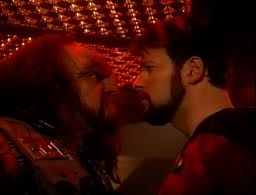
TNG Flashback: A Matter of Honor
Having established in an earlier episode that Riker has an interest in Klingon culture, Star Trek: The Next Generation took advantage of it with the big, Klingon-themed "A Matter of Honor."
We learn of an "officer exchange program" within Starfleet, as a Benzite ensign comes aboard the Enterprise to learn about human customs. Commander Riker decides to participate in the program himself, accepting a temporary transfer to serve aboard a Klingon bird-of-prey. When a hull-corroding bacteria is discovered on the hull of the Klingon ship, the captain accuses the Enterprise of deliberately putting it there, and Riker must find a way to avoid attacking his own former ship.
There's a refreshing simplicity to this episode. It's not about any "big science fiction idea," but is simply an exploration of culture clash. The fact that it uses Klingons to do so is just gravy for many longtime Star Trek fans who enjoy that alien race in particular.
Though I wouldn't count myself among the Klingon enthusiasts, even I found myself enjoying their use here. Their portrayal in this episode is much more rounded and interesting than our earlier taste of Klingons in "Heart of Glory." A particular scene demonstrates that they have a sense of humor, and makes a point of Riker being as surprised at that discovery as we the audience. What's more, it's a different type and tone of humor than the "straight man" comedy often given to Worf (even in this very episode); Klingon humor is more like insult comedy, about keeping people from getting too big a head, and it works very well for them.
Especially effective within the Klingon plot is the character of the second officer, Klag. He's as well-rounded a Klingon as any we've seen next to Worf, with a back story about a disgraced father, plus a character arc of gaining respect for Riker. And it's the fact that the story comes to us through Riker as a lens that keeps it from falling into "too much about the guest star" territory.
What's far less effective is the story of Mendon, the Benzite exchange officer who comes on the Enterprise. His cocky arrogance certainly provides a different tone from the usual atmosphere on the bridge, but his character arc of essentially learning to be cocky in a different way (after a pep talk from Wesley Crusher) isn't a very compelling one. I could have done without this subplot, in favor of spending more time with Riker on the Klingon ship.
The thing that's interesting about Mendon has nothing to do with the character, but rather with John Putch, the actor playing him. He also played Mordock, the other Benzite we met in "Coming of Age," and the episode specifically acknowledges this by having Wesley Crusher mistake one for the other. (Fortunately, Wesley's "all Benzites look alike" declaration, which might have come off as racist, is excused when Mendon himself acknowledges that they actually do.) But it turns out that the repeat casting had nothing to do with a quirk of an imagined alien race, nor was it even about the producers liking the actor from his first appearance. The makeup department already had created the makeup to form-fit the actor in his previous episode, and the show saved money by reusing him and not having to do a makeup redesign for a head cast of a new actor.
At least the money saved there does show up in the episode in other places. We get a ship full of Klingons, for starters, plus some fantastically disgusting Klingon food created by the prop department. There's also a scene in the teaser set on the Phaser Range, a neat visual setting for a conversation between Picard and Riker. (Even though the empty black void surely didn't cost much to produce, the phaser shots and moving targets definitely didn't come for free.)
Other observations:
- Mendon's uniform has a collar on the neck, though it's not quite like what we'd see when the Starfleet uniforms were redesigned for season 3.
- We're told in this episode that part of serving on a Klingon ship is a readiness to assassinate one's superior any time he should show weakness. Worf tries to characterize this as aiding the superior's "honorable retirement," but if you ask me, it sounds more treacherous and Romulan-like to me than noble and Klingon.
- Not all the humor in the episode is Klingon inspired. O'Brien has some great fun messing with Riker just before beaming him over to the Klingon ship.
- It's fun to see Data occupying the first officer's chair while Riker is away.
- Riker knows he has to beat up Klag to earn his respect, though he basically starts the fight by catching Klag off guard with a cheap shot. But then, how else would Riker get the drop on a burly Klingon warrior?
- It's interesting that Riker criticizes Klag for not speaking to his father. We'd learn later in this very season that Riker hasn't spoken to his own father in more than a decade. (Main characters on television shows always have issues with their parents, don't they?)
- This episode boasts another fantastic score from composer Ron Jones. It has everything from intriguing, light tension for the mysterious ship-eating organism to all-out Klingon action music for the final confrontation.
Sunday, February 17, 2013
56 and Counting
A few years back, I watched the seven documentaries of the Up series. These films began in the early 1960s, when a documentary crew in Britain made a short film called Seven Up, which looked at 14 children, all aged seven. The children were taken from a wide variety of educational climates, from expensive boarding schools to lower-class rural schools.
The film posited two major theses. First, it espoused the Jesuit teaching "Give me a child until he is seven and I will give you the man." In short, it proposed that you could tell everything about the future nature of a person from the morals, values, and aspirations s/he exhibits at age seven. Second, it implicitly argued that the class structure of British society was so strict as to render social mobility virtually impossible. A rich kid would grow up to lead an easy life, while a poor kid would struggle to ever rise from the lower class as an adult.
That first film was fairly simplistic, but then something more ambitious happened. Every seven years, director Michael Apted returned to interview the subjects -- at age 14, 21, 28, and so forth. Not only was the initial hypothesis put to the test, but a truly unique form of documentary was invented. The lives of roughly a dozen people were being chronicled through triumphs and hardships, through all of life's major events: births and deaths, marriages and divorces, relocations all around the world, career changes and values changes. In short, the series became truly fascinating.
2012 marked the year all the original subjects turned 56, so late in the year, Michael Apted went back to produce an eighth film in the series, 56 Up. It aired on BBC television a few months ago, and now has come to America for a run in art house theaters. You have to dig deep to find it, but if you've followed the series at all to this point, it's a search you'll feel compelled to undertake.
56 Up is a very interesting film in the series on several levels. In some ways, it represents the first time that nearly all the participants' lives have fully "gelled." A few people have become grandparents who weren't before, which is of course a significant life change. But nearly all of them are living in the same houses they were in 49 Up, with the same people they were with in 49 Up. As these people are now very clearly into the latter half of their lives, the big career changes, emigrations, and other massive transformations seem to have mostly ended. But that hardly means the film is boring. Instead, two major new elements come into play in this installment.
First is the element of "the Second Generation of Up," if you will. I mentioned that many of the series participants are now grandparents. For them, it means adjusting to a new stage of life. But for the audience, it's a chance to see the documentaries original theories put back to the test once more. In past installments of the films (mainly 28 Up and 35 Up), we got to see the children of the Up Children all right around that important age of seven, where the whole thing started. We got to see the type of education they were having, and the type of people they were as kids. And now they are the adults in their 20s, and we're getting to see just what they're turning into. Did they have any more educational opportunities than their parents? Did that translate into any upward mobility? Or do we see a lot of "like father, like son?"
The second major difference of 56 Up is that it feels dramatically more political than any earlier film in the series. Between past films, the lives of the subjects were all impacted by different events. But since 2005 and 49 Up, we've experienced the global financial crisis. That turns out to have been a shared event in the lives of many of the subjects; several have politics keenly on their minds this time around. You hear about it from all classes -- from poor Jackie whose disability benefits have been revoked, to middle-class Tony whose efforts to open a new business completely imploded, to well-off John who fears that the increased building efforts to jump start the economy will permanently destroy the natural beauty of the English countryside. So important is the subject of politics that one subject, Peter, has returned after a 28-year hiatus to appear in this film. His harsh comments on the austerity measures of Margaret Thatcher in 28 Up had an unfortunate fallout in his regular life, but he returns this time to warn against returning to such practices now (and to plug his blossoming band; he's not the first Up participant to use the films to promote other endeavors).
For me personally, there was a third significant difference with this newest documentary. It was the first time I ever had to wait to watch the next film in the series. I only heard about the Up films in 2010, and was able to watch all seven that then existed in the span of a month or so. I've waited a little over two years to check in with these people and see what's developed, and that wait I think made me a bit more introspective about this film than the previous ones. All over again, and in greater detail, I couldn't help but think about my own life at the times documented in these films. Where was I at 7? 14? 21? 28? 35? Where might I be when 42 comes around? Not many films have the power to make a person examine themselves like that.
In fact, I found 56 Up to be the best yet of the series. I give it an A-. And since it was a 2012 movie, that means it finds a slot on my ever-fluctuating Top 10 of 2012 list, taking over the #6 slot. If you've never watched The Up Series, it's definitely a time investment, but I think it's well worth it.
Saturday, February 16, 2013
Heavy Size
I recently watched the documentary that put director Morgan Spurlock on the map, Super Size Me. It's an examination of obesity in the United States, centered around fast food giant McDonald's. I'd only seen Spurlock's efforts in smaller segments of other work, and I was interested to see what he'd do with a full-length film.
The answer, in my view, is that Spurlock is a similar filmmaker to Michael Moore, with a few (not all) of the extremes sanded down. Consistent between the two is a whole-hearted commitment to their subjects, and the desire to insert themselves into their narrative. The main throughline of Super Size Me is Spurlock's own experience eating nothing but McDonald's food for every meal over an entire month. We see his doctor visits, his trips to the restaurants, and the steady (but not slow) decay of his health.
What we don't get as much of is the extreme grandstanding Moore tends to include in his movies. I didn't really perceive any Morgan Spurlock equivalent of ambushing Charlton Heston for an interview, or protesting alone on the steps of some building with a megaphone. Nor does Spurlock so often deploy sarcasm or real anger. And no doubt this is part of why Spurlock is a less polarizing figure that Moore... though the lack of more extreme showmanship also results in a movie that I think functions less well as a piece of entertainment.
Of course, documentaries are meant to educate as well as entertain, and Super Size Me does do a good job of that. I don't think too many people are really unaware of the fact that fast food isn't healthy for you, and Morgan Spurlock even acknowledges this at points in his movie. But he does an excellent job of showing just how bad it is for you, something not widely known before this film, something in fact shocking the physicians he employs in monitoring him during his 30 day experiment.
The film was also made a big impact. Between the time of its film festival debut and its wider release in theaters, McDonald's removed the "Super Size" options from its menu. (Though a) That's not the real point here; and b) they claimed it had nothing to do with the film. Sure.) And while I was hardly ever a McDonald's eater in particular, it has certainly made me try a bit harder to eat less fast food in general. I suppose if I were truly committed to a healthier diet, I'd start learning to cook a wider variety of things, but hey, it's a start.
So, a documentary that's informative and affects a change in the world? That's probably what's most important, even if it isn't as entertaining as some others I've seen. I certainly give it the thumbs up, and grade it a B. If you've never seen it, it's worth the time.
Friday, February 15, 2013
I Do
Glee took advantage of this year's Valentine's Day falling on Thursday to do the big Will-Emma wedding episode... except that the writers chose to leave out the actual wedding.
I don't know that I've ever been as invested in the Will and Emma relationship as I was back during the first season, when I was certainly in anybody-but-pregnancy-faking-psychopath-Teri mode. There have been other good moments here and there since then, but I think I was ready for them to stop playing "will they, won't they" with the couple and have the wedding they were talking about this time last season.
On the other hand, Glee probably served up its greatest dose of realism in a long time by having things unfold the way they did. Will has been gone for what, three months now? And he left his OCD bride during that time to suffer the mental torture of planning the wedding on her own? Yeah, that certainly seems like something is seriously wrong in the relationship. Following through on that by having Emma run out on the wedding seems like a reasonable plot development when examined through that lens. (And it led to Jayma Mays and Amber Riley absolutely killing it on the song from the musical Company.)
There were other good developments this week too. They seem to have finally put the Tina-chasing-Blaine story to bed once and for all, so hooray for that. Seeing Ali Stroker from season 2 of The Glee Project turn up was a nice treat as well; while I definitely thought Blake was the best fit for Glee of those contestants, Ali certainly made a stronger impact than either of the "co-winners" from season 1. I hope they continue her story with Artie a bit and bring her back for another episode or two.
Other stories were a bit of a mixed bag. When it came to the Jake-Marley-Ryder story, the Cyrano tale has been done to death, and hanging a bell on it by referencing it directly on screen doesn't really save it. But while it was kind of boring on paper, it helped that it had some good acting. Blake Jenner was particularly strong as Ryder, showing in my opinion why he was the right pick to win The Glee Project.
But finally bringing Schu back to the show, only to barely feature him in his return episode? Huh? Santana and Quinn having a one-night hookup? Huh? Blaine and Kurt getting back together only for Kurt to insist they aren't back together? Huh? Sue in the duplicate wedding dress, willing to let someone with a mental disorder get caught in the crossfire of her revenge plan (despite the sensitivity she should have to such matters)? Huh? Rachel possibly pregnant, and in a way that's apparently setting us up for a who's-the-father storyline? Ugh.
The vocal performances themselves seemed quite strong to me this week, though nearly all the songs were presented (in whole or in large part) as "on stage" performances, which as always isn't my favorite thing. I still prefer the songs to be a bit more integrated, which is why my favorite moments were "Getting Married Today" (as I mentioned earlier) and the tale end of "We've Got Tonite."
I think all told, I'd call this episode a B. And apparently, that will have to tide Glee fans over for a couple weeks here until the next new installment.
Thursday, February 14, 2013
TNG Flashback: Unnatural Selection
On occasion, Star Trek: The Next Generation would lift a story idea from the original series. Never did they do so as openly as with the first season's "The Naked Now," and perhaps they did not always copy things deliberately. But with the pool of Trek-esque science fiction concepts being only so big, and with The Next Generation structured so firmly in the mold of the classic series (more so than the later spin-offs), repeat ideas were bound to happen. One such idea was that of an "old-age virus," tackled on the original series in an episode titled "The Deadly Years," and on The Next Generation with "Unnatural Selection."
The Enterprise responds to a distress call from the starship Lantree, only to find the entire crew dead of rapid aging. Backtracking the other ship's final days, the crew visits a genetic research facility, finding that their scientists are also undergoing a sudden, unexplained acceleration of the aging process. The genetically engineered children they're developing show no signs of this disease, but may in fact be the cause -- which begins to become apparent when Dr. Pulaski herself contracts the aging virus.
As I mentioned, the "old age virus" gimmick was done first on the original series, and done better too. There, most of the bridge crew contracted the disease, and the drama came from showing the heroes in a suddenly vulnerable position -- particularly Captain Kirk. Here, Pulaski is the sole victim among the regular characters. The episode is trying to use this as a way of humanizing her, but it manages only to feel like some kind of bizarre come-uppance for thoroughly prickly and off-putting behavior.
Even in this episode, before contracting the disease, Pulaski displays no endearing traits. She butts heads with Picard throughout, showing such enthusiasm for the act of arguing itself (as opposed to the topic of the argument) that she doesn't even hear Picard at first when he agrees to one of her requests. In one scene, Troi graciously tries to characterize their personality conflict as a clash of "well-established personalities." That seems to be code for "stubbornness," but there's absolutely no history of Picard ignoring the opinions of his crew and barging ahead unreasonably with whatever he wants to do. (That's an unlikeable trait that the writers of Voyager and Enterprise would end up giving to Janeway and Archer.) It seems that the only way the writers can attempt to make Pulaski likeable is to try and convince us that the other characters we already know are in fact not like what we know them to be. That extends even to Beverly Crusher, not even around to defend herself, when Troi says of Pulaski: "I've never met a more dedicated physician."
All the bad traits of Pulaski already established in previous episodes continue in full force here. When Data helps her out by agreeing to pilot a shuttle for her, she uses the trip to insult him a few more times, speechifying about what it is to be human, and assigning to him a selfishness he has never demonstrated. She continues to steal personality quirks from the original series' Dr. McCoy; here, she picks up his distaste for using the transporter. And she adds outright lying to her repertoire this time too: when Data asks point blank whether Picard approved his piloting of her shuttlecraft, she says he did when in fact Picard approved her putting only herself at risk.
I feel sorry for Diana Muldaur in all this, because I don't think she was comfortable with the direction of her character either. The director of this episode, Paul Lynch, claimed in a later interview that Muldaur had a particularly hard time learning her lines in his episode. It was so bad, he said, that they ended up writing her dialogue on cue cards at times. There's even a scene between Troi and Pulaski where this is boldly apparent; Troi engages Pulaski repeatedly as hey walk down a corridor, while Pulaski just stares straight ahead into space without ever looking back. In my own limited experience, the number one reason an actor struggles with lines is that they aren't connecting with the material. They can't remember what to say, because what they have to say makes no sense to them.
Another Pulaski folly by the writers was giving her an old age story to begin with. Technically speaking, an authentic appearance of old age is one of the most difficult makeup effects to achieve. It's virtually impossible on a television budget and schedule, as demonstrated by the horrible "Too Short a Season." And even when done well, it's usually to make a very young actor appear impossibly old. Here, the story called for making someone of middle age appear elderly. That's an even more difficult effect to achieve, and the results here are silly.
Oddly, while the writers were putting all this push behind developing Pulaski, they did a better job of developing a different character in this episode. For the first time, Colm Meaney gets guest star billing, and his transporter chief gets his name: O'Brien. Given the significance of all this, it's little wonder Colm Meaney once said in an interview how much he liked this episode. But he actually explained his affection in non-selfish terms, saying: "It was a marvelous sort of detective story in a way, while at the same time it was making a statement about the dangers of these wonderful scientific developments that can be used for great benefit. It also said something deeper about the dangers of them, and in a sense it begged the question should we really be trying this?" Wow... that does sound like a good episode! Too bad Meaney was more articulate about the message in two sentences that the episode itself was in 45 minutes.
Just a few episodes into the season, and the series was again trying to save money. The genetically engineered superchildren are all telepaths, an obvious cheat so that it wouldn't be necessary to pay any of the actors to speak. In one scene, Geordi rigs up a special force field, and it's operated by this ridiculously huge piece of machinery that looks nothing like other Starfleet technology -- almost certainly some found item in Paramount's prop storage. Also, the crew suddenly gets the idea to remote access the starship Lantree rather than beam over, to save on the need for an extensive bridge set and space suits to protect from the disease. (Though it is appropriate that the last time we saw a Federation ship accessed by "remote control" was in Star Trek II: The Wrath of Khan; the Lantree here is a reuse of the Reliant starship model.)
Other observations:
- The names of the planetary system and scientific research station in this episode are nice shout-outs to cosmonaut Yuri Gagarin and scientist Charles Darwin.
- Picard lays the most awesome smackdown on Pulaski when he exits Sickbay with the line: "Doctor, God knows I'm not one to discourage input, but I would appreciate it if you'd let me finish my sentences once in a while."
- I don't think Pulaski needed to put Data at risk by having him pilot her shuttle. Couldn't anyone have piloted the shuttle out to a stationary position, then beamed off before she began her experiments?
- This episode sets a terrible precedent (that was wisely ignored in the future) that the transporter could be used to essentially undo any disease by utilizing an untainted DNA sample from the subject. That was definitely too much power for our characters to wield.
- Speaking of precedents, a later episode would establish that genetic engineering of humans, as depicted here, is in fact illegal in the Federation. (And later, it became a major plot point for the character of Dr. Bashir on Deep Space Nine.)
- The doctor running the research station has weirdly white-tipped fingers for reasons that are never acknowledged. They're so white that I thought at first she was wearing rubber gloves, but nope, that's not it. Is it super-bad "bad old age makeup?"
- The Enterprise abandons the Lantree under quarantine early in the episode, only to come back at the end to destroy it. There's a nice ceremonial aspect to the destruction that's effective, but why they didn't do that in the first place makes no sense to me.
Wednesday, February 13, 2013
As the Chrome Flies
This week, Syfy aired the 2-hour Battlestar Galactica movie Blood and Chrome. Conceived of as the pilot for a new prequel series set between Caprica and Battlestar Galactica, the film follows a young William Adama in his adventures as a brash young pilot on his first assignment.
Syfy actually passed on taking this pilot to a full series order. After a brief flirtation with the idea of starting up a direct-to-internet series, this pilot was broken up into 10 installments and serialized online before its broadcast this week as a one-off movie. It sounds like an undignified end for what must have been a poor effort... until you consider the many horrible decisions the network has made in recent years, at least from the perspective of a true science fiction fan. Perhaps failing to pick up Blood and Chrome was only one of the latest?
Or perhaps not. I felt that Blood and Chrome, neither great nor terrible, represented more than anything else an overreaction to the reception of the series Caprica. The great mistake of Caprica may actually have been billing it too much as a Battlestar Galactica prequel. The idea for that series was actually an unrelated pitch from an outside writer, fused together with producer Ron Moore's ideas on a prequel to create a new series. I found the results uneven, though compelling at times. But it certainly wasn't a show that could satisfy the masses. Most Galactica fans, it seems, were engaged by the action rather than the dramatic personal stakes of the characters. But the Caprica spin-off was nothing but the drama.
Blood and Chrome, by contrast, is almost nothing but action. The first third of it, in fact, bobs from one action sequence to the next at a breakneck pace apparently designed to keep you from asking "wait, why are we getting into another fight?" There are some character beats here and there, but they do feel tacked on like an afterthought. As for the plot, it manages to somehow be incoherent and simplistic in equal measure.
But the thing is, damn but the action is exhilarating. Perhaps no series was ordered because the network doubted such thrilling visuals could be delivered on a weekly basis. When it comes to space battles, Blood and Chrome seems to one-up all the best action ever depicted on Battlestar Galactica. It's wild, exciting stuff. And that's only part of the visual feast. Blood and Chrome's sets are almost entirely rendered in CG. It's hardly the first production to do this; Syfy's regular series Sanctuary, for example, has made extensive use of digital sets. But Blood and Chrome seems to one-up past competitors in this area too. It's not that all the environments are 100% credible; no, there are still scenes here and there with slightly off lighting and weight, where the actors don't quite feel anchored in the virtual space. But the bustling environments of the fighter bay, Galactica's CIC (rendered from scans of the original set, before it was dismantled), and more... they still manage to impress.
The two core actors, Luke Pasqualino and Ben Cotton, do a decent job. Pasqualino plays the young Adama, and both he and the director are wise to avoid any attempt at impersonating Edward James Olmos. Plus, throughout the rest of the cast, you'll recognize faces from both Galactica and Caprica; everyone is playing a new role here, but the production clearly went to actors who had worked well in the past. No one quite pops, but I chalk that up more to the frenetic, character-light nature of the script than the quality of the performers.
Would I have continued to sample more Blood and Chrome, had it gone to series? Probably. Am I disappointed it didn't actually get the chance? Probably not. I imagine the flaws could have been improved over time, but I also don't get the impression that this series would have even tried to introduce the elements that made Battlestar Galactica most compelling -- the harsh examination of how people really would behave in a hopeless situation. Blood and Chrome seemed only to want to blow things up good. Though that, at least, it did fairly well. I'd call it a B-. It's real lasting legacy for me will likely be the pulse-pounding musical score by Bear McCreary. It's good to get another dose of his fantastic work on the Galactica franchise, and La-La Land Records has already announced plans to release a CD.
Tuesday, February 12, 2013
ParaNorman Activity
Last year's animated film ParaNorman didn't make much of a splash at the box office. And if my own attitude toward it was typical, it's not hard to see why. Even though many critics had great things to say about the film, it just didn't seem worth going to the theater to catch. I did catch up with the movie on Blu-ray, though.
ParaNorman is the story of a young boy who can see the ghosts of the dead. His crazy uncle dies, revealing that the boy is the now only one who can perform a ritual that will keep a centuries-old witch from sending her zombie minions to devour the town. Heroism ensues.
Every now and then, I've noted that some movies seem to exist mainly to serve as a visual feast. The plot is lacking, the characters are nothing revolutionary, but you've never seen anything so gorgeous. I think that a large number of film critics out there respond to this film-as-visual-art vibe, and that explains the wide praise for ParaNorman. Truly, you've never seen anything so gorgeous.
The visual style of the film is thoroughly thought out, and well executed from top to bottom. The atmosphere is creepy. The use of occasional CG effects to supplement the stop-motion animation is inspired. And the characters themselves are quite the curiosity, too; I've read that the heads were created on a 3D printer, thus making even the stop-motion a revolutionary new blend of computer and traditional animation.
But the style goes too far for the intended audience. I am the last person to ever claim that animated films are "for kids," and I firmly believe that the good ones can entertain a viewer of any age. But when all the major characters of the story are children and teenagers, fighting to save the world and struggling against parents who don't believe them -- you're making a kids' movie. Sure, I suppose every now and then, along comes The Goonies. But the bottom line is, I think this movie is way too scary for most kids of the main character's age. Those breathtaking visuals I mentioned are often quite intense and sinister.
At the same time, the course of the plot is too predictable and not emotional enough to truly satisfy any adults in the audience. (And that's where this movie is no Goonies.) My attention waned as the story hit all the expected beats, and drifted further when the "it's all a big misunderstanding" moralistic message materialized in the final act.
In essence, great new ground was forged... in rebuilding a well-forged path to a familiar story. Your mileage may vary, depending on whether you're a "film-as-visual-art" type, but I found the whole to be an average C.
With the official review out of the way, I want to devote a couple of paragraphs to one aspect of the film that sparked commentary during the film's original run. ParaNorman is the first American animated film to include an openly gay character. In the final few minutes, the main sidekick's older brother, a dumb jock character who has been tagging along in the adventure, casually mentions that he has a boyfriend. It's a punchline that comes not at his expense, but at the expense of the amorous teenage girl who has been pursuing him for the whole movie. It's nice that the character's role in the plot doesn't revolve around his orientation, and that he's not a stereotype (not of gay men, anyway; he's as stock as all the other characters in every other way). But the bottom line is, the revelation is done in a way that's probably only going to serve to piss everyone off.
Many writers for the LGBT community criticized the technique of hiding the character's sexuality until the end of the film. They argued that it was disingenuous to try to "make you care about the character first," and only then reveal him as gay, as opposed to getting that out of the way first, and then showing him on the adventure. At the same time, intolerant parents lodged complaints anywhere that would print them, complaining that they'd brought their kids to see this movie, and weren't prepared at having to discuss sexual orientation on the car ride home. (Ignoring the fact that apparently no conversation about sex would have been necessary about the teen girl throwing herself at the guy all movie. And as if a kid would notice such a throwaway line while they're busy being petrified by the 90 minutes that came before.)
It's a no-win scenario. And for that, I suppose I ultimately applaud the inclusion. It isn't central to the plot in any way, there was nothing to be gained by putting it in there, and indeed only criticisms to be had for including it. And they did it anyway. So... yay? I guess?
My footnote thoughts on a footnote plot point.
Monday, February 11, 2013
Great Ape
On numerous occasions, I've mentioned my love of composer Jerry Goldsmith in reviewing some of the dozens of films he scored. Many critics have noted the injustice that he won only one Oscar in his long career.
One film that's often pointed to as his best is the original Planet of the Apes. I finally got around to watching the movie about a year ago, and I had to agree, Goldsmith's score was one of the best things about the film. It led to me eventually picking up the soundtrack, so I could enjoy the music on its own.
Planet of the Apes was quite a revolutionary score for its time. Films were typically scored with loud, emotion-laden strings and thunderous brass. Apes turned that on its head by shifting the focus to the percussion section of the orchestra. Inspired by the humanoid primates of the story, the music Goldsmith composed is, well... kind of apeshit. It's unrestrained, tribal, and persistent. Where other scores of the era seem to be telling you how to feel, the Planet of the Apes score is just feeling it on its own; whether you get caught up in feeling anything yourself, it really doesn't give a care.
That's not to say that the music isn't melodic. Quite the opposite. But even as strings and horns weave in and out of the chaos, Goldsmith plays with instruments that are both melodic and percussive at the same time. Pulsing rhythms are pounded out in the bass register of a piano, xylophones punctuate key moments, and pitched wood blocks are scattered throughout. There are also bursts from instruments not normally part of an orchestra, strange and foreign sounds that shouldn't fit, but do perfectly.
I still wouldn't place this score above Star Trek: The Motion Picture, nor the one film for which Goldsmith did receive an Oscar (The Omen). Still, film music enthusiasts are right to call this one of the best scores the composer ever produced. I can't believe all this time, it hasn't been in my collection. I give it an A-.
Sunday, February 10, 2013
Hysterical
Quite some time back, I saw Maggie Gyllenhaal in an interview on The Daily Show, promoting her newest film Hysteria. It was a low budget British film, not likely to be in many theaters here in Denver (or at least, any comfortable enough to sit in for two hours), so I put the movie into the Netflix queue and patiently waited for it to make its way to DVD.
The film is a period piece, set in London at the end of the 19th century. The attention-grabbing way of telling you what it's about is this: it's the story of the invention of the vibrator. But what it's really about is a key period in the evolution of women's rights. The "hysteria" of the title, for those who don't know, was a catch-all medical diagnosis for women of the time, a supposed physical ailment to explain away unhappiness really brought about by inequity and societal limitations. And the film goes right to the heart of these issues without being overly preachy.
Hugh Dancy plays a thoroughly modern doctor whose desire to embrace the newest discoveries of medicine has put him into conflict with many other older physicians. He's bounced from job to job, until he winds up in the practice of a doctor played by Jonathan Pryce, a practice that has grown very successful thanks to its interesting... treatment for hysteria in women. Pryce's character has two daughters, the staid and obedient one played by Felicity Jones, and the fiery and spirited one played by Maggie Gyllenhaal. The film chronicles the Dancy character's growing relationship with the two women, as he works with his own best friend (played by Rupert Everett) to revolutionize the practice.
The script is wonderfully clever, and brought to life with skilled direction by Tanya Wexler. She knows how to capture the period without calling attention to it, and seems to hold no element above getting the best performances from her actors. Everyone in the film is superb. Jonathan Pryce is particularly funny as a character who doesn't ever realize he's being funny at all, while Hugh Dancy and Maggie Gyllenhaal make for truly compelling leads.
Hysteria is an especially wonderful use of period storytelling, as it contains many messages still absolutely topical today. Although women got the right to vote a century ago, and have been making grand strides toward equality with men ever since, women's sexuality can still be an oddly controversial topic even today. One look at the firestorms that surrounded people like Sandra Fluke and Todd Akin is enough to illustrate that many people today are sadly not any more evolved in their attitudes than the people depicted in the time period of this movie.
And it's also just a delightfully funny film too.
I grade Hysteria an A-. At this point, my "Top 10 of 2011" list is woefully out of date -- not that anyone would be paying attention to it at this point anyway. But if I were to update it, this movie would definitely be on it.
Saturday, February 09, 2013
TNG Flashback: The Schizoid Man
One of the more successful first season episodes of Star Trek: The Next Generation had Brent Spiner take on the dual roles of Data and his evil brother, Lore. Perhaps the knowledge of that was in the back of the writers' minds when they crafted "The Schizoid Man," another episode that would allow Spiner to embody a different character.
The Enteprise responds to a distress call from a remote world where Ira Graves, a brilliant (and arrogant) cyberneticist, is dying of a terminal disease. Having developed a way to transfer his consciousness into a computer before the moment of death, he seizes the coincidence of Data's presence and transfers his mind into the android instead. As the crew tries to make sense of "Data's" odd behavior, Graves aims to use his new immortal body to makes amorous advances on his young lab assistant. But when he starts to imagine Picard as a romantic rival, will his jealousy and newfound physical strength form a lethal combination?
This episode is a decidedly mixed effort, and I think it started out that way even on paper. I've read that this script resulted when two other similar ideas were combined. The first was the story of a scientist who tried downloading his consciousness into Data -- with the full knowledge and cooperation of the android and the entire crew. The second picked up on a loose thread of back story mentioned in "Datalore," the fact that Data's mind was preloaded with the memories of the hundreds of colonists from the planet where he was found. A woman from that colony was to have come aboard the Enterprise, the romantic object of two rival men stored in Data's memory. Those two personalities were then to have begun asserting themselves, Jekyll and Hyde style, to continue their pursuit of the woman.
If you ask me, that second story would have made for a far more compelling episode than the ultimate result. Jekyll and Hyde, the tale of the enemy within, is a much deeper and affecting story than that of an invader without. Indeed, I think the writers ultimately thought they were still telling Jekyll and Hyde in the finished product. Troi runs a personality test on "Data" at one point in the episode (side note: that's two episodes running where she gets to actually be a counselor!), and reports finding two disparate personalities within him: the Graves personality, and the suppressed Data personality. The problem with that is, we never once see Data pop up after Graves takes him over. There's no apparent struggle for control over the android's body, just the complete dominance of the invading scientist. An actual, crazy Data would have been a far more interesting thing to see.
Another element that drags the episode down is the character of Graves himself, specifically what an unbelievable ass he is. Most of the time, The Next Generation is showing us (or preaching at us through hackneyed monologues) how evolved humans of the 24th century have become. Graves, by contrast, is horrible. He's sexist, clearly treating both Troi and Dr. Selar as objects more than people. He's also racist, making derogatory comments about Klingons and Romulans even though he knows it will anger Worf. Now granted, Graves is of an older generation, and not in Starfleet either, which would explain to some extent why he might not be as much a paragon of virtue as our main characters. Still, he seems a couple hundred years -- not a couple generations -- behind in social evolution.
And how is it that a frail old man, dying of a terminal disease, actually manages to get the drop on Data anyway? I mean, not that Data would beat up a dying old man or anything, but there's definitely a reason we don't see the moment where Graves somehow overpowers Data and downloads his consciousness... because I can't imagine any way that would have made sense.
Science fiction fans can geek out over the casting of the old Ira Graves. He's played by W. Morgan Sheppard, who besides appearing in Star Trek VI and an episode of Voyager, also showed up on Babylon 5 and Quantum Leap. What's more, his son, Mark Sheppard, has made even more memorable appearances on Firefly, Battlestar Galactica, and Supernatural. Sheppard sets up Graves with eccentricities that Brent Spiner then adopts in his own performance when Data becomes "possessed." Particularly effective is a scene where Graves, in Data's body, eulogizes himself at his own funeral; Spiner gives an appropriately ridiculous and entertaining performance.
Oddly enough, another thing that stands out about the episode is the lighting design. There are some subtly different techniques at play in this installment. Particularly effective are two scenes near the end. When Graves (as Data) reveals himself to his assistant in Ten Forward, a sickly green pallor is being cast upon him from below, highlighting the sinister undertones. And in the final confrontation between Graves and Picard (which for reasons I couldn't really tell you, takes place in Engineering), there are very dramatic shadows being cast from the warp core. Even though another confrontation took place here in the episode "Heart of Glory," the lighting there was not as appropriately sinister.
Other observations:
- The opening log entry of this episode is delivered not by Picard, but by Dr. Pulaski. It seems truly random, particularly as she isn't really a significant character in the episode.
- There's a neat little trick achieved with a green screen at the start of the episode, which shows in a single take Pulaski getting into a turbolift on a lower deck and exiting on the bridge.
- In the teaser, Data explores changing his appearance, trying out a full beard. (It's somewhat in the style of Riker's beard; were they having fun with Jonathan Frakes here?) The two people whose opinion Data seeks are his best friend Geordi (which makes sense) and Counselor Troi (who I'm not quite sure why Data would ask).
- This episode guest stars Suzie Plakson, who would show up later as Worf's love interest, K'Ehkeyr. Here, she's a Vulcan doctor named Selar, and she gives a fine performance in the role. It's a shame we never saw Selar on screen again (though I believe she's mentioned several times again throughout the series).
- There's this minor dramatic moment made of executing a "near-warp transport" in the first act of the episode, but I'm not sure what the point of it was. The moment doesn't really go anywhere, either in this or any subsequent episodes.
- I find it interesting that Data, not Riker, leads the Away Team in this episode. Did the writers somehow think that Riker's presence might have been a story problem somehow?
- Troi states that she can sense Graves' emotions emanating from Data. So there's some minor social commentary on the nature of what emotions are, and also on how Troi's empathic sense functions. Apparently, computer mechanisms don't stand in the way of creating or perceiving feelings.
- In an episode of lackluster music, composer Dennis McCarthy delivers one uncharacteristic, 10-second burst of awesome during the scene where Data/Graves takes Troi's psychological test. It's a truly wild and interesting couple measures of music, though it sticks out badly from everything else in the episode.
- It's rather unbelievable that Graves isn't motivated to give up Data's body after he accidentally injures his own lab assistant, but does decide to do so after injuring Picard, his perceived romantic rival.
- Data is apparently a very advanced computer indeed. Though Graves retains his full self inside Data's mind, when he transfers himself into the Enterprise computer at the end of the episode, we're told his knowledge now exists without consciousness.
- The man who ran the writing staff at this time, Maurice Hurley, hates on this episode big time. Granted, it truly isn't very good, but Hurley referred to it in a later interview as "science fiction bullshit," and claimed it did irreparable harm to the character of Data... as though somehow Data were responsible for anything he did while Graves controlled him? If you ask me, Hurley doesn't seem to be displaying much understanding or respect for the "science fiction bullshit" he's supposed to be in charge of creating. I think it was best for everyone that he left the show after this season. (And I think it's no coincidence the show got much more consistently better as soon as he did.)
Friday, February 08, 2013
Diva
This week's Glee wasn't exactly bad, but I did think it was a bit of a tough one to love if you haven't really believed in some of the character choices the writers have been making lately. I do give them credit for sticking to their guns and having a little consistency from week to week; that's something I think Glee was really bad at for a long stretch. Still...
The whole Tina-Blaine relationship kind of feels like watching a car crash in progress. It's just uncomfortable that those most significant storyline Tina has received in more than a year has her doggedly pursuing an unattainable guy. Normally, I'd think Finn kissing Emma would be the most uncomfortable moment in an episode, except that we watched the whole creepy VapoRub scene. (Speaking of which, the Finn and Emma moment seemed like such a contrived wrinkle for just one week before we're supposed to see the big wedding.)
The Brittany-Sam relationship is somewhat easier to watch, but bringing in Santana for the love triangle felt like replaying a beat already covered earlier this season. Santana already went through the "if you love someone, set them free" moment, and yet still teleported back from New York (great commentary from Sue Sylvester on that) briefly before deciding to relocate there.
The aspect that worked best for me in the episode was Kurt and Rachel's Diva-off. I think Rachel's suddenly sky high confidence would have played better this week if we hadn't seen her doubting herself with the nude scene just a week ago, but it was still nice to call back to the first season's "Defying Gravity" episode. I was led to expect that Rachel would somehow realize she should throw this competition as Kurt threw that last one, and was pleasantly surprised that they went another route instead.
As for the songs this week, I thought they were pretty good. Though I didn't feel like any of them had truly strong emotional relevance to the story, the performances were nevertheless effective across the board. Santana's numbers were particularly powerful, both in the vocals and (in the choir room number) the choreography.
All told, I'd give this one a B-.
Thursday, February 07, 2013
A Bit Pitchy
I've never seen the competitive cheerleading movie Bring It On (though I imagine I'll get around to it eventually). But from everything I have heard about it, if you were to combine it with Glee, you'd wind up with last year's Pitch Perfect.
Pitch Perfect is a comedy set in the world of college a cappella. Teams are competing to make it to the national stage, battling both each other and personality conflicts within. Hilarity ensues. Well, maybe not "hilarity," but... amusement?
It's possible you'll recognize some of the faces in the film. Anna Kendrick was in Scott Pilgrim vs. the World. Adam DeVine is part of Comedy Central's bizarre Workaholics. Anna Camp has had memorable recurring roles on Mad Men and The Good Wife. If you're into the Broadway theater scene, you may have caught Skylar Astin in Spring Awakening. But most critics singled out Rebel Wilson (who also appeared in Bridesmaids) as the one who ran away with this film with her no-holds-barred character of "Fat Amy."
The whole of this film is greater than the sum of its parts. There aren't a ton of laugh-out-loud moments. The staging of performances doesn't quite knock your socks off. The plot is rather predictable. But it all blends into a cocktail that is pretty fun. It keeps a smile on your face.
The song choices and arrangements are solid throughout. There are some inspired mash-ups that actually work (and anyone who has read my Glee reviews will know, I'm not usually a fan of mash-ups). Plus, because the main group in the story is all female, the sound of most of the songs is quite different from most a cappella music.
There's also an entertaining runner of two competition commentators, played by John Michael Higgins and Elizabeth Banks (the latter of whom is also a producer on the film). The schtick they do is perhaps along the lines of Gary Cole and Jason Bateman's comedy in Dodgeball, but it's still a gag that works.
In all, I wouldn't say it's a must-see movie, but if you feel at all inclined to check it out, I'd wager you'll be entertained. I give it a B.
Wednesday, February 06, 2013
These Are the Songs of the Voyages...
Even occasional readers of my blog will have picked up on the fact that I like Star Trek, and will probably also know of my love for the musical scores composed for the series and movies. A couple years ago, La-La Land Records produced catnip for folks like me, in the form of The Ron Jones Project, a massive box set of every Star Trek: The Next Generation score written by the series' best composer. Now the company has taken things one step farther by releasing the real Holy Grail of Star Trek Music -- Star Trek: The Original Series Soundtrack Collection.
Returning to all the original master recordings from the 1960s, this 15 CD collection offers every note of original music ever composed for the three seasons of the original Star Trek series. Every. Note. That includes numerous alternates and outtakes, and all the sound effects that were created by means of musical instruments. (Did you know that the iconic transporter sound was originally conceived of as the background noise of an alien planet's atmosphere? I didn't!)
Star Trek was a series on a small budget, and so their contracts with the composers allowed for the reuse of music in other episodes besides the ones for which it was originally created. Out of 79 episodes produced, only around 20 received complete original scores. Another handful had "partial" scores, a few minutes of original music created to supplement the "library music." But the majority of the episodes were scored with reused tracks from other episodes. It saves this from being a 50 or 60 CD collection, and also accounts for why so much of this music will be familiar to you.
And I guarantee, it will be familiar. Even if you've only caught a few Star Trek episodes here and there, you'll have heard some of the iconic themes that cropped up again and again. Some of them, like the famous "Star Trek fight music," seeped into popular culture, being parodied in other movies and TV series. Even if all you know is the theme song, this collection will make you realize how many subtly different versions of it were recorded over the run of the show -- versions emphasizing the soprano vocalist, a cello, and more.
I had always associated two composers most strongly with the sound of Star Trek. There was Alexander Courage, who wrote the theme and composed for the earliest episodes, and Fred Steiner, the most prolific of the series' composers, who even worked on one episode of Star Trek: The Next Generation. This soundtrack collection has made me realize that it's actually the work of other composers that I was enjoying most in the show.
The real rock star, in my newly reformed opinion, is Gerald Fried. He's the one who scored "Amok Time," creating both that famous fight music I mentioned, and the distinctive bass guitar theme for Mr. Spock. His music for "Catspaw" was also often cited throughout the series, and his work on "Shore Leave" was a standout of the first season. If you can hum any bit of music from classic Star Trek other than the theme, I can almost guarantee you it's the work of Gerald Fried.
I also came to appreciate the work of Sol Kaplan. He worked on only two episodes, "The Enemy Within" and "The Doomsday Machine," but in those episodes he created some of the most intense and exhilarating music of the series. His music for the latter was particularly effective, and in fact so strikingly similar to the John Williams' later score for Jaws that you have to wonder if some subconscious copying took place there.
If Star Trek's lighter moments were your favorites, then you'll probably recognize the work of Jerry Fielding, who scored "The Trouble With Tribbles." Or if Star Trek makes you think of brazen, romantic (and yes, a bit over the top) strings, you're probably thinking of Joseph Mullendore's work on "The Conscience of the King," or George Duning's scores for "Metamorphosis" and "The Empath."
In all, nine composers wrote for Star Trek, and they're all represented here. I have found the box set a wonderful addition to my iPod; virtually every track that comes up on the shuffle is a winner that takes me back instantly to a moment from an an episode burned into my memory. It's a collection no Star Trek fan should be without. That said, it's a collection some Star Trek fans may have to be without, because it doesn't come cheap. Remastering some 15 hours' worth of music from 45 year old tapes was a massive undertaking, and was done without cutting any corners. As such, La-La Land is charging $225 for the set. That comes out to a not-unreasonable $15 per disc, but it is a hefty sum to shell out all at once.
Still, I'm here to tell you that if you remember this, or this, or this, you want this set, now. There are a few tracks that I find a little too sedate to listen to outside of an episode itself, but I'd still give the set an A- overall.
Tuesday, February 05, 2013
A Brave Old World
I recently caught up with last summer's new film from Pixar, Brave. This is also the film that many are predicting will win the Oscar for Best Animated Feature this year, so I was eager to see how it stacked up compared to the fairly well-done Frankenweenie. As it turned out, while I did enjoy Brave (considerably more than the lackluster Cars 2), I would actually give the edge to Frankenweenie by a bit.
It's hard to believe after a dozen other films, but Brave is Pixar's first to focus on a female character. Scottish princess Merida is rebellious against her mother the queen's plans for her, preferring a tomboyish lifestyle alone in the countryside with her horse and her considerable bow skills. When Merida happens upon a mysterious old woman who promises a way to make the queen change, she seizes the opportunity without realizing the sinister undertones in the offer. Adventure ensues.
Brave does return to Pixar's winning formula of emotionally ripe, character-driven stories. Cars 2 fell flat by being essentially devoid of any emotional content. Brave at least puts its heart in the right place, centering on the strained relationship between a mother and daughter. But that said, it's not a relationship that feels quite as deep as those presented in, say, Up, Finding Nemo, or other Pixar greats. Brave's story winds up being as strong as it is not because of what's on the script page, but because of the excellent efforts of the animators (who inject the mother with great expressiveness, even after her "change" occur).
If anything, Brave feels a Disney film -- perhaps fitting, as it's one of the first Pixar films conceived of and executed entirely after the company's full acquisition by Disney. Merida is even literally a "Disney princess." That's not to say that anything about the film is done poorly. Quite the contrary, actually. The visuals are incredible, with sweeping Scottish landscapes and cleverly designed characters. The voice actors are well cast, particularly Kelly MacDonald as Merida, and Emma Thompson and Billy Connolly as her parents. It's just that it all feels a bit conventional. Despite the different trappings (which you can never forget about, given the thick accents), this feels like a movie you've seen somewhere before.
I give Brave a B. It's certainly an improvement over Pixar's last effort, but it falls well short of the studio's many greats of years past.
Monday, February 04, 2013
TNG Flashback: Loud as a Whisper
I've noted in recent reviews of Star Trek: The Next Generation that the Writers' Strike of 1988 left the series desperate for scripts to put into production early in its second season. That made the writers look for stories in places they otherwise might not have considered, and sometimes that yielded positive results. One such case was the episode "Loud as a Whisper."
When two factions on a warring planet are looking for an end to centuries of conflict, they ask the Federation to deliver to them a famous mediator named Riva. The Enterprise picks him up for transport to the peace talks, learning that he was born deaf, and communicates telepathically through the use of three interpreters that serve as his "chorus." When that chorus is killed during opening negotiations by an angry dissident, Riva is left with no means to complete his mission, or even to communicate with the crew.
The idea for this episode came from Howie Seago, the actor who played Riva. Deaf himself in real life, and an advocate for other deaf actors, he approached the Star Trek team in the hopes of finding a place to portray a character who would help dispel stereotypes about the limitations of deaf people. The writers were quite receptive to the idea, and created this episode for that purpose.
But Seago's key role in the creation of the story didn't end there. I have read that in the first draft of the script, the connection with Riva's chorus was technological in nature rather than telepathic. The crisis of the episode was not the murder of the chorus, but the malfunctioning of the device that facilitated their communication. And in response, the character of Riva was to have learned to speak in a day to carry on his negotiations. Howie Seago himself suggested the alternative ending -- just one day before filming on the episode began -- that was ultimately used: that Riva comes to realize he can teach the warring factions sign language, helping them learn to communicate with one another as they learn to communicate with him.
This is really the essence of Star Trek right here: overcoming personal obstacles to serve the greater good, in this case to literally make peace. These are the "Roddenberry ideals" often praised in academic discussions of the original series, and this subject really is tailor-made for an episode of The Next Generation.
That said, the integrity and power of the concept is a bit loftier than the results. A lot of that stems from some strangeness in the character of Riva. He's supposed to be a great diplomat with a long track record (which, despite his apparent age, somehow includes negotiations between the Klingons and the Federation, we're told). But he's quite arrogant and a bit of a horndog. He doesn't ever seem to show much interest in what anybody else wants to say to him, even interrupting people with regularity. It's hard to believe a man of such character would have any kind of successful career as a diplomat.
And then there's the matter of his deafness, which somehow isn't mentioned in his profile, and isn't known to anyone despite his supposed fame; our heroes are all quite surprised to learn of it. (Though they do deal with it and immediately move on in a refreshingly nonchalant way.) Riva's chorus is also a bit awkward, coming off a bit more science fiction than it really needs to be. Does he really have to have three people, each one to represent a different aspect of his personality? Wouldn't one interpreter have been fine, both practically within the story, and for the realities of producing a television series? (Certainly, it would have been more believable to depict one person getting killed rather than three all in one shot.)
Still, Riva is at least a real enough person to be sympathetic when his chorus is killed. It's easy to imagine his frustration and isolation at that point. It's actually an intriguing mental exercise to imagine an analogous situation. Would it be like a hearing person suddenly being struck deaf? Something even more traumatic?
Of course, my perennial complaint about episodes with major guest characters is that they often lose sight of the main characters. Fortunately, this installment steers mostly clear of that hole by including a good story arc for Troi. It starts off weak, appearing to be a romantic storyline between her and Riva, but transforms into something much better after the chorus is killed. Troi gets to show off her counseling skills, pushing Riva's buttons in just the right way to get him excited to try for peace again. This pivotal scene is even set up and paid off well in the episode too: an earlier scene has Troi noting how difficult it is to restore someone else's self-confidence, while the concluding scene of the episode is a nice moment where Picard compliments Troi on a job well done.
Brent Spiner has some good moments in the episode as well. This isn't a big Data episode, but the character does learn Riva's sign language and becomes an interpreter after the loss of the chorus. Spiner walks a very fine line that sets up a moment where Riva notes that the android can't convey the emotion of his words adequately; Spiner's delivery has in fact been more monotone and emotionless than usual for Data, but not to an extent where it feels suddenly out of character. That said, there's also some bad editing that leaves Brent Spiner hanging in some scenes, as it often appears that he's "translating" words that Riva hasn't actually signed yet.
There's also a go-nowhere subplot for Geordi, a scene where Dr. Pulaski advises him about the possibility of a surgery to give him normal eyesight. You'd think as long as Pulaski has been on the ship by now -- having specifically interacted with Geordi in that time -- she'd have mentioned, "by the way, I can cure your blindness." (Unless it's not just Data she enjoys being a jerk to.) We're denied any wrap-up moment of Geordi making a decision; he just says he'll "think about it," and then nothing ever happens. Perhaps worst of all, in my Pulaski-hating mind, I feel like the scene is a roundabout way of spitting on the "grave" of the departed Dr. Crusher, who specifically told us in the first episode of the series that she could do nothing for Geordi's condition. (Pulaski's a better doctor, get it?)
Actually, I've read that the truth of this scene is that Levar Burton was actively lobbying the writers and producers to let him stop wearing a hair barrette on his face, so that he could make use of one of an actor's most powerful tools: his eyes. This scene was a way of setting up the possibility of actually curing Geordi's condition, and was placed in this episode because of its dramatic reflection on the main story involving deafness. Burton would ultimately realize the inspirational power of this aspect of his character, however, deciding to keep the VISOR through the run of the series.
Other observations:
- There are bizarre pacing issues in parts of the episode. The teaser, for example, ends not on a moment of tension, but on Picard, Troi, and Worf simply beaming down to find an empty room. Is that supposed to be spooky? There's also an odd bookend device of Picard geeking out over the strange orbital path of some random planet. It leads to a truly bizarre discussion of astrophysics between he and Riker than neither goes anywhere nor has any metaphorical connection to anything else that appears in the episode.
- There's another Picard/Riker scene that's as neat as the planetary orbit scene is strange, though. It includes Picard accusing Riker of being a "Mother Hen," and later has Riker delivering a rather lofty soliloquy that prompts Picard to comment: "isn't that my speech, Number One?" Very fun character moments for both.
- There's a moment where Worf says that Klingons didn't even have a word for "peacekeeper" until Riva came along. I can't decide if I think that's silly, or a cool commentary on Klingon culture. I'm less on the fence about a later moment where Worf admires sign language for its possible uses in communicating covertly. That's just fun. That's our Worf.
- In most of the scenes involving Riva's chorus, the chorus stands behind Riva himself. It's a purposeful staging used to remind the audience of who is really supposed to be speaking. And yet, remembering that actor Howie Seago is actually deaf, I had to marvel a bit at the "choreography" involved. He's very expressive with his face throughout the episode, and is having to time those expressions to match dialogue he can't even hear or follow because the speaker is behind him.
- There's a moment in the episode where, on a planet surface, Worf orders "seven to beam up." This totally geeky part of me just wanted to see what the arrival -- on the six person transporter pad -- would have looked like.
- The warring aliens are armed with almost comically large weapons. Just sayin'.
Sunday, February 03, 2013
Frightfully Good
I never saw the original version of Fright Night. But there were enough small things going for last year's remake to add up to enough to make me curious. Chiefly, the new script was written by Marti Noxon, a writer who came up through the school of Joss Whedon (on Buffy the Vampire Slayer), and learned about writing effective horror laced with subversive comedy. But I also thought actor Anton Yelchin was good in Charlie Bartlett, and as Chekov in the newest Star Trek. Casting Colin Farrell as a smiling, seductive psychopath (never mind the vampire part) is only natural. And even never having watched one Doctor Who starring him, I still love David Tennant.
Indeed, a movie that could easily have turned out to be cheesy was actually quite fun. Well, I should say also quite fun, because it is still cheesy in parts. The CG-distorted vampire faces are a little too far over the top, more cartoonish than scary. And there are also about four or five conspicuous 3D gags forced in, as though that justified the upsell from an otherwise thoroughly 2D movie.
But aside from those shortcomings, the movie is quite enjoyable. Anton Yelchin is indeed a young hero easy to root for, who makes only some of the "stupid hero decisions" common to these kinds of movies. Colin Farrell seems to be loving his role as evil vampire Jerry, almost breaking down the fourth wall with his glee. And David Tennant is fantastic as a Russell Brand-ish kind of character that chews the scenery with relish.
Toni Collette is also in the cast, almost adding a degree of legitimacy to the proceedings. She plays the hero's mother, and as I normally associate her with more dramatic roles with some heft, her presence here almost elevates the film. Christopher Mintz-Plasse -- best known for Superbad and Kick-Ass -- plays the close friend of the hero, first to suspect the vampiric menace. He's well-used in the film, in a way that makes me look even more forward to the now-filming Kick-Ass 2. There's also a fun cameo appearance by Chris Sarandon; even though I never saw the original film, I appreciated the nod to it. (And who doesn't enjoy seeing Prince Humperdinck?)
As horror movies go, I'd call this one of the better ones. That said, there's nothing vastly different here that's going to make someone who doesn't like the genre appreciate this. I give it a B+, and a recommendation if you enjoy a fun horror movie.
Saturday, February 02, 2013
A Long Awaited Choice
Author Terry Brooks is continuing the most prolific period of his career. He has a complete trilogy unfolding in a twelve-month span, and a series of short stories interspersed between those novels. The second of those "Paladins of Shannara" short stories was recently released, The Weapon Master's Choice.
This story focuses on Garet Jax, arguably the most popular character Brooks ever created. Though Garet Jax appeared in just one book, The Wishsong of Shannara, fans were so enamored that Terry Brooks later crafted a novella around him. Indomitable was based on just the possibility of seeing the character again, and didn't even deliver the "actual" goods. Now comes The Weapon Master's Choice to fulfill the promise.
Set some unspecified time before the events of Wishsong, this short story has a mysterious woman approaching Garet Jax to secure his skills in rescuing her distant and unknown village from an evil invader. She's clearly hiding something from him, but Jax is intrigued enough to accept the task anyway. A brief adventure follows, in which we get to see the Weapons Master in action.
The story isn't revolutionary, but few writers can pull off something truly profound in the short story format. Brooks himself has acknowledged that novels are his medium, and that this series of short stories have been a sort of experiment for him. Still, this is an entertaining story. It contains some of the elements that are typical in a Terry Brooks story, but weaves them together for a conclusion that's rather unconventional for him. And along the way, his writing style is brisk and easy to read as always.
Overall, I liked this story a touch better than his previous one, Allanon's Quest. Brooks has said he intends at least one more in the series, and it will be interesting to see what character he focuses on. Garet Jax and Allanon were almost mandatory, given the passion of his fan base. Perhaps in the next volume, he'll focus on a character that ignites his passion more. But this one is still a fun read for his longtime fans. I give it a B+.
Friday, February 01, 2013
Naked
Glee picked up a bit this week, but in part just because it wasn't hard to top last week's mess. Writer Ryan Murphy seemed to have come up with this episode mainly as an excuse to make eye candy of his male cast members, but a few moments of brain candy snuck in too.
At first I wasn't quite feeling the conceit of Rachel literally talking to herself, but then the double diva rendition of "Torn" turned out to be one of the better numbers on the show in a while. It had creative staging, and it was fun to compare "college style Rachel" and "high school style Rachel."
I also wasn't really going with the Sam plot this week at first. I feel like I remember a time when the show didn't play him as being dumb like a male Brittany, but at least they've now gotten some decent material out of going all the way down that road. It was nice to see Emma back for a bit, having a moment on screen that didn't have to do with Will, and doing some actually counseling of a student that didn't involve a jokey pamphlet. Plus, the video montage Blaine assembled for him was sweet (even if the three seconds of Mercedes did make me think it's been far too long since we've seen her on the show in any meaningful capacity).
Of course, Rachel wasn't going to go through with the nude scene, and of course she had to make a big diva scene in deciding to back down. That all would have been a total yawn for me, except for the fact that the subplot brought Santana and Quinn to New York. I haven't missed the latter much, though I've certainly missed the former. And it seems like they were setting up for her to relocate to New York, and hopefully become a more regular fixture on the show again.
The rest of the episode was pretty lightweight, but it was an enjoyable enough kind of fluffy once you overlooked the fact that Sue was actually probably right on this occasion -- it didn't seem quite right for Finn to be pushing the sale of a calendar of shirtless pictures of students.
I'd call this one a B-.
Subscribe to:
Posts (Atom)