Wednesday, April 17, 2024

Slice of Cake (and Fionna)

A few months back, I wrote about the animated series Adventure Time. Over the course of 10 seasons and nearly 300 episodes, the show presented the endlessly entertaining exploits of Jake the Dog and Finn the Human through the fantasy world of Ooo, picking up surprising pathos and stakes along the journey.

A hallmark of Adventure Time was the truly weird subplots it would indulge and allow to become the main plot for entire episodes. One of these goofy larks involved the characters of Fionna and Cake, gender-swapped facsimiles of the main characters who appeared in literal fan fiction written by one of the other characters in the show.

I hope that brief description is enough to give you sense of how strange it was to hear that a brand-new Adventure Time spin-off series debuted in 2023, Adventure Time: Fionna and Cake. There had been a few episodes of the original Adventure Time that were, beginning to end, the Ice King's fan fiction about these characters. So I supposed this new series would be just that all the time. Fair enough, I thought. Adventure Time was always clever and enjoyable, including those "alternate universe" episodes, so sure -- sign me up for more Adventure Time!

But the Fionna and Cake series is so not that, it's hard to wrap your head around. It's different in almost every conceivable way. The format is half-hour episodes, rather than the 15-minute eps of the original series. It's an explicitly dramatic show telling a serious story; OG Adventure Time certainly had its serious themes at times, but was fundamentally a light and comedic show. Strangest of all, Fionna and Cake is not a fiction-within-a-fiction, but somehow pulls off being an actual sequel to the events of the flagship series. (How this happens is best left to discover for yourself when you watch it.)

Most of the Adventure Time cast returns to voice their characters in Fionna and Cake. (Or versions of their characters.) The small handful of actors who don't return have their roles handed off to performers definitely trying to impersonate the originals. And it's important to attempt this sort of seamless continuity with the original series... because the show is otherwise asking a lot of its audience.

If the original Adventure Time was a show originally intended for a young audience, and slowly grew into a more "young adult" show as its audience grew up along with it? Then Fionna and Cake is a show made for those now-adults. It's a single serialized story told over 10 episodes. (In fact, it's so serialized and feels so complete that I'm not sure where they'll go in the announced season 2.) It's the tragedy mask to Adventure Time's comedy mask, though every episode still has the potential to leave you with the "what did I just watch?" feeling that often concluded an episode of the original.

Having watched the whole season, I struggle to say how much I actually liked the spin-off. I mean, it was good television. I didn't enjoy it as much as the original, for sure. But also, comparing the two is to compare the proverbial apples and oranges. You can respect the creative choice to come at a spin-off this way, to say "ok, but we're not going to give the audience what they'll expect in a spin-off."

Call season 1 a B overall? What I can say for sure is a) that anyone who finishes the original Adventure Time probably owes it to themselves to check out this radical departure; and b) this sequel probably doesn't resonate if you haven't seen the original. (Which I know sucks for them trying to grow a new audience, but hey... there it is.)

Tuesday, April 16, 2024

Civil Discourse

I haven't loved everything by writer-director Alex Garland, but he has made enough things that really wowed me that I felt compelled to check out his new movie, Civil War. Set in a war-torn America in the final days of a massive conflict, the story follows photo journalist Lee Smith and her partner on a mission to reach the autocratic president and interview him before his regime collapses. Along for the ride are an older journalist and mentor to Lee, and young Jessie, who aspires to do what Lee does -- but has never truly witnessed the horrors of war in person.

Alex Garland set an impossibly high bar with Ex Machina and Devs, so I know I shouldn't be expecting something that good every time I see his name in the credits. In fact, this isn't even Garland's first trip into what you could brand as an "apocalypse," as he wrote the script for 28 Days Later. But it does seem like Garland's first run at "realism." Civil War does not concern itself with the premise of "how we got here." It simply puts us there, in a war zone that also just happens to be the (formerly) United States.

The resulting movie is just vaguely science fiction (to the degree it reads as "alternate history" in the present), but much more akin to a movie like The Hurt Locker. This is a story about the kind of person who took the infamous Saigon Execution photo, and it wants to be as visceral as fiction can be in capturing that feeling. Civil War effectively keeps the audience on edge by seesawing back and forth: much of the time, it could be a story set in any war zone, foreign and remote in the way that frankly most Americans think of most wars; then it has a moment tailored to remind the audience that this is all happening "in your neighborhood."

In being a movie about a particular kind of driven professional in a war -- a type of person doing a job you probably haven't thought much about -- this movie succeeds. It's often visceral and shocking, and makes you reconsider war in interesting ways. But it also feels like there's an entire story the movie isn't telling and isn't interested in telling. "Civil War" is a misleading title, because that isn't the story here; it's only the setting. The movie has absolutely nothing to say about autocracy, "brother against brother," or how normal "life goes on" in the midst of a conflict. It's fine that this simply isn't the story Garland wants to tell, but it's the story I personally would have been more interested in.

Kirsten Dunst makes a solid and stoic protagonist. Wagner Moura is an actor I don't recall seeing elsewhere, but he takes on the more emotional character in the pair, and gives a solid performance. Most other key roles are filled with actors Alex Garland has worked with before, including Cailee Spaeny, Stephen McKinley Henderson, Sonoya Mizuno, and Nick Offerman. There's also a chilling uncredited performance by Jesse Plemons (who reportedly replaced another actor who dropped out at the last minute).

Civil War can be a hard watch. Whether you think it's "can't miss" is much tougher to say. But I give it a B. Interestingly, Garland says he now plans to pull back on directing and focus more on writing. I'm curious to see what results from that renewed focus.

Monday, April 15, 2024

Discovery: Jinaal

The farewell season of Star Trek: Discovery continues with "Jinaal."

Discovery travels to Trill for the next piece of their galactic puzzle. Culber agrees to serve as a host in a zhian'tara ritual so that Burnham and Booker can get the information they need. On the ship, Rayner has been ordered to meet the crew, and Tilly is dismayed at the way he seems to skirt the spirit of that order. Meanwhile, Adira and Gray confront the state of their relationship, while Saru and T'Rina prepare an announcement regarding theirs... which T'Rina's aide tries to forestall.

Lots of story lines in this episode mean that it's perhaps a bit overstuffed. But it also means that no matter which elements of the show you enjoy best, there's probably something for you somewhere in this episode. For my money, the continued RPG quest, bringing a clash with CG monsters and a predictable test for the heroes, wasn't the most engaging part of the episode. Still, there was fun to be had, thanks in large part to Wilson Cruz's fun, swaggering portrayal of the Trill Jinaal.

I continue to enjoy the abrasive nature of the new Rayner character. Sure, his "hardassery" was dialed up to the max this episode, but that just serves to highlight how different he is from the more emotional crew of Discovery, to make the gap between them that much wider to bridge. (Though perhaps there's something interesting in the fact that Discovery really seems to accept all types of people, but not someone whose instinct is to be "all business." They're huggers, the Discovery characters, and you're just going to have to let them hug you.)

I was least engaged in the Adira/Gray parts of the episode, but mostly because I felt like this had largely been resolved when they separated physically last season. Them separating emotionally here didn't seem as weighty -- especially when neither Culber or Stamets, they're "parental-ish" figures, couldn't be bothered to care about it either. (Though I love that Stamets' indifference allowed Jet Reno to step up and fill the gap. Give me all the Tig Notaro that you can possibly stuff into this last season, please.)

While the Saru / T'Rina story really had nothing to do with the ongoing galactic-level concerns of the season, I enjoyed it nonetheless. Indeed, it was really my favorite part of the episode. I continue to just be entertained by them as a couple, but I especially enjoyed seeing Vulcan conflict resolution on display. I also liked the show wagging a finger at mansplaining: T'Rina understood the politics of the situation better than Saru or her aide.

Plus, as a fun garnish on the episode, there were lots of great deep cut references sprinkled throughout -- fan service done right in that none of it was required background to follow the story, just things for you to notice (or not) and smile at (or not). My personal favorites were the mentions of tongo, the order of a Slug-o-Cola, and the appearance of a Selay alien in a makeup that didn't look stupid.

For me, it all works out to giving "Jinaal" a B+. I feel like the season is slowly warming up.

Friday, April 12, 2024

Voyager Flashback: Flesh and Blood

Star Trek: Voyager served up three two-part episodes in its final season. (Four, if you count the resolution of the season six cliffhanger.) The first of those originally aired as a single, two-hour event: "Flesh and Blood."

When Voyager responds to a Hirogen distress call, they find a station that was overrun by the holograms the Hirogen were hunting there. Lamenting her prior decision to give the Hirogen holographic technology, Janeway sets out after the escaped holograms. The Doctor feels a kinship with these holograms, finally free to pursue their own lives and start their own culture -- and he even turns against Janeway and the Voyager crew to help them. But the holograms' leader, Iden, may be a false prophet, pursuing an agenda the Doctor cannot endorse.

I suppose there are lots of reasons that an episodic television show might choose to stage a two-part episode -- including purely financial ones. But if there's any artistic integrity in the endeavor, surely it must be because you have a story to tell that would feel too compressed in the traditional one-hour format. "Flesh and Blood" gets two hours, and yet feels just as rushed and illogical to me as it would have been had it been stuffed into a single hour. I'm hard-pressed to point to a single character here who follows a logical arc of behavior from the beginning to the end of the story. Everyone is at the whims of a story that has a schedule to stick to. Every plot twist is utterly predictable, and yet simultaneously feels completely unearned.

Janeway is usually willing to be diplomatic and give the aliens of the week every benefit of the doubt, but here she decides immediately that these holograms are irredeemably violent and ought to have their memories excised. It's an artificial plot move solely to motivate the Doctor to "mutiny" against her. And in the end, she abruptly changes her mind and decides that the holograms are fine as long as they have a "supervisor" in the form of the Hirogen Donik (even though he was there when they rebelled and escaped the station the first time).

A few seasons ago, B'Elanna was so opposed to a hologram who looked like a Cardassian that she said she'd rather die than interact with him; what's changed since then that she can now come to accept the holographic Cardassian engineer she meets here? It's another artificial move -- necessitated because someone has to come to accept the holograms as people, and the story structure means that can't be Janeway.

The guest characters of this episode don't behave any more logically. The audience is made to feel sympathy for Iden when he engages in Bajoran prayer; yet not long later, he is decrying all organic culture as anathema, and eager to start his own holographic culture. Why the abrupt change? Because he can't be exposed as a megalomaniac until after the Doctor has made the mistake of joining him. Then, of course, he's free to become cartoonishly evil.

There are at least elements of the narrative that are interesting. The oppression of these holograms is palpable, and the notions that they were specifically made to feel pain when they don't have to (because "prey" must feel pain), and that they've been killed and revived over and over again with their memories intact -- these are particularly effective details. In the character of Donik, you're introduced to the idea that the Hirogen really didn't even have engineers like him until they were given holotechnology. And it's clever that holograms could settle on a traditionally uninhabitable planet, simply because they are holograms.

Even though the script may be weak, the production team seizes the moment. The Hirogen hunting scenario that opens the story is one of the series' most convincing settings, with more (realistic looking) trees than normal and even a pond (from which ambushers rise up in slow motion as if out of a war movie). The huge variety of species among the holograms allows the makeup department to show off -- we've got a Bajoran, a Romulan, a Cardassian, a Borg, a Breen, a Klingon, a Vulcan, a Jem'Hadar... it's great fun.

Other observations:

  • Recurring Star Trek guest star Vaughn Armstrong is back, adding another alien (Hirogen) to the long roster of parts he's played across multiple series.
  • Donik sounds a lot like a young Josh Gad. (No, it's not him.)
  • Iden sure gives "his word" a lot.
  • The Doctor gets off with a slap on the wrist at the end of this story, as Janeway says she "let" the Doctor grow to the point where he could act like this. When Paris acted mutinously, he got demoted and confined to the brig from 30 days. In an episode that's all about treating holograms as you would any flesh and blood being, the Doctor needed a true punishment of some kind to end it.

In the final season of any show, each episode feels precious -- one of the last opportunities the series will ever have to tell a story. In expanding to a two-parter here and then not making good use of it, it feels like at least one episode wasted. I give "Flesh and Blood" a C+.

Thursday, April 11, 2024

Discovery: Under the Twin Moons

The two-episode kickoff to Star Trek: Discovery's final season continued with "Under the Twin Moons."

Discovery begins its search for Progenitor technology at a burial ground on a now-uninhabited planet, and the away team must overcome the security measures installed there. It will also be Saru's last mission as Burnham's first officer, as he has decided to accept an ambassadorial appointment. Tilly is also there on temporary assignment from Starfleet Academy, making this one "last ride" together for much of the Discovery crew. Meanwhile, Booker helps in the hunt for Moll and L'ak, and uncovers a personal connection.

In many ways, I felt similarly about episode two of this final season as I did about episode one, both in what I found good and not-so-good. But I also felt like this was a generally more polished episode that I enjoyed quite a bit more.

We got another big action set piece that might well have been what the episode was crafted around... but the running and hiding from mechanical sentries on the planet surface felt well integrated -- not "action for action's sake." (Not to mention, when you plant the idea of "Action Saru," you have to pay it off.)

The structure of this season-long story was more fully revealed, and I'm entertained. The fact that Discovery will seemingly have to collect five pieces of some mystical device feels straight out of some RPG, and maybe that's a little cheesy, but I'm here for it all the same. I think it sets up for "chapters" that will feel slightly less serialized than normal for Discovery, allowing them to bring us different adventures in different settings.

And wow, is the show amazing at that. When past Star Trek would visit a jungle planet, it always looked like the production cleaned out the garden center at the local hardware superstore and awkwardly clustered things together on a sound stage. The planet of "Under the Twin Moons" was an absolutely realistic environment with fantastic-looking stone ruins, convincing wide landscape shots, dangerous drones, and enough airborne pollen(?) to choke you. Very cool. A season format that allows Discovery to do this kind of thing several more times sounds great to me.

Another thing I appreciate about the story structure here is bringing in Rayner as the new first officer. It makes perfect sense for Michael Burnham's story to come full circle, for her to give someone else the second chance she herself was given. And I actually don't have confidence that Rayner will embrace that chance wholeheartedly, which I think is also good for the show. The characters on Discovery sometimes feel too open with their feelings, sometimes too supportive of one another and too easily able to learn and grow. Rayner feels like a welcome bitter taste to balance all the sweet. Plus, I loved Callum Keith Rennie on Battlestar Galactica, and am excited to see him take on a different role here.

But still, the episode had its weaker elements too. Bringing Tilly back for this mission felt like a weird stretch with a half-hearted justification at best. And timing that with Saru's "last mission" felt especially ill-considered. If Tilly can leave and then just come back this easily, does Saru's departure actually mean anything?

If Moll and L'ak reached this planet before Discovery, how did they get by all the sentry drones, and why was there no apparent evidence of any fireworks from their recent presence? For that matter, how did the Romulan scientist get in there centuries ago to actually leave the piece of the Macguffin? Does the tenuous connection revealed between Moll and Booker (that she's the daughter of his mentor) actually mean anything important? (Despite having taken the man's name, Booker never really talks about the guy.)

Still, call this episode a step in the right direction after a season premiere I felt much more mixed about. I give "Under the Twin Moons" a B.

Wednesday, April 10, 2024

My Ride (Campaign) Has Come to a Final Stop

I've played several Legacy board games with my gaming group over the years, and recently we've completed another --  Ticket to Ride Legacy: Legends of the West. This takes the approachable gameplay of one of the premiere "gateway" board games and builds it out over a 12-game campaign.

Because part of the fun of a legacy game is the surprise twists revealed throughout the campaign, I'm going to try to be a bit circumspect in my thoughts here. Still, if you plan to play yourself and don't want anything spoiled for you in any way, perhaps you should just skip to the last paragraph here for my summation.

Ticket to Ride Legacy comes from legacy game gurus Rob Daviau and Matt Leacock (along with original Ticket to Ride designer Alan R. Moon), and I'm pleased to say that despite the large number of legacy games they've created, they haven't run out of innovation or new ideas. One aspect of this game in particular feels like an evolution on the genre that I expect to see popping up in future legacy games. (Small spoiler here: most mechanics or "modules" in the game have a built-in expiration to ensure they'll last only a few games before passing out of the campaign. This is a mechanism to control the ever-escalating complexity that's a not-always-good hallmark of previous legacy games.)

The game also delighted me with one of the components revealed early in the campaign. I'm not usually the sort of gamer who is swept up by a particular part in a board game; I'm much more drawn to the way the systems of the game interact with one another. But when this particular component was revealed, I grinned ear to ear. On one level, it seemed so obvious, so perfect for Ticket to Ride Legacy, that of course the game was going to include it. On the other hand, I certainly hadn't anticipated that it was coming -- and I can't say for certain that I, had I been tasked with creating a Ticket to Ride Legacy, would have thought of it.

But while Ticket to Ride Legacy certainly has its clever ideas and enjoyable elements, I do also have reservations about the experience overall. Competitive legacy board games are hard. Really hard. Balancing things so that one or two players don't build out an early advantage in the campaign and ride it to victory over the remaining games is very much at odds with the idea that the decisions you make in one playthrough will have an important, lasting impact in later plays. It's a target with an impossibly small bullseye, and I cannot say that Ticket to Ride Legacy hits it.

Another issue is that the game gets uncomfortably complex in the middle of the campaign -- shockingly so for a board game that is fundamentally something as "easy" for "real gamers" as Ticket to Ride. I mentioned earlier that the design had a clever way to control the growth of complexity. I think that method doesn't do so enough, at least not for the pace at which significant new mechanics are brought into the campaign. For a period of several games in the heart of our campaign, all the players struggled to remember the many consequences that could result from a single action. This caused frustration no matter how we handled it, be it allowing someone to roll back later to do the things they'd forgotten, insisting we not do that, or trying to handhold fellow players through the 3 or 4 possible consequences of their turn (assuming somebody else even remembered them all).

And while I was generally positive on the experience when the whole campaign was said and done, at least one of our group of four was actually miserable -- continuing to play only so we could all complete the thing, and despairing of having any fun for many, many games before it was all over. (Watching a friend be so unhappy playing a board game he felt obligated to continue playing certainly wasn't fun, regardless of whatever other fun I might have derived from the experience.)

So all told, I think I would give Ticket to Ride Legacy: Legends of the West a B. Despite how great the original Ticket to Ride is for introducing people to the wide world of gaming beyond the likes of Monopoly and Sorry, I'm not sure this game would be a casual gamer's best introduction to legacy games. But if you have enjoyed other legacy games, I'd bet this one would at least be worth consideration for your gaming group.

Monday, April 08, 2024

Discovery: Red Directive

The final season of Star Trek: Discovery has begun, with two of the 10 episodes dropped together late last week. I'm here to talk about the first of those, "Red Directive."

Discovery is given a highly classified mission to retrieve something from an ancient Romulan ship. But Captain Rayner, of the starship that Discovery must team up with, plays much looser with the "at any cost" parameters of the mission. Meanwhile, Saru must decide whether to accept a new position that will take him away from Discovery.

I would never have expected differently, but this first episode of the final season made it clear that Discovery is going to go out just like it came in. The show has always had operatic, galactic stakes, and has always been highly serialized. It's had jaw-droppingly amazing visuals -- as good or better than any Star Trek movie, brought to television every episode. It's also occasionally had deficits in the writing, which in my view are usually made up for with two big plusses: top notch acting by Sonequa Martin-Green, and a roster of characters that have filled Star Trek's "Infinite Diversity in Infinite Combinations" ideal better than any series that came before (or since).

"Red Directive" certainly demonstrated all of this -- to a new extreme, if anything. Parts of the episode felt like the action beats of a summer blockbuster around which the whole thing had been crafted: Burnham "surfing" on the outside of a ship at warp, "motorcycles" running from a massive rockslide. Mindless action that felt much more "Star Wars" than "Star Trek," but which looked fantastic.

Saru's relationship with T'Rina remained as charming to me as it was last season. I appreciated that the way Discovery has gone, Saru might credibly said yes OR no to the job offer. This is a show determined to grow its characters and not put them back in the package at the end of each episode -- even when that sometimes makes storytelling a bit more challenging. (See: the struggles to keep Tilly around despite her new job.) Every major character on Discovery has grown and changed since we first met them, though for Saru it has probably been the longest (since he literally transformed from cowering "prey" to dart-throwing badass)... and so I appreciate this final arc for him.

But other character moves in the episode were less successful. The intended awkwardness of bringing back Book didn't really land for me. Yes, time has passed in both the world of show and the real world since Discovery's last adventure. And yet, we didn't even have an episode without Book around, so it really doesn't feel like he ever left. And with Burnham seemingly determined to make it not weird, to just ignore everything he did, it really comes off like nothing's wrong at all -- and that is kind of weird.

Discovery began its run very much tied to classic Star Trek, and now it appears it's going to go out tied to The Next Generation, setting up a season-long arc following up on a fan-favorite episode. It's arguably an easy trick to pull in a longtime Star Trek fan like me... and yet I don't mind being "tricked." It does feel to me like the right kind of story to pick up on, with enough interesting elements to form a worthwhile sequel, while not messing with something so "sacred" that you'd wish they'd left it alone. I'll be interested to see where it goes.

But... man, did this feel like a rocky start. I had a hard time with the episode's mindless action and needless secrecy. Like I said, though, Discovery has sometimes been these things too, amid things I've really liked. It's no surprise it's going out on its own terms. I give "Red Directive" a C+... but I hold out hope for what's yet to come in this final season.

Thursday, April 04, 2024

Sight (No Longer) Unseen

I'm a huge fan of director Steven Soderbergh's remake of Ocean's Eleven. Surprisingly, though, I had never seen the movie that essentially made Ocean's Eleven possible. No, not the original Rat Pack version. (What a snooze!) The 1998 movie Out of Sight. Based on the novel by Elmore Leonard, Out of Sight is the story of bank robber Jack Foley, who escapes from prison and becomes infatuated with the U.S. Marshal pursuing him, Karen Sisco.

There are numerous reasons I could have found my way to this movie earlier. It was the first collaboration between Soderbergh and actor George Clooney. (That's what I mean when I say it paved the way for Ocean's Eleven.) It was near the front of a trend that brought more "non-chronological storytelling" to movies; you can see where this film took the baton from Pulp Fiction and passed it on to many that followed. It was based on the writing of Elmore Leonard, which I might easily have backtracked to pick up after so thoroughly enjoying the TV series Justified. It was the first notable screen appearance of the character of Karen Sisco, which I might also have backtracked for after thoroughly enjoying the half-season-and-cancelled-too-soon series named for the character, starring Carla Gugino.

In any case, I may be more than 25 years late to the party, but I'm here now. And as far as I'm concerned, the party is still going strong: Out of Sight is super fun. The casting is great and the characters are sharp. If you liked Ocean's Eleven (and/or any of its sequels) you can't help but enjoy George Clooney's brand of unflappable cool, oozing all over this movie. His Eleven co-star Don Cheadle is here too, playing an often-as-smooth, but very "flappable" villain.

Ving Rhames is here, which totally makes sense when you think about how "heisty" this movie is, and realize that Mission: Impossible was just turning into a franchise at about this time. (What's surprising, actually, is that Rhames didn't appear in the Ocean's movies.) The movie's deep, deep bench of supporting characters are played by the likes of Steve Zahn, Albert Brooks, Dennis Farina, Luis Guzmán, Isaiah Washington, Nancy Allen, Catherine Keener, and Viola Davis. And there are a couple of delightful cameos as well, best not spoiled if you too have somehow gone all this time without seeing this movie.

Then there's Jennifer Lopez in the role of Karen Sisco. Certainly, I like her performance; she has great chemistry opposite Clooney, and what her work was enough to make some studio executive say, "hey, this character deserves a TV series." Without taking anything away from Lopez though, I'll just say two things. One, I feel like the writing of her character isn't as strong (in several senses of that word) as it could be. And two, Carla Gugino is to me just a next level actress who is amazing in everything. I haven't watched an episode of the Karen Sisco series since it was canceled-too-soon, and yet I still remember how that show made me thinking, "who is she?" -- and subsequently liking her in everything I've seen her in right up to The Fall of the House of Usher. In my own personal non-chronological approach to the character of Karen Sisco, Jennifer Lopez had a tough act to follow.

Regardless, I was tickled by this movie. Even though I'd heard people talking about it here and there over the years, I feel like I've discovered some hidden gem. I give Out of Sight an A-. If you've never seen it before, and even remotely like the heist genre (and/or Elmore Leonard), I think you'll love it. If you have seen it before, but it's been a while, it's probably a movie you'd appreciate revisiting.

Wednesday, April 03, 2024

Voyager Flashback: Nightingale

Watching Star Trek: Voyager for the first time in two decades, and now being on the last season, I've been finding that the show is generally better than I remembered. That's a topic I'll explore more fully, I imagine, when I reach the finale. But today, I'm here to discuss an episode that's exactly the kind of thing I thought I remembered, "Nightingale."

When Harry Kim rescues an alien starship from attack, its passengers install him as their captain. But a humanitarian mission to deliver medical supplies is soon revealed to be hiding something darker. And Harry Kim is soon revealed to have much to learn about command. Meanwhile, aboard Voyager, Icheb mistakenly believes that B'Elanna has feelings for him.

One of my criticisms of Star Trek: Voyager -- particularly coming on the heels of Deep Space Nine as it did -- was that most of the characters generally felt so limited and one-dimensional. That may not be entirely true across the board, but it's true enough to make an episode like "Nightingale" not work. The Voyager characters are so constrained in their range of behavior that when they behave at all out of character, they don't feel true to themselves.

Harry Kim's aspirations for higher rank and starship command have been a runner throughout the series. He's even been commanding night shifts aboard Voyager for several seasons now. Why then is he so inept in this command scenario? Is he still so naive, after nearly seven years, that he actually thinks strangers will blindly follow his orders without question? Why, after he final turns his failure into success in the end, does he then decide that he's actually ready for command after all? Hell, the writers can't even remember that they've established he plays clarinet; he brings a saxophone aboard the alien ship to decorate his ready room.

Kim is hardly the only one behaving out of character. Seven of Nine has far too much intelligence about social cues and leading people than she should; literally any other character on the show would have made more sense to pair with Harry aboard this ship (though, of course, literally any other character -- but the Doctor (?) -- would have outranked him). B'Elanna is creepily nice in this episode simply to facilitate Icheb's misreading of the situation. She never treats anyone as kindly as she does Icheb in this episode (and certainly not a Borg drone, as we've seen from her interactions with Seven); it's no wonder Icheb thinks she has a crush on him. (She's even still nice when she lets him down easy in the end rather that verbally crushing him like a bug.) The Doctor, for once, is not the perviest character on the show -- instead, he's the voice of reason who says that the social signals Icheb is picking up might be just signs of friendship instead.

Even the one-off aliens of this episode don't behave believably. After ousting Kim as their captain, they quickly make him their captain again! (And don't oust him again when he goes right back to barking orders without explanation.) Plus, the concept of "Star Trek itself" is kind of off its game here, as the episode never interrogates whether these aliens are telling the truth. They claim they're oppressed by the others who are hunting them down. But they lied about their cloaking device technology actually being "medical supplies," so are they telling the truth about anything else? Who are really the oppressors here? And how good is this cloaking device anyway? In the opening sequence, their ship can seemingly be detected and fired upon even while it's cloaked.

The story may be poorly written, but some aspects of the episode do work. LeVar Burton directs, and when an actor directs other actors, you usually get stronger performances. It's also nice to see Ron Glass here as a guest star (only shortly before he'd return to science fiction on the short-lived Firefly.) There are great visual effects, including Voyager set down for repairs, and the Delta Flyer running from an attacking ship.

Other observations:

  • Okay, Neelix is still behaving in character. His terrible advice about command is that you have to know your answer to everything (even what you want to eat), and never show indecision or solicit advice.
  • The captain's chair aboard the alien ship is ugly: olive green, with alternating corduroy and leather stripes.
  • When Tom challenges Icheb to a friendly car race, Icheb interprets it as competition over B'Elanna. Were this episode made today, a far more interesting angle to take would be if Icheb thought Tom was also into him, or hinting at a poly relationship, or some such.

This is another point I'll likely touch on when talking about the series finale and summing up Star Trek: Voyager -- but even when it's bad, the series usually isn't that bad. Performances, production value, and pace are all fine in this episode... so it is essentially "watchable." It's just not an episode I expect to ever re-watch again. I give this episode-long justification for "why we haven't promoted Harry Kim" a C-.

Tuesday, April 02, 2024

Berry Entertaining

I recently streamed on Hulu the movie BlackBerry -- the story of the rise and fall of the once ubiquitous smartphone that was a status symbol for all the high-powered executives and tech bros of the world. It's an interesting movie in a few ways.

First is the odd synthesis of tropes at play here. I think everyone is familiar with the "cradle to grave" biopic that tells the story of one noted individual. We're also familiar with the "birth of a great idea" movie; it seems like virtually any great invention you can think of from the last century or so has at least one movie celebrating its creation. BlackBerry is an interesting blend of both these things: it's a "cradle to grave" story about an invention, featured on one of the few inventions that might have such a tale worth telling.

Secondly, it's a distinctly Canadian film. This is fitting, since the BlackBerry itself was the invention of a Canadian company. The movie is written and directed by Canadians, and stars mostly Canadians in the key roles. And the "Canadianness" seeps into the movie in ways big and small -- from the occasional, faintly detectable accents to the inclusion of a hockey subplot to the foreign (to American eyes) approach to business and interpersonal conflict.

The casting I mentioned is a key part of the appeal. The two leads are played by actors known mainly for comedy, which makes their performances here a shocking -- but effective -- change of pace. Jay Baruchel stars as soft-spoken engineer Mike Lazaridis, while Glenn Howerton plays power-broker investor Jim Balsillie. Both are well-suited to their roles, though it's Howerton who really commands the screen, playing a wound-too-tight-for-living asshole. Appearing in minor roles throughout the movie, you'll also see Michael Ironside, Rich Sommer, Martin Donovan, Saul Rubinek, and Cary Elwes. (No, there really aren't any women in this story.)

It's an entertaining movie... and yet there honestly isn't that much "there" there. Despite the performances, the characters border on caricature; there's a certain level at which this could be the story of any technology being supplanted by another, or even (if you squint hard) any clash of "art vs. commerce." The story of the BlackBerry doesn't cry out as one that Must Be Told -- even if here, it is told well enough.

I understand there was enough cut footage from the film that it was repackaged in longer form as a three-part TV series on AMC; if you subscribe to that channel's unique streaming service, you can watch the longer version instead. Maybe that would change my opinion some? Likely not. I would guess it's a fun diversion in either form. If you, like me, have a large "slush pile" of things to watch, this might not ever find its way to the top. But if a certain kind of movie has hit the bullseye for you before -- say, Tetris -- then you'll probably enjoy this. I give BlackBerry a B-.

Friday, March 29, 2024

Voyager Flashback: Body and Soul

Most sci-fi television shows that run for enough episodes are eventually going to do their take on a few genre staples: the "Groundhog Day" episode, the "entire show might be a delusion" episode... and the "body swap" episode. Voyager's take on that last was to do half a body swap episode, with "Body and Soul."

When Harry Kim, Seven of Nine, and the Doctor are captured by aliens with a prejudice against holograms, the Doctor must hide somewhere to avoid being erased. That "somewhere" ends up being Seven of Nine's body, where his invading consciousness pushes her own to the side. Meanwhile, aboard Voyager, Tuvok undergoes his pon farr -- and with the Doctor away, he has only Tom Paris to turn to for medical help.

There's a reason "body swap" (even in this case, where the "swap" isn't actually reciprocal) is such a popular story idea. When a show runs long enough, everyone comes to understand at a very deep level how all of the characters would react in most situations. So it's just plain fun to watch another actor take over that character for an episode. It's a very knowing wink to the audience. It's watching someone do an impersonation right in front of the person being impersonated.

It's especially fitting that this kind of story would also be directed by one of the main cast members; this is actor Robert Duncan McNeill's last turn in the director's chair for Star Trek: Voyager, and he guides the action well. According to episode writer Mike Sussman, Robert Picardo videotaped himself performing all the scenes of the episode to give a reference on how he thought the Doctor would behave.

We can't know how much that reference was really followed, but it's clear from the results that Jeri Ryan really learned to give an excellent Robert Picardo impersonation. Her comedy with the cheesecake is delightful. The many knowing lines she delivers to the audience all land perfectly. The scene in which the Doctor must distract the alien captain has a classic comedic tone, like a scene from Some Like It Hot.

It's good that Ryan does all this so well, generating so much fun for the episode. Because there's also a lot about the episode that's really quite uncomfortable. The fact that the Doctor has expressed romantic interest in Seven before makes this situation quite skeezy. The character becoming drunk (and aroused) in Seven's body really is a horrible violation as Seven of Nine says it is (even though her declaration is played as a laugh line). Some of the comedy hits the gender switch element here in a way that feels a little transphobic.

But there's still more to distract from all that: the Tuvok subplot is pretty fun too. You get the expected jokes about Vulcans' peculiar relationship with their sex drives.... but they're well-tempered with more sensitivity from Paris than one would expect, and understanding from Janeway as well. (Neelix, predictably, is clueless.) This B plot even connects well with the A plot, as Paris' holodeck solution must be put on hold when Voyager must interact with the hologram-hating aliens.

Indeed, the whole tone of the episode is so light that the turn at the end doesn't quite work. The Doctor winds up saving the alien captain's life, and this one moment of kindness seems to be enough to unravel a lifetime of racism for at least the aliens on this ship. Yes, it's true that what often seems to change a bigot's mind is when the "face-eating leopards come to eat their face," but it still feels like the change here comes too easily. Yet that's the easy tone of this episode overall, and that must be honored.

Other observations:

  • The opening scene of the episode sets up friction between Seven and the Doctor for the sake of the story to come. Still, it feels weird for Seven, the Doctor's closest friend, to be joking about disabling his vocal processor because he talks too much.

  • I wonder what Tuvok's wife would think about all this when Tuvok returns home? (I suppose simply that he did the logical thing -- so maybe there's no real story potential there after all.)

Jeri Ryan makes this episode what it is. But the creepy undertones of the Doctor's behavior keep it from being "great." I give "Body and Soul" a B.

Wednesday, March 27, 2024

Voyager Flashback: Inside Man

After multiple episodes featuring the characters of Reginald Barclay and Deanna Troi, Star Trek: Voyager had essentially laid claim to the characters to bring back on a recurring basis. They did so for one last time (together) with "Inside Man."

Voyager receives a hologram of Reginald Barclay in place of their monthly data stream from Starfleet, and he brings exciting news: he has a plan to return them home! But back in the Alpha Quadrant, the real Reginald Barclay is dismayed that his attempt to send a hologram to Voyager has apparently failed. And with the help of Counselor Troi, he soon learns that someone has hijacked his program and modified it for nefarious purposes.

When Star Trek: Voyager served up its first Barclay/Troi episode, I commented that as much as I enjoyed seeing the characters again (especially Troi), it didn't exactly feel like a Star Trek: Voyager episode with it featuring the main cast so little. "Inside Man" is balanced a little better in this regard, with scenes split between the Alpha and Delta Quadrants. Yet it still falls flat for me as a Star Trek: Voyager episode in one key way. Our regular characters are made to look painfully, fatally stupid.

Voyager never actually has any direct communication with Starfleet at any point in this episode, and thus the characters never have any agency in the plot. They're all duped by holographic Barclay (despite initial skepticism that quickly goes away), and then come moments away from all being killed before they're saved by an outside intervention they're completely unaware of. Worse still, it's a group of particularly stupid Ferengi that manage to pull one over on the entire Voyager crew. It's a truly poor showing for them all.

If you can overlook that and see this more generally as a Star Trek episode, then at least it's rather fun. Barclay is always good for an "it's not paranoia if it's actually happening" story. (You'd think sooner or later, his boss would start believing him. I guess we're not seeing all the times he's wrong.) In particular, it's a good episode for Dwight Schultz, who gives two very different takes on his character between "Barclay actual" and the smooth-talking, supremely confident "Barclay hologram." Plus, Troi (and Marina Sirtis) gets some good moments too: actually counseling Barclay about his breakup, and applying pressure in an interrogation to extract useful information.

There's some great production value here. We get a return of the Pathfinder project lab, this time with a group of school children on a tour. We get the bridge of a Ferengi starship, with three different bantering characters. There's even a day of filming out on the beach, complete with background actors in alien makeup. (Every last bit of dialogue would have to have been dubbed later, due to the sound of the crashing waves. What a pain!)

Get past that concern I have with the story construction, and the writing actually seems pretty good throughout. I appreciate "hanging a lantern" on this being the umpteenth time Voyager might find a fast way home, as Paris specifically references past episodes where that happened. The talk of a just-off-screen Will Riker serves well enough to make you not miss Jonathan Frakes too badly. And the Ferengi characters, along with Leosa the scamming dabo girl, all feel consistent with everything we've seen on Deep Space Nine.

Other observations:

  • The scene of the Barclay holo doing impersonations of Janeway and Tuvok for entertainment cleverly sets up the later moment when he'll impersonate Seven of Nine's voice as part of his scheme.
  • I love the ridiculousness of Barclay's improv about "Vidiian Phage torpedoes." (But also... remember that the people who were fooled by that are the same people who fooled the entire Voyager crew here. Yeah, just not a good day for Our Heroes.)

I'm jumping ahead here to a review I suppose I'll end up writing years from now, when I point out that the series finale of Star Trek: Enterprise was widely criticized for featuring characters from Star Trek: The Next Generation more prominently than those of that show itself. In many ways, I feel like this episode laid a crucial bit of track getting to that later point. But this is at least is the better, more fun version of that. I give "Inside Man" a B.

Tuesday, March 26, 2024

Using My Platform to Talk About Another

Today, I bring you another "from the depths of Netflix" review. This one has actually been on my radar for some time, ever since it sprang from nowhere onto the Top 10 Movies of 2020 list from critic Tasha Robinson. Finally, the moment seemed right, and I watched The Platform.

This movie is a dystopian thriller with a dash of science fiction. It's a Spanish film. (The original title is "El hoyo" -- The Hole.) It's set in a prison facility of an uncertain number of levels, each one a single room housing two prisoners. The only food delivered comes via a large stone platform that slowly descends through the levels. What begins on Level 1 as a lavish feast becomes a picked-over mess of leftovers, and ultimately a collection of empty plates.

The social commentary here is not subtle, nor new. In particular, Snowpiercer featured many of the same ideas about class structure that are centered here. Also not new is the idea of a science fiction movie in a repetitive, spartan setting. (There have been more Cube movies than I have managed to see.) And yet, as The Platform unfolds, it feels like something surprisingly original.

It certainly feels darker and nastier. The Platform is a visceral and harrowing story even before it becomes violent and cruel (which doesn't take long). There are very few characters, as you might expect, so much of why the movie works at all is thanks to the main actor, Iván Massagué. From what I can see online, he's actually known mainly as a comedic actor, making this a massive casting against type. But his performance as Goreng draws you in and makes the horrors of the situation feel more real.

I'll be blunt: the ending of the movie doesn't quite make sense -- it defies logic in ways that are hard to accept. And yet, at the same time, I sort of feel like it shouldn't be hard to accept them. If you've come 85 minutes, believing in the heightened premise this movie proposes, what you're asked to believe in the last 10 minutes probably isn't asking that much more. And it's not like the ending hasn't been earned through various seeds planted throughout the story. Still, it's tough to go out asking "how is that possible?" when suspension of disbelief has been so skillfully deployed before then.

Put simply, were it not for the ending, I probably also would have put The Platform on my Top 10 Movies of 2020 list (or 2019, if you go by the original Spanish release). And I'd still say it was more of a "hop on the landing" than a full face plant. I give The Platform a B+. It's not an easy watch, but if the concept sounds intriguing to you, I certainly recommend it.

Monday, March 25, 2024

From Dune to Tune

When the SAG-AFTRA strike last year delayed the release of a number of movies, it broke up a double-dose of Timothée Chalamet: the originally-scheduled release date of Dune Part Two would have seen it in theaters at the same time as Wonka, the musical prequel centered on one of author Roald Dahl's most beloved characters. I wound up having that double feature experience anyway. Wonka has just arrived to stream on Max, and so I have indeed chased worm-riding, knife-fighting, war-leading Chalamet with singing, dancing Chalamet.

I think I'm one of the very few people of my generation not to hold the movie Willy Wonka and the Chocolate Factory in the highest regards. By not watching it until I was older, it seems I was rendered immune to many of the movie's charms. But one that still connected was the performance of Gene Wilder. So while I was not as skeptical of this new prequel as I'm sure many were, I was still probably a bit cautious in my expectations of what a Wonka prequel would look like.

In the months since Wonka's original release, the online consensus seems to have become that while the movie is generally "good," Chalamet's take on the main character lacks the occasionally sinister undercurrent of Wilder's take. And that is true; if you come here looking for anything like a Gene Wilder impersonation, you're going to be disappointed. But I think that expectation is overlooking a key feature of the writing of Roald Dahl.

I don't pretend to be a Dahl scholar when I say this. (I don't think I've even actually read any of his books, but I've consumed enough film adaptations to have observed this.) Every Dahl story I've seen is littered with monstrous villains whose evil is exaggerated to a comedic extreme. Set in direct opposition to that is the impossibly virtuous, even naive, protagonist at the story's heart. When Simon Farnaby and director Paul King set out to write the screenplay for Wonka, they were creating a new story, but very much wanted to be faithful to Dahl's style. And so they've made a completely pure protagonist of Wonka. No, none of Gene Wilder's at-the-margins darkness is here, because that's not likely how Dahl would have written this story (had he actually done so).

Timothée Chalamet gives a performance perfectly suited to that take on the character. But it's also something of a thankless role, being the wild-eyed "child" in a Roald Dahl (inspired) story. The fun here is had by the supporting cast playing the monstrous villains I spoke of, and so the real scene-stealers of the movie are Keegan-Michael Key, Paterson Joseph, Matt Lucas, Mathew Baynton, Rowan Atkinson, Tom Davis... and most of all, Olivia Colman. (But come on, you knew that. Olivia Colman is always the best thing about everything she's in.)

Another key feature is the lineup of catchy songs. There's nothing here that's going to compete with "Pure Imagination." (Though the filmmakers don't run from that; both it and versions of the "Oompa Loompa" song with new lyrics are included here.) Still, Neil Hannon has crafted several earworms that'll stay in your head long after the end credits have rolled.

So, while your mileage may vary here depending on your love for Willy Wonka and the Chocolate Factory, or Roald Dahl generally, I found Wonka to be a pleasant enough spectacle for the eyes and ears. I give it a B.

Wednesday, March 20, 2024

Project (Expectation) Management

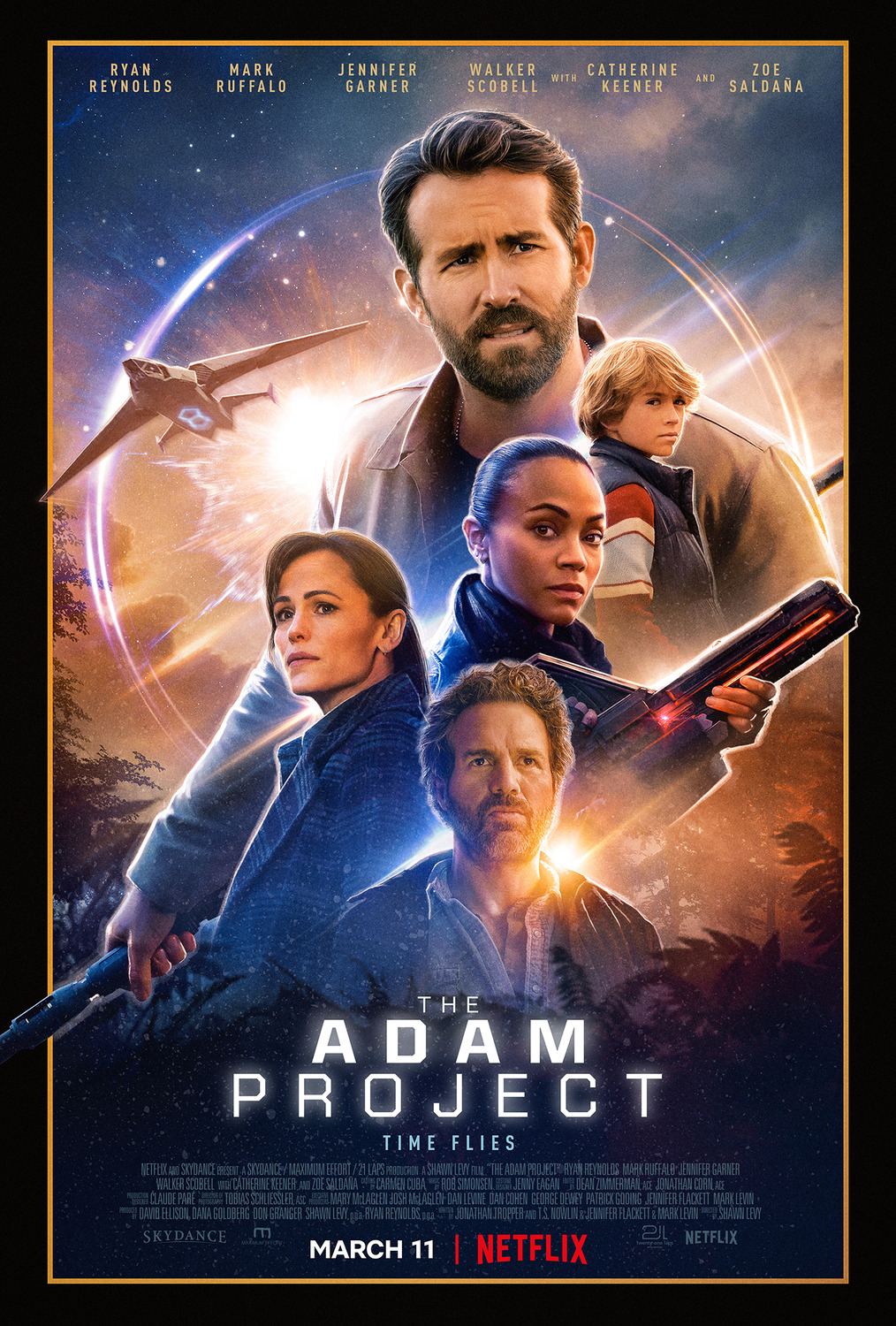
When the new Percy Jackson and the Olympians series made a splash at the start of the year, several older clips of lead actor Walker Scobell resurfaced, from a few years ago when he was promoting his first-ever film, the Netflix movie The Adam Project, starring Ryan Reynolds. Oh yeah, I thought... I remember the half-week-or-so that movie felt like "a thing." And these clips of this kid quoting Deadpool around his cast mates (in full R-rated glory) seem hilarious. Maybe I should give the movie a chance.

The Adam Project is the story of pilot Adam Reed, who time travels back from a dystopian 2050 to try to find his girlfriend and stop the dark future from ever coming to pass. He crash-lands in 2022, where he meets up with his own 12-year-old self. Together, both must flee from future hunters as they pursue the older Adam's goal.

It seems like a couple times a year, Netflix just backs up the money truck and produces a giant $50 to $100 million movie that ought to be one of the tent poles of the summer blockbuster season... and then they just drop it exclusively on their service like everything else, where it quickly vanishes in an algorithmic swamp. The Adam Project easily could have been a widely-seen theater movie of 2022; instead, here I am reminding you it was actually a thing two years later. That's just how Netflix rolls.

Now, to be clear, I'm not here to tell you that The Adam Project was one of the best movies of 2022. It's pretty rote pulp sci-fi, and it doesn't think of anything especially clever with the "meeting your younger self" time travel premise that you wouldn't have thought of yourself. Yet at the same time, the movie certainly feels like a thing that more people should have seen, and would have talked about for a bit if they had. In my mind, that's because the cast is surprisingly excellent.

For one thing, there's a weirdly deep bench here in the supporting cast. Jennifer Garner and Mark Ruffalo stage a mini "13 Going on 30" reunion here as Adam's parents, and the movie leverages their chemistry in making you want to see them together on screen more than you do. Plus, both bring a lovely bit of sentiment to an otherwise jokey, actiony movie. Catherine Keener makes for a fun villain, chewing up the scenery in a fun dual role (just don't look too closely at the "de-aging" effects used on her younger version). Zoe Saldaña, underheralded queen of multiple science fiction franchises, brings her high-wattage action star power to bear as well.

But, of course, the premise is the entire movie here: kid meets his future adult self. So the movie can only ever be as good as that pairing. And that part, at least, is excellent. Walker Scobell feels like he was grown in a lab to impersonate Ryan Reynolds (which, "retroactively" makes me appreciate his very different performance in Percy Jackson even more). The two have a fantastic rapport, deliver plenty of laugh out loud funny exchanges, and will generally make you glad you watched the movie... even if you decide the rest of it doesn't make a lick of sense and isn't all that great. (Seriously, just watch this and then tell me you're not open two more hours of it.)

I'll try to temper overall expectations, though, and say that I'd give The Adam Project a B-. It may well be that even if it had had a big summer theatrical release, we still wouldn't remember it much now. But I think it's a pretty fun diversion.

Tuesday, March 19, 2024

Voyager Flashback: Critical Care

Star Trek is well known for taking modern issues and filtering them through a science fiction lens to offer social commentary. Rarely has the franchise been so "on the nose" in doing this as it was with Voyager's "Critical Care."

The Doctor has been stolen from Voyager, and finds himself put to work in an alien hospital where the quality of patient care is proportional to an assessment of the patient's value to society. The Doctor takes it upon himself to care for the "have nots," as Voyager works to track down where he's been taken.

As modern Star Trek has continued in its storied tradition of espousing humanist values, and has expanded its storytelling to include a wider variety of people than ever before, a small cadre of the online clueless has risen to demand "when did Star Trek become so woke?" I wonder what they'd make of an episode like this, so proudly waving an "eat the rich" flag? (Perhaps they'd say the parable here is about allowing "death panels" to decide a person's worth, not denying basic healthcare to the poor.) It just feels impossible to miss the point on this one. And yeah, part of me thinks that a truly top-notch episode would be a bit more subtle than this.

But then, it's not like this episode has its heart in the wrong place. The Doctor really is the perfect character to put at the center of a story about the "haves" and "have nots"; the fact that it's an explicitly medical story just cements it. Yet it's also effectively a fish-out-of-water tale, as the Doctor isn't trying to cure some rare disease. His attempts to circumvent this system range from trying to hack it to actual theft. He shows particular ingenuity in convincing another doctor (played by Star Trek and 24 veteran Gregory Itzin) to help him out before the system start cracking down on his own resources. It's a great story overall for the Doctor.

The one part of it that doesn't land quite as well for me is the end, where he asks Seven to check if his ethical subroutines are still intact. I suppose it's a beat that makes sense for the character, given some of his past ethical lapses. But I feel like we've seen it before. Moreover, it feels like one moment where this transparent allegory could have been slightly more opaque. The question of undertaking "unethical" actions to thwart an unjust system feels deserving of its own full episode exploration, and not just as a footnote here.

The subplot of Voyager's search for the Doctor serves as comic relief to the rest. Neelix puts his famously toxic cooking to use as a form of socially acceptable torture. (He isn't doing anything to a captive that he hasn't done to his own friends.) An almost montage-like quest through a procession of side characters (including Parks and Recreation's Jim O'Heir!) leads Janeway and Tuvok to pose amusingly as a couple. At another point, Janeway has to deal with, essentially, an automated call menu. Fun.

Other observations:

  • CG is just fully part of Star Trek: Voyager at this point. The episode opens with an elaborate vista of an alien cityscape.
  • Paris and Kim get their comedic moment walking down the hallway wearing full hockey gear. My question: is it possible to get injured playing hockey on the holodeck? Did they turn the safeties off?

I wish that this medically-themed episode could have wielded a scalpel rather than a mallet. Still, it's not bad. I give "Critical Care" a B.

Monday, March 18, 2024

Vacation at the Lake

There's more "prestige television" available now than any person could ever keep up with. Yet I would posit that even if you tried to do so, watching nothing but "serious, award-worthy television," you'd burn yourself out with the weightiness of it all. I say you need some fluffier, low-stakes diversions in your TV diet. And for me, lately, that's been The Lake.

The Lake is a Canadian series streaming on Amazon Prime. It centers on Justin, a gay man who has returned from overseas to spend a summer bonding with a now-teenage daughter, Billie, that he gave up for adoption. But there are plenty of hijinks with the "heartfelt," as Justin is also trying wrest control of a lakeside family cottage from his hyper-competitive step-sister, Maisy-May.

Over the course of (so far) two 8-episode seasons, The Lake has been a light and breezy half-hour show that has the spirit of a sitcom without (usually) trading in the rote "setup / punchline" construction of that format. Actually, for most people, the acting might be the main avenue into interest in the show. Orphan Black fans may recall Sarah's wild brother Felix from that show; here actor Jordan Gavaris gets center stage (and a more comedic canvas to play broadly on) as Justin. His foil is a performer I think everyone has seen in at least one movie at some point, Julia Stiles. She's perfectly vindictive and "wound too tightly" as Maisy-May.

Try a few episodes, and soon you'll find you're as interested in other performers rounding out the odd ensemble cast. Madison Shamoun plays Billie, who grounds the wilder elements with a beyond-her-years poise. Terry Chen is fun as Maisy-May's retired pro-hockey-playing bro of a husband, Victor. And young Declan Whaley is an absolute scene-stealer as Opal, Maisy and Victory's gender-queer son.

The first season is the better of the two; it's centered on the bitter rivalry between Justin and Maisy. Season two wisely recognizes that that story can't be stretched to fill another season, and so introduces a mystery instead... but that never quite reaches the comedic potential inherent in the "step-siblings at odds" premise of the original. Regardless, both seasons are simply fun, a welcome de-escalation from the sort of "life and death" stakes likely at play in other television shows you're probably watching.

I give The Lake a B. No decision has been announced yet on a season three; I only want them to do it if they really feel like they can find another entertaining story to tell. Either way, I'm glad for the lightness that it's brought so far.

Thursday, March 14, 2024

Meet a Stranger

The Academy Awards may now be in the books, but I'm ready to talk about a "snub" in the nominations. That's because I've only recently watched the movie All of Us Strangers.

From writer-director Andrew Haigh (and nominally adapted from the book Strangers by Taichi Yamada), All of Us Strangers centers on a secluded writer named Adam. As the film opens, he meets a drunken neighbor, Harry, whose amorous advances he declines. But he can't get Harry out of his head, nor can he thoughts of his parents -- who died decades earlier, before he came out as gay. When Adam decides to visit his childhood home, he discovers the ghosts of his parents still living there, giving him the opportunity to share with his parents the man he truly is.

Let me first say that I'm not certain I would have put All of Us Strangers in contention for Best Picture. (Not, at least, if you were to just literally list my personal 10 favorite movies as the nominees.) I'll get into why in a moment. But this is certainly the kind of movie that usually catches Oscar's eye, and there are certainly a few categories in which it should have contended.

Most notably, Andrew Scott should have been a nominee for Best Actor. His performance as Adam is simply remarkable, handling a raft of huge emotions with a careful subtlety. (Perhaps too subtle to have courted the notice of Oscar voters?) The character says he's out and proud, but his actions sometimes give the lie to that. He tells his parents he is happy, but his solitary demeanor isn't readily recognizable as such. In scenes with Adam's parents, Andrew Scott adopts a childlike deference that's wholly absent in scenes with Henry. Every moment of the performance has a potent context that shapes the behavior.

At least two supporting performances might well have been nominated too. Paul Mescal plays Henry, exuding a perfectly uneasy charisma with Andrew Scott that makes their relationship believable while simultaneously making you sense that something isn't quite right. Claire Foy plays Adam's Mom. Because her ghostly character appears at the age she died, she's actually younger on screen than her son Adam, but Foy's performance wields every bit of the parental authority that the story needs.

While I loved a lot about All of Us Strangers, I have reservations about the movie as a whole. It's hard to get into exactly why without spoiling key moments in the story, but suffice it to say that I found the script strange. Almost cruel, even. What sets out like an uplifting tale about going back to actually take the "road not taken" winds up heaping sadness on top of sadness by the final act. I felt somewhat similarly about it as I did to last year's critical/award contender Tár.

To save you the click, it boils down to this: I absolutely want stories about LGBT+ characters in entertainment to represent humanity in all its good and bad facets. But right now, I worry that negative portrayals simply feed the persistent toxic views that still get the oxygen they need to be starved of. All of Us Strangers does not depict any predatory monster, so in that sense it's nothing like the destructive character at the center of Tár. (And importantly, where Tár came from a straight writer-director, Andrew Haigh is himself LGBT+.) Still, it would be easy to watch All of Us Strangers and say, "well... if you choose to be gay, of course your life is going to be full of sadness and regret."

Still, if you're reading this blog, that's quite unlikely to be your read of the film. And so I think I can recommend All of Us Strangers to you -- certainly for the performances, if nothing else. Overall, though, I think I'll give the movie a B-. I don't think its shut-out from even any Oscar nominations was necessarily sinister; there were LGBT+ artists nominated for their work. Still, it does seem like a bit of a head-scratcher to me in the case of Andrew Scott, who did probably his career-best work in this movie.

Wednesday, March 13, 2024

Voyager Flashback: Repression

Star Trek: Voyager featured three two-part episodes in its final season (including its finale). And yet one story that to me really cried out for two episodes, yet didn't get it, was "Repression."

Maquis crewmembers aboard Voyager are falling into comas, and soon it becomes clear that some assailant aboard the ship is responsible. No sooner than Tuvok reaches the inescapable conclusion of the culprit's identity is the true purpose of these attacks revealed: a Maquis agent from the Alpha Quadrant has used his mind control techniques, and the monthly data streams to Voyager, to reactivate his "compatriots" in the Delta Quadrant.

While this episode doesn't have two different story lines exactly, it does take a sharp turn partway through... and I feel like both parts are intriguing without either getting full space to breathe. Initially, the episode is a mystery, following Tuvok as he investigates a series of attacks. This aspect of the story admittedly couldn't be stretched too much further for a few reasons. For one, the timing is wrong -- this story would have played much better earlier in the series, when there was more mistrust of the Maquis aboard Voyager. (It would have also helped to show Tuvok doing his security job early on, more than just standing at the tactical station.) For another, the episode's twist is totally spoiled during the scene in which the holodeck extracts a shadowy image of the attacker; the figure isn't shadowy enough, and you can totally make out Tuvok's Vulcan ears and the gold of his uniform.

Still, a bit more more could have been made out of Tuvok uncharacteristically following a "hunch," and of digging deeper into the histories of the Maquis victims. (After all, the episode actually goes to the trouble of bringing back multiple characters introduced in previous episodes.) It could have gotten a bit more mileage out of the paranoia among Maquis about who might be attacked next, and could also could have extracted a few more minutes in the Doctor seeking a medical solution for Tuvok's condition once it's fully exposed.

None of that is strictly necessary, of course. But I'm looking to flesh things out to roughly a full episode's length, so we can end on a cliffhanger of "sleeper cell Maquis" taking over Voyager. Because the rest of the story after that feels like an interesting premise of its own that gets far too little time in the episode as aired. Voyager crewmembers working against each other is a great thing to dramatize. So is trying to stage a retaking of the ship when you can't use lethal force to do so. Taking the ship back should be really difficult, but we really don't see any of that.

It might also have been good to understand more of what Teero Anaydis, this distant Alpha Quadrant puppeteer, was really planning here. Janeway is right to ask at one point: what good does it do to have just one Maquis ship, thousands of light years from home? What was he trying to do? Why mind control only Maquis crew members, when it seems like mindmeld-fueled brainwashing would have worked on the Starfleet crew equally well? (It can't be that you already have to be sympathetic to the Maquis; Tuvok himself never was.) Maybe I just wanted to see more of guest star Keith Szarabajka, who enjoyably played this sort of righteous zealot on other genre shows I've seen over the tears.

So yeah, my issue is that this episode is overstuffed. Yet it does still make time for a few nice moments. The movie theater is a fun new holodeck setting (especially B'Elanna's snark about using a 3D environment to project a 2D image, then wearing glasses to make it appear 3D again). Harry's reaction to having his mail read and then being accused of a crime by Tuvok feels like a rare bit of earned conflict between main characters. It's also nice to more heavily feature the relationship between Janeway and Tuvok (even if I think it's a stretch that a simple talk from her can overcome mind control; that's something that also could have been given more time in a two-part episode).

Other observations:

  • Whenever people in TV and movies decide to break off into pairs, someone in a pair always finds a reason to head off alone so they can become a victim. Like, why do the writers even have the characters suggest the whole "work in pairs" thing only to have to then come up with a weak excuse to undermine that so the plot can progress?
  • And while we're playing the hits, gotta do the "never give someone a working 'gun' and ask them to prove their loyalty" trope.
  • Brainwashed B'Elanna is enthusiastic about marooning all the Starfleet people on some planet. It would be nice if the episode could acknowledge that she's now married to one of those Starfleet people.

I love the potential of this story, but I think the execution has problems. The mystery is exposed too early, and the far more interesting "friends against friends" part of the story gets short shrift indeed. I give "Repression" a B-.

Monday, March 11, 2024

Less Snarky Oscars Thoughts

Sorry, readers -- no Oscars snark this year. Half of the group I usually gather with to watch the Oscars was out of the country on vacation this year, and for those of us who were left, it seemed like we weren't feeling the need to convene for what was likely to be one of the more "foregone conclusions" Oscars in recent years. But if you care for a few less snarky scattered thoughts on this year's awards, here you go:

I did not see all the Best Picture contenders this year. I made it to 8 of the 10 as of this just-past Friday, when I watched (and loathed) Poor Things. Yet that still doesn't make it the Best Picture nominee I liked least: I actually tried sitting down to watch Maestro a few weeks back, got perhaps 20 minutes in, and decided to "nope" out. (That leaves The Zone of Interest as the only nominee I've not attempted at all. I'm open to it, but very much need to be in the right frame of mind.)

Usually, there's a "clear winner" in my mind, one movie that stands out above the rest and usually has no actual chance of winning. (And usually, my personal favorite movie of the year isn't in contention at all.) This year, the Anatomy of a Fall would have been my personal pick from the available options -- though I would have been equally appreciative of Barbie or American Fiction taking top honors. (But none of the three had any actual chance of winning this year.)

As for the ultimate winner, Oppenheimer... it's a classic example of Oscar doing Oscar does: awarding a person who has not done career-best work, because they missed the boat years earlier on awarding someone's best work (when they were busy giving some other person an overdue award). I maintain that one-third of Oppenheimer's runtime is devoted to a subplot that undermines the core thematic conceit of the movie (but hey, Robert Downey Jr. must be happy Nolan saw fit to put it there, as he won his own "time delayed" Oscar as a result).

The broadcast itself had some nice highlights. The best were comedic: the over-the-top live performance of "I'm Just Ken," John Cena's memorable "Best Costuming" intro, Emily Blunt and Ryan Gosling's banter (that convinces me that the upcoming The Fall Guy will probably be better than I expect), and John Mulaney effectively auditioning to be a future Oscars host. More earnest moments played well too, like Da’Vine Joy Randolph's acceptance speech moving half the audience to tears, the filmmaker of 20 Days in Mariupol wishing he'd never made the movie, and some of the past acting winners paying tribute to this year's nominees. (You could easily tell who meant what they said and who, let's say, would not be up for an Oscar for presenting an Oscar.)

There are still more 2023 movies than 2024 movies in my personal viewing mix right now. But "officially," the movie year of "Barbenheimer" is now in the history books.

Friday, March 08, 2024

Two Good

Just when everyone was at last able to see Dune: Part Two... I headed out to Louisville for GAMA Expo 2024, and had no time for blogging. But now, as the sequel heads into its second weekend, I have a moment to put down my thoughts on the film.

I should perhaps start by locating my "Dune fandom" on the map: I've read the original book a couple of times and have enjoyed it well enough -- but I'd say that anyone who would call themselves a "Dune fan" surely feels more passionate about it than I do. It's not really fair to come too hard at a book written in 1965 for feeling "dated," and I would say that Dune has held up better than most classic science fiction from the most heralded authors of the genre.

Still... I think Dune really shows its age. Herbert had themes in mind that the world wasn't quite ready for in 1965, taking a dim view of religious zealotry and highlighting the dark sides of colonialism. But at the same time, he could only "reach toward" some of his own themes more than he could fully "grapple with" them. Most keenly, he was ahead of the curve enough to question the "white savior" archetype... but hardly gives it a full-throated rejection in his original book.

All that is a perhaps too-long walk leading up to this: given what the underlying themes of Dune really are, I don't think you could tell the story of Dune any better than director Denis Villeneuve and his co-writer Jon Spaihts have done here in Dune: Part Two. This adaptation changes a fair amount -- though I've been pleasantly surprised to hear fewer complaints from "book purists" than I would have imagined. The changes are all in service of sharpening the core of the story.

The central themes of religion and colonialism are heightened in this adaptation, and while the character of Paul (of many names) is still the conventional protagonist, it's really almost more "Chani's movie." The character, rather underdeveloped in the books (if you ask me), is given so much more material in Dune: Part Two (more than making up for her minimal appearance in Part One), and Zendaya really rises to the occasion.

She can't quite steal the movie, thanks to the other great stuff going on. Javier Bardem's version of Stilgar delighted me, a spot-on portrayal of unthinking zealotry that's utterly impervious to reason. Rebecca Ferguson has somewhat less to do here than in Part One, but what she has is excellent: not only does she negotiate this adaptation's take on Alia (very clever) without seeming mad, she leans into the character's dark side most effectively. The Jessica of Dune: Part Two strikes me as almost being a villain in how manipulative she is -- and her aspirations for her son come off as equally self-serving.

The production design remains incredible, which could almost go overlooked because so much of the look and feel of this was established in the prior Dune movie. Still: Paul's worm-riding sequence could have looked so dopey (it's such a far out concept), yet it felt visceral and dangerous and powerful. Much has been said about the infrared photography used for the outdoor scenes on Giedi Prime... but much should be said, because the look was striking. New costumes for new characters, new sets -- all top notch work. (It always annoys me when movies like this lose production design Oscars to period pieces where the design team was able to simply do historical research to create their looks. Everything here is invented, and it's cohesive and perfect.)

I will say that even at two hours and 45 minutes (which don't feel overly long), the movie still doesn't have enough space for all its characters. This is another "unadaptable" part of Herbert's book, and while this adaptation does remove both Hasimir Fenring and Thufir Hawat, and reworks Alia into something that will play on-screen better than a murderous "toddler adult," it still has more characters than can be serviced well. You don't really need a name as big as Christopher Walken to play an Emperor with this little presence in the story. And while Margot Fenring made it into the movie where her husband did not, it hardly felt like her brief story arc contributed much to this story (as opposed to laying track for later ones). Still, Villeneuve and Spaihts strayed farther from the source material than I would have imagined, and I'd rather give them credit for what they did do than quibble with still deeper changes they didn't.

I gave Dune: Part One a B+, and this movie is undeniably better. So I'll call Dune: Part Two an A-. It excited me to see still more of the story in a way that the books themselves never really did. And judging by the box office, it seems like we all will get to.